

8 Real Conversational Marketing Examples That Drove Massive Sales
You’ve done everything right, ads dialed in, landing pages optimized, content performing, but conversions? Still flat.
Discover how conversational marketing can transform your sales with real-time, personalized customer interactions. Learn from eight successful examples across various industries.
On this page7
- What Makes Great Conversational Marketing?
- Conversational Marketing as Lead Reactivation
- 8 Conversational Marketing Examples That Drove Real Sales
- How to Build an Effective Conversational Marketing Strategy
- How MagicBlocks.ai Fits In
- Conclusion: The Conversation Is the Conversion
- Frequently Asked Questions about Conversational Marketing
You’ve done everything right, ads dialed in, landing pages optimized, content performing, but conversions? Still flat.
Here’s the uncomfortable truth: it’s not your traffic. It’s your silence.
Every day, thousands of potential customers visit websites, browse, hesitate… and leave. No follow-up, no engagement, no sale. Traditional marketing or inbound marketing funnels weren’t designed for dialogue. They were designed to broadcast, not listen.
Conversational marketing flips that on its head. It uses real-time, two-way conversations, powered by chatbots, live chat, and conversational AI to turn curiosity into commitment.
When done right, it feels less like marketing and more like a helpful conversation that solves pain points, addresses customer issues, and builds genuine customer loyalty.
This isn’t a trend. It’s the next phase of how smart brands connect with their target audience, deliver better customer experiences, and drive predictable growth.
So let’s dig in. Here’s what great conversational marketing looks like, backed by data, proven best practices, and eight real conversational marketing examples that delivered massive sales across mortgage, tourism, fitness, fertility, SaaS, and more.
What we’ll cover:
- What Makes Great Conversational Marketing?
- Conversational Marketing as Lead Reactivation
- 8 Conversational Marketing Examples That Drove Real Sales
- How to Build an Effective Conversational Marketing Strategy
- How MagicBlocks.ai Fits In
- Conclusion: The Conversation Is the Conversion
- Frequently Asked Questions about Conversational Marketing
What Makes Great Conversational Marketing?
At its core, conversational marketing is about connection — a strategy that makes every visitor feel like a personalized customer, not a data point.
It’s not about replacing people with bots. It’s about combining human empathy with AI precision to create a better, faster, more relevant customer interaction — at scale.
The Struggle Is Real — And It’s Not Just You
If you’ve tried to use chatbots before and they felt clunky, robotic, or useless — that’s normal. Most “chat widgets” are built to react, not sell. They’re built for customer support, not sales.
But the next generation of conversational marketing tools changes that. With generative AI and real-time personalization, these systems don’t just answer — they understand. They tailor every interaction to the person on the other end.
And the data backs it up.
The Research That Proves the Shift
- 71% of consumers expect personalized experiences, and 76% get frustrated when they don’t get them. (McKinsey & Company)
- Companies leading in personalization see 40% more revenue from those efforts (McKinsey Research)
- 70% of customers expect real-time engagement when interacting with brands.
(Qualified.com) - AI-assisted chatbots help humans respond 20% faster and with more empathy.(Harvard Business Review)
That last stat matters: the future isn’t AI versus humans — it’s AI with humans. Conversational AI empowers your sales team and support reps to deliver faster, smarter, more personalized help.
When you blend empathy, data, and timing, the result is more customer engagement, higher conversion rates, and longer customer loyalty.
Conversational Marketing as Lead Reactivation
Let’s talk about one of the most profitable but overlooked use cases — lead reactivation.
Marketers spend heavily to get leads in the door, but most go cold after the first touch. They stop replying to emails, forget about your offer, or ghost after filling a form.
Conversational marketing gives you a second chance — and this time, it’s personal.
Imagine this:
A prospect checked your pricing page but never scheduled a demo. Two weeks later, your AI agent sends a message through live chat or SMS:
“Hey Alex — saw you looked at our Enterprise plan last week. Want me to show you what companies your size usually save in the first quarter?”
That’s contextual. Helpful. Real-time.
And the best part? You don’t need a human to remember or send it. Your conversational AI system (like MagicBlocks.ai) can track behavior, recall context, and re-engage that same lead automatically — turning cold prospects into warm conversations.
We’ve seen clients achieve up to 5x ROI from this approach alone — simply by using intelligent dialogue instead of automated drips.
8 Conversational Marketing Examples That Drove Real Sales
Now, let’s get into the good stuff — the real conversational marketing examples that prove this strategy works across industries.
Each example highlights how conversational tools — like chatbots, SMS agents, or live chat flows — can be tailored to your specific target audience and business goals.
1. Mortgage Industry: Turning Rate Shoppers into Real Applicants
Scenario:
A visitor’s comparing mortgage rates, unsure what fits their budget.
Conversation Example:
“Hi! I can show you how much you’d save with a 15-year vs 30-year plan — want me to run the numbers?”
Why It Works:
It answers a complex financial question in real time, eliminates friction, and qualifies leads immediately.
2. Tourism: Saving Abandoned Bookings
Scenario:
A user’s browsing a Bali tour but leaves before booking.
Conversation Example:
“Still thinking about your Bali getaway? I can check which dates still have sunset spots left. Want me to look?”
Why It Works:
The chat feels personal and time-sensitive, triggering an instant customer interaction that converts hesitation into booking.
3. Fitness & Gyms: Selling Memberships Through Personalization
Scenario:
Visitor’s on the “Membership Pricing” page, comparing options.
Conversation Example:
“Want me to show which plan fits best if you train three times a week?”
Why It Works:
It’s personalized, immediate, and helpful — the trifecta of great conversational marketing tools.
4. Fertility Clinics: Building Trust with Empathy
Scenario:
Someone downloads a fertility guide but doesn’t book a consultation.
Conversation Example:
“Hi, I saw you downloaded our fertility e-guide. Would you like a free 10-min consult with a specialist to discuss your next steps?”
Why It Works:
This example combines emotional intelligence with clear next steps — humanizing a sensitive topic.
5. SaaS: Matching Plans to Problems
Scenario:
A visitor’s stuck on your pricing page.
Conversation Example:
“Choosing a plan can be tricky. Want me to recommend one based on your team size?”
Why It Works:
It replaces cognitive load with instant clarity — and it uses generative AI to suggest plans dynamically.
6. E-Commerce: Guiding Product Decisions
Scenario:
A shopper’s hesitating between two products.
Conversation Example:
“Can I help you compare these two models? I can tell you which one fits better for your use case.”
Why It Works:
It acts like chatbots that think — blending real-time personalization with authentic assistance.
7. Insurance: Simplifying Complex Choices
Scenario:
Prospect overwhelmed by too many coverage options.
Conversation Example:
“I can help you find the right plan for your age and income — just two quick questions?”
Why It Works:
It’s simple, conversational, and builds trust. The AI acts like a friendly sales rep guiding users through decisions.
8. Education & Coaching: Matching Goals to Courses
Scenario:
A student’s browsing courses but unsure where to start.
Conversation Example:
“Hey, what’s your goal — career change, upskilling, or certification?”
Based on the answer, the AI tailors the suggestion and even checks scholarship eligibility.
How to Build an Effective Conversational Marketing Strategy
Now that you’ve seen how it works, let’s get practical. Here’s how to implement conversational marketing in your own business.
1. Map the Customer Journey
Start by identifying conversation-worthy moments — points where users hesitate, have questions, or show intent. Think pricing pages, checkout, or demo signups.
Each of those is a chance to replace a customer issue with an intelligent interaction.
2. Set Clear Objectives
Every conversational flow should have a purpose:
- Qualify leads
- Handle objections
- Improve customer engagement
- Route to a human when needed
- If your chat doesn’t drive clarity or value, refine it.
3. Personalize the Experience
Use context: browsing history, referral source, or CRM data. Then use generative AI to dynamically tailor tone, message, or offer in real time.
It’s personalization — without creepiness.
4. Blend AI and Human Touch
AI can handle 80% of repetitive interactions. But when stakes rise — big purchase, emotional decision, complex issue — hand off to a live agent.
That’s hybrid customer support done right.
5. Measure What Matters
Track conversation rates, qualification rates, response times, and conversion impact.
Tools like MagicBlocks.ai give you full analytics visibility — you’ll know which conversations drive real revenue.
6. Follow Conversational Marketing Best Practices
Here’s what works consistently:
- Keep tone friendly, not formal.
- Use short sentences and natural phrasing.
- Address pain points quickly — don’t bury the answer.
- Ask open questions (“What’s your goal?” vs. “Need help?”).
- Provide clear next steps (link, form, booking).
- Always offer an exit to talk to a human.
Follow those best practices and your AI agent becomes your highest-performing digital salesperson.
How MagicBlocks.ai Fits In
This is where MagicBlocks.ai shines — it’s a revenue capture engine, not a gimmick.
With MagicBlocks, you can:
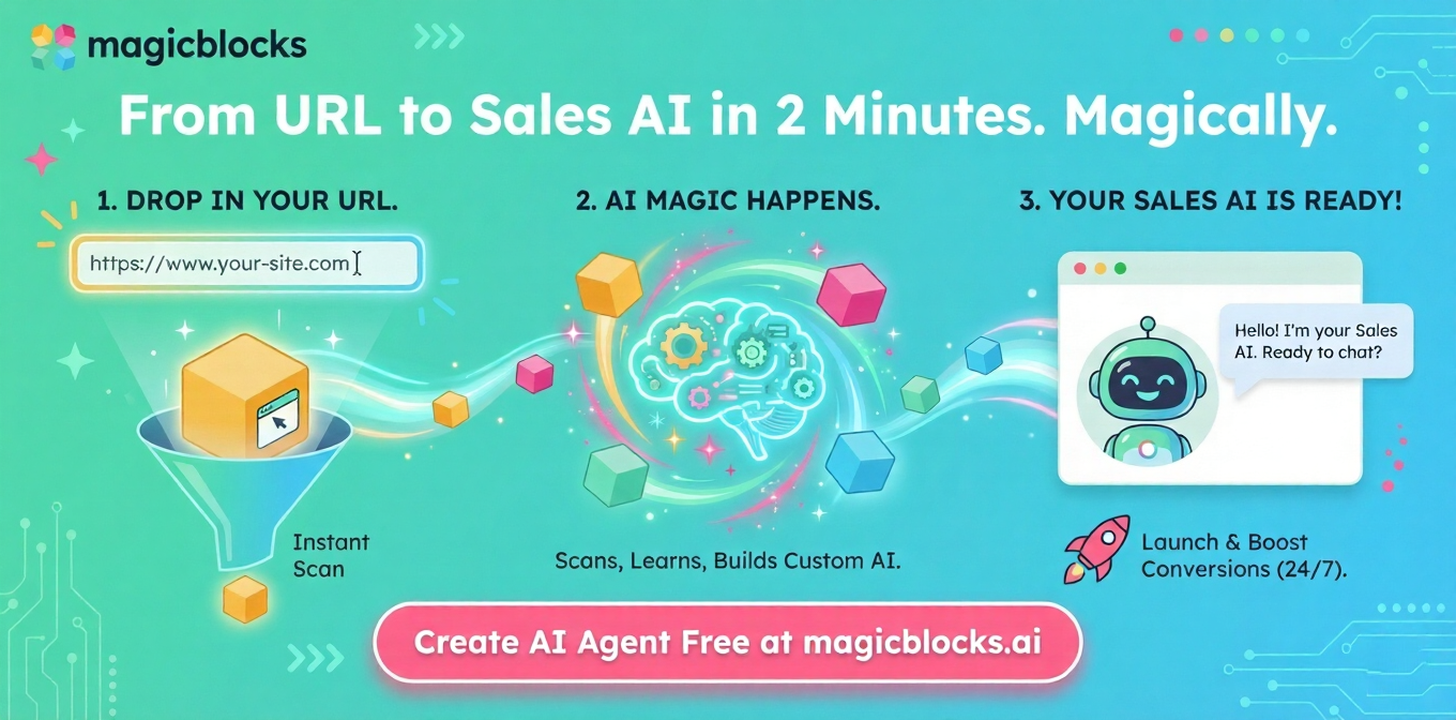
- Build AI agents in 2 minutes (just drop in your URL, it learns your offer).
- Run real-time conversations via web, SMS, or messaging apps.
- Use conversational marketing tools that understand context, not just keywords.
- Turn cold leads into live conversations with lead reactivation flows.
- Improve customer engagement and reduce customer issues automatically.
- Deliver a personalized customer experience that converts traffic into trust.
It’s like having a team of smart, always-on chatbots trained to sell the way your best rep would — 24/7.
Conclusion: The Conversation Is the Conversion
The future of digital marketing isn’t more ads. It’s better conversations.
Every visitor you don’t talk to is a lost opportunity. Conversational marketing gives you the ability to engage, assist, and convert — in real time, with empathy and intelligence.
You now know:
- Why conversational marketing works (and the research behind it)
- How to design customer interactions that sell
- Real conversational marketing examples to model
- How to implement the strategy and track results
Start small. Pick one point in your funnel — a pricing page, a follow-up email, a form that underperforms. Turn it into a conversation.
And if you’re ready to do it at scale — with personalization, analytics, and AI that actually sells — MagicBlocks.ai can make that happen.
Because the most powerful marketing isn’t broadcast.
It’s a dialogue — and it starts the moment you say hello.
Conversational marketing isn’t about automating your brand. It’s about scaling your humanity.
And with MagicBlocks.ai, you can do it — at scale, with intelligence, empathy, and measurable ROI.
Because in the end, the conversation is the conversion.
Frequently Asked Questions about Conversational Marketing
What is conversational marketing?
Conversational marketing is a strategy that focuses on engaging customers through real-time conversations, often utilizing tools like chatbots and live chat.
How does conversational marketing help with lead generation?
Conversational marketing helps by engaging visitors instantly, allowing businesses to qualify leads and gather inquiry information effectively.
What are the benefits of using conversational marketing?
The benefits of conversational marketing include enhanced customer engagement, improved customer-centric interactions, and a streamlined sales cycle.
How does conversational marketing differ from traditional marketing methods?
Unlike traditional marketing, which often relies on one-way communication, conversational marketing fosters two-way dialogue, allowing businesses to better understand customer needs.
Can conversational marketing be implemented on social media platforms?
Yes, implementing conversational marketing strategies on social media platforms like Facebook Messenger can greatly enhance marketing efforts.
What types of conversational marketing tools are available?
Popular conversational marketing tools include chatbots, live chat, SMS marketing, and conversational bots that can facilitate real-time customer interactions.
How effective is conversational marketing compared to email marketing?
The effectiveness of conversational marketing often surpasses email marketing as it allows for immediate responses to customer inquiries, leading to higher engagement rates.
What are the advantages of using chatbots in conversational marketing?
Chatbots can handle multiple inquiries simultaneously, providing instant responses and freeing up customer service resources for more complex issues.
What marketing channels benefit from conversational marketing?
Conversational marketing can benefit various marketing channels, including social media marketing, email marketing, and SMS marketing.
How can businesses leverage conversational marketing?
Businesses can leverage conversational marketing by creating strong conversational marketing campaigns that focus on customer engagement and real-time communication.
Want to see this in action?
See a demoRead the playbook. Now see it run.
Watch a 4-minute demo. No sales pitch. Then decide if you want to talk.