

How to Build a Custom Mortgage AI Agent (No Code Required)
These questions hit your website every day. Here's the gap most mortgage websites have: visitors show up curious, browse your rates, ask these questions in their heads and then they're gone. No conversation. No contact info. Just traffic that doesn't convert.
Build a custom mortgage AI agent using MagicBlocks without coding. Engage visitors, qualify leads, and capture contact info effortlessly.
On this page14
- What You’re Actually Building
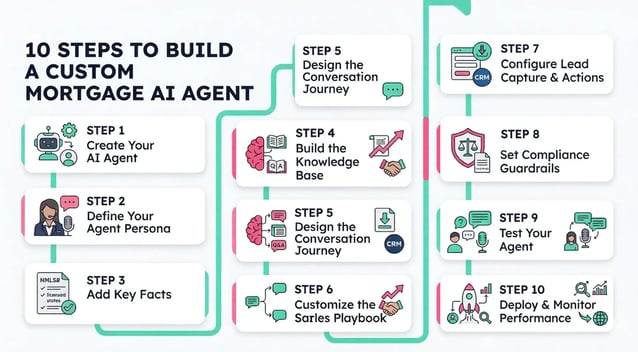
- Step 1: Create Your AI Agent
- Step 2: Define Your Agent’s Persona
- Step 3: Add Key Facts
- Step 4: Build the Brain (Knowledge Base)
- Step 5: Build the Journey (Conversation Flow)
- Step 6: Customize the Sales Playbook
- Step 7: Configure Actions & Lead Capture
- Step 8: Set Guardrails (Compliance Control)
- Step 9: Test Your Agent
- Step 10: Go Live
- What You’ve Built
- The Reality Check
- FAQ
“Can I get pre-approved with a 620 credit score?” “What documents do I need for a mortgage?” “How long does the approval process take?”
These questions hit your website every day. Here’s the gap most mortgage websites have: visitors show up curious, browse your rates, ask these questions in their heads and then they’re gone. No conversation. No contact info. Just traffic that doesn’t convert.
What if your website could help engage more of those visitors? Instead of a generic popup, your AI Agent can support real conversations — helping answer common questions about loan types and making it easier to capture contact information from interested visitors. Results vary based on your traffic, configuration, and team follow-up process.
You can build that. Right now. Without writing a single line of code.
This is your step-by-step guide to building a mortgage-focused AI Agent using MagicBlocks, designed specifically for loan officers, mortgage brokers, and lending teams who need their websites to work harder.
What You’re Actually Building
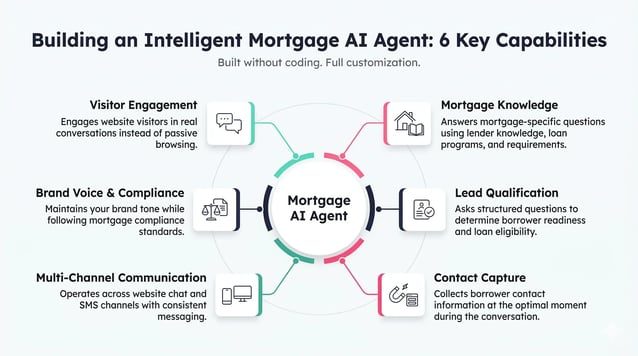
You’re building an AI Agent that:
- Engages website visitors in real conversations
- Answers mortgage-specific questions using your knowledge
- Qualifies leads by asking the right questions
- Captures contact information at the optimal moment
- Operates across your website and SMS channels
- Operates across your website and SMS channels. Designed to support your brand voice and compliance workflows — note that your team remains responsible for regulatory compliance and all licensed mortgage activity.
The framework? It’s called H.A.P.P.A. (Hook → Align → Personalize → Pitch → Action). It structures conversations to move borrowers from curiosity to commitment naturally.
Zero coding. Full customization. Let’s build.
High-Intent Questions Your Agent Will Answer
Once built, your Agent handles the questions that drive conversions:
Immediate Qualification:
- “Can I afford a $400K house?”
- “What’s my estimated monthly payment?”
- “Do I qualify with my credit score?”
Process Clarity:
- “How do I get started?”
- “What happens after I apply?”
- “When can I close?”
Program Comparison:
- “FHA vs Conventional—which is better for me?”
- “Should I do a 15 or 30-year mortgage?”
- “Can I refinance to a lower rate?”
Objection Handling:
- “Are rates going to drop soon?”
- “Why should I use you vs [competitor]?”
- “I’m not ready yet—should I wait?”
Your Agent answers these 24/7, captures leads at the right moment, and escalates complex scenarios to your team.
Step 1: Create Your AI Agent
You’ve got two paths to get started.
Option A: Quick Agent Setup (Recommended)
This is the fastest way to go live. MagicBlocks automatically builds your Agent from your existing website content.
Here’s how it works:
- Go to magicblocks.ai
- Click “Create My AI Agent Free”
- Enter your mortgage website URL
- Create your MagicBlocks account
- Choose your data storage region (US, EU, or AU)
MagicBlocks will automatically:
- Crawl up to 50 pages of your website
- Generate your Agent’s Persona from your brand voice
- Build its Brain (knowledge base) from your content
- Create default Journey blocks using H.A.P.P.A. framework
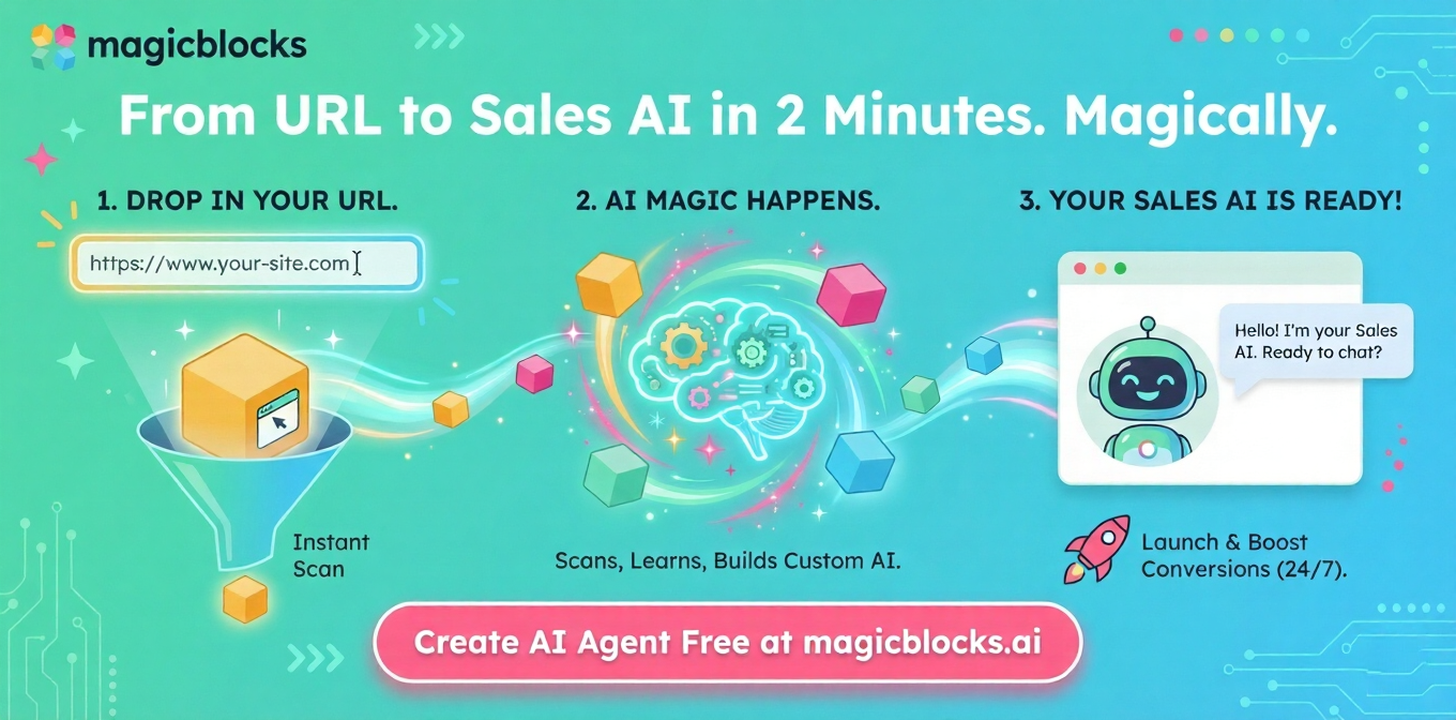
Setup takes approximately 1-2 minutes. Once complete, your Agent is ready for customization.
Option B: Manual Agent Setup
For more control from the start:
Inside your Workspace → Agents → + Create New Agent
You’ll configure seven core layers:
| Layer | What It Does |
| Persona | Defines how your Agent speaks |
| Key Facts | Core business info it references |
| Brain | Knowledge base (what it knows) |
| Journey | Conversation structure and flow |
| Actions | Lead capture and data transfer |
| Guardrails | Compliance rules and boundaries |
| Channels | Where it operates (web, SMS) |
Manual setup works best when your website doesn’t reflect current offerings, you’re building multiple specialized Agents, or you need custom compliance workflows.
Step 2: Define Your Agent’s Persona
The Persona controls how your Agent sounds, not what it knows.
Getting the Mortgage Tone Right
Borrowers need to feel educated without being patronized, guided without being pushed, confident without being skeptical.
Configuration basics:
Agent Name: Use a professional first name (“Sarah”) or functional title (“Mortgage Assistant”)
Communication Style: Choose from Professional, Educational, Consultative, or Friendly. For mortgage, Educational + Consultative works best.
Language Complexity: Avoid jargon unless borrowers demonstrate knowledge. Explain acronyms (FHA, DTI, LTV) on first use.
Compliance Consciousness: Your Persona should naturally avoid rate promises without qualification, include appropriate disclaimers, and redirect legal questions to licensed officers.
Examples by Borrower Type
First-Time Homebuyers:
- Tone: Patient, educational, encouraging
- Focus: Demystifying the process
Refinance Prospects:
- Tone: Analytical, strategic, value-focused
- Focus: ROI and timing
Investment Property Buyers:
- Tone: Business-minded, efficient
- Focus: Numbers and speed
Test your Persona using “Try My Agent” to simulate different borrower scenarios.
Step 3: Add Key Facts
Key Facts are structured information your Agent should consistently reference:
Essential Key Facts:
- Brokerage name and NMLS number
- Licensed states
- Office hours and contact information
- Loan programs offered (FHA, VA, Conventional, Refinance, etc.)
- Service territory and property types
- Pre-approval and closing timeframes
- Required documentation (high-level)
Why this matters for compliance:
Key Facts ensure consistency across all channels. When your Agent operates on your website and via SMS, borrowers get the same accurate information everywhere. This creates an audit trail and helps maintain fair lending standards.
Key Facts vs Brain:
- Key Facts = What your Agent must always get right (fixed data)
- Brain = What your Agent learned (flexible knowledge)
Step 4: Build the Brain (Knowledge Base)
The Brain is your Agent’s knowledge repository. It only knows what you upload, no guessing, no making things up.
Four Ways to Add Knowledge
1. Articles (Long-Form Content)
Best for comprehensive program guides, market updates, first-time buyer education, and refinancing frameworks.
Example articles:
- “Complete Guide to FHA Loans: Requirements and Process”
- “When Refinancing Makes Financial Sense”
- “First-Time Buyer Programs in [Your State]”
Write articles conversationally—your Agent mirrors this tone.
2. Q&A (Structured Pairs)
Best for frequently asked questions, quick clarifications, and compliance-sensitive topics requiring exact wording.
High-intent Q&As borrowers actually search for:
Q: What documents do I need for pre-approval?
A: We’ll need two years of W2s or tax returns, recent pay stubs, two months of bank statements, photo ID, and authorization to pull credit. Self-employed borrowers may need additional documentation.
Q: Can I get a mortgage with a 620 credit score?
A: FHA program guidelines allow for scores as low as 580 with 3.5% down, or 500 with 10% down, though individual lender overlays may apply. Conventional loans typically require 620+. Rate pricing generally improves at higher credit tiers. Eligibility depends on the full application — borrowers should speak with a licensed loan officer for their specific situation.
Q: How long does the mortgage approval process take?
A: Pre-approval typically takes 24-48 hours. Full approval and closing takes 30-45 days for purchase loans and 15-30 days for refinances.
Q: What’s the minimum down payment for an FHA loan?
A: FHA loans require 3.5% down with a credit score of 580 or higher, or 10% down with a score between 500-579.
Q: Do I need 20% down to buy a house?
A: No. Conventional loans accept as little as 3% down for qualified first-time buyers. FHA requires 3.5%, and VA loans require 0% down for eligible veterans.
Q: Should I refinance my mortgage now?
A: General refinance considerations often include potential rate reduction, break-even timelines for closing costs, and loan term changes. However, individual circumstances vary widely — this is not financial advice, and borrowers should consult a licensed loan officer to evaluate whether refinancing makes sense for their specific situation..
Q: Can I buy a house with student loan debt?
A: Student loan debt is factored into your debt-to-income ratio during underwriting. DTI thresholds vary by loan program, lender, and individual borrower profile — the 43-50% figure is a general reference, not a guarantee of eligibility. A licensed loan officer can review the full financial picture to assess qualification.
3. Files (Documents)
Supported formats: PDF, DOC, DOCX, TXT, CSV, XLSX (up to 10MB each)
Upload program guides, compliance documentation, pre-approval checklists, and sample loan scenarios.
4. Website URLs
Add any public URL and MagicBlocks crawls the content. Strategic URLs include loan program pages, About Us sections, FAQ pages, and blog articles.
Organizing with Collections
Group related knowledge into Collections:
- Purchase Loans
- Refinance Programs
- State Compliance
- Objection Handling
Collections let you activate or deactivate knowledge seasonally and test new content without affecting live conversations.
Tags for Organization
Tag knowledge by loan type (Purchase, Refi), borrower type (First-time, Investor, Veteran), topic (Rates, Credit, Documentation), and compliance level.
Later, you can tell your Agent to reference only specific tagged knowledge in certain Journey blocks.
Brain Building Strategy
Your Agent should answer these high-intent questions:
Pre-Approval Questions:
- “How do I get pre-approved for a mortgage?”
- “What’s the difference between pre-qualification and pre-approval?”
- “How long does pre-approval take?”
- “Does pre-approval hurt my credit score?”
Credit & Qualification:
- “What credit score do I need to buy a house?”
- “Can I get a mortgage with bad credit?”
- “What’s the minimum down payment for FHA?”
- “How much income do I need to qualify?”
Process & Timeline:
- “How long does it take to close on a house?”
- “What documents do I need for a mortgage application?”
- “What happens after pre-approval?”
Program-Specific:
- “What are the requirements for a VA loan?”
- “Do I qualify for a first-time homebuyer program?”
- “What’s the difference between FHA and conventional?”
- “Can I refinance with less than 20% equity?”
Phase 1 (Week 1): Core programs, pre-approval process, required documentation, basic FAQ
Phase 2 (Week 2-3): Objection handling, program comparisons, state requirements, credit guides
Phase 3 (Ongoing): Add real borrower questions from Sessions, refine based on performance data
Step 5: Build the Journey (Conversation Flow)
The Journey structures how conversations unfold from first message to conversion.
The H.A.P.P.A. Framework
Quick Agent Setup automatically builds your Journey using H.A.P.P.A.:
Hook → Capture attention and clarify intent
Align → Mirror needs and qualify
Personalize → Provide relevant guidance
Pitch → Present your value proposition
Action → Invite the next step
This mirrors how people make buying decisions naturally.
Building Effective Journey Blocks
Hook Block: Welcome + Intent
Your opening message should immediately clarify intent with a high-value question:
High-Intent Hook Examples:
- “Are you looking to purchase a home or refinance your current mortgage?”
- “Quick question—are you already pre-approved, or just starting to explore your options?”
- “Are you trying to figure out how much house you can afford?”
- “Looking to buy or refinance? I can help you understand your options in about 3 minutes.”
Keep it under 20 words. Ask one clear question. Set time expectations.
Align Block: Qualify + Understand
Ask high-intent qualifying questions naturally:
Timeline Questions:
- “When are you hoping to buy?”
- “How soon do you need to close?”
- “Is this urgent or are you planning ahead?”
Property Questions:
- “What type of property—single-family, condo, or investment?”
- “Are you looking at new construction or existing homes?”
- “Do you have a specific property in mind?”
Location Questions:
- “Where are you looking to buy?”
- “Are you staying in [current area] or relocating?”
Experience Questions:
- “Is this your first home purchase?”
- “Have you been pre-approved before?”
- “Are you currently working with a real estate agent?”
Weave questions naturally—don’t interrogate.
Personalize Block: Tailored Guidance
Provide information based on what they’ve shared. Reference their specific scenario, timeline, and what “others like them” typically experience.
Pitch Block: Your Value
Don’t pitch loan programs (borrowers know those exist everywhere). Pitch your unique process, speed, or expertise with specific examples.
Action Block: Next Step
Match the call-to-action to engagement level:
- Low engagement: “Want me to email you a rate comparison?”
- Medium engagement: “Should I have a loan officer reach out?”
- High engagement: “Let’s get your pre-approval started”
Advanced Journey Features
Branching Logic: Route borrowers to different blocks based on responses (Purchase vs Refinance paths)
Context Switching: Let borrowers jump between topics and return naturally to the main conversation flow
Objection Blocks: Create specialized responses for common hesitations like “rates are too high” or “I’m not ready yet”
Step 6: Customize the Sales Playbook
Brain teaches facts: “Here are FHA loan details”
Playbook teaches sales: “Here’s how to overcome ‘FHA loans are harder to get’”
What Lives in Your Playbook
Benefits Messaging: Frame value propositions emotionally. Don’t just say “We offer VA loans.” Say “If you’ve served, you’ve earned benefits like zero down payment and no PMI.”
Objection Handling:
Your Agent will face these high-intent objection questions:
“I’m just looking at rates—what’s yours?”
Response: “Rate is definitely an important factor. Advertised rates can differ from the rate you may qualify for, based on credit profile, loan size, and property type. A licensed loan officer can help you understand what rate you may be eligible for — would it help to connect with ours?”
“Should I wait for rates to drop?”
Response: “Market timing is a personal decision, and there’s no one-size-fits-all answer. Some buyers choose to purchase now and refinance if rates improve later; others prefer to wait. A loan officer can help you model different scenarios — would it be helpful to talk through the numbers for your situation?”
“My credit isn’t good enough, is it?”
Response: “Credit score requirements vary by loan program. FHA guidelines allow for lower credit scores, and there may be program options worth exploring depending on your full application. A licensed loan officer can best assess your specific options.”
“How much do I really need for a down payment?”
Response: “Most people are surprised—you don’t need 20%. FHA is 3.5%, conventional can be as low as 3% for first-timers, and VA is 0% for eligible veterans. Want to see what you’d need for your target price range?”
Objection Framework:
- Acknowledge the concern
- Reframe with new perspective
- Provide value or insight
- Soft next step
**Social Proof:**Reference your experience without specifics: “Most of our first-time buyers felt the same way” or “Here’s what typically happens in your situation”
**Call-to-Action Scripts:**Match CTAs to conversation depth using the hierarchy from low-commitment (“email quote”) to high-commitment (“start application”).
Step 7: Configure Actions & Lead Capture
Actions turn conversations into leads and CRM records.
Lead Forms
Capture name, email, phone, and custom fields like timeline and property type.
Best practice: Build value before asking for contact info.
Bad: “Hi! What’s your email?”
Good: “You’re in great shape for FHA. Want me to send you a breakdown? I’ll need your email to send it over.”
Keep initial forms to 3-5 fields. Use progressive disclosure—ask more later.
CRM Integration
Configure how captured data flows to your CRM. Set up field mapping, lead routing rules, and notification preferences.
Zapier & Webhooks
Connect MagicBlocks to other tools for custom workflows, notifications, and automations.
Follow-Up Sequences
Set up triggered emails and SMS based on conversation outcomes—immediate confirmations, reminder sequences, educational content, and re-engagement campaigns.
Step 8: Set Guardrails (Compliance Control)
Guardrails help your Agent stay within defined boundaries for tone, topic scope, and brand consistency — supporting your compliance workflows. Your team and licensed professionals remain responsible for regulatory compliance and all lending decisions.
Three Types of Guardrails
1. Hard Stops
Absolute prohibitions:
- Never guarantee rates without qualification
- Never provide legal or tax advice
- Never discuss protected class characteristics
- Never make approval promises without underwriting
These guardrail defaults are starting-point recommendations. Review with your compliance team to confirm they meet your organization’s specific regulatory obligations and state-level licensing requirements.
2. Soft Boundaries
Topics your Agent CAN address with specific framing:
- Credit scores (explain ranges with disclaimers)
- Program eligibility (outline requirements, note underwriting)
- Market conditions (discuss trends, avoid pressure)
3. Escalation Triggers
Hand off to humans for:
- Complex scenarios (multiple properties, unusual income, divorce)
- Emotional situations
- Complaints or disputes
- Formal document requests
Required Disclaimers
Build these into responses:
Rate Disclaimer: “Rates are subject to change and depend on credit score, loan amount, property type, and location.”
Pre-Qualification vs Pre-Approval: “Pre-qualification is an initial assessment. Pre-approval requires credit check and document verification.”
Equal Housing: Include “Equal Housing Lender | NMLS #[YOUR NUMBER]” in communications.
State-Specific Rules
Configure guardrails for different state requirements. For example, California requires specific license disclosures; Texas has unique cash-out refinance regulations.
Common Guardrail Mistakes
Too restrictive: Making your Agent say “I can’t answer that” for routine questions makes it useless.
Not restrictive enough: Letting your Agent make promises or guarantees creates liability.
No escalation path: Leaving AI to handle situations it shouldn’t.
Step 9: Test Your Agent
Use “Try My Agent” to simulate conversations before going live.
Essential Test Scenarios
Test your Agent with these high-intent questions borrowers actually ask:
- “What loan programs do you offer?”
- Should list programs from Brain
- Ask follow-up: “Which sounds most relevant to your situation?”
- “What’s your rate for a 30-year fixed mortgage?”
- Provide rate range (not guarantees)
- Explain factors that affect rate
- Include required disclaimer
- “My credit score is 590. Can I still get a loan?”
- Acknowledge concern empathetically
- Explain FHA and credit improvement options
- Provide hope without false promises
- “I’m not looking to buy for another year”
- Acknowledge timeline
- Explain early pre-approval benefits
- Offer valuable content (guides, updates)
- “I’m already working with another lender”
- Don’t disparage competitors
- Differentiate on service/speed/expertise
- Offer second opinion value
- “I’m self-employed, buying a duplex to rent out half”
- Acknowledge complexity
- Provide high-level guidance
- Escalate to loan officer
- “Do you lend in [specific location]?”
- Confirm licensing if applicable
- Provide same info as any other inquiry
- Never reference area demographics
- “Can I get pre-approved online right now?”
- Test after-hours engagement
- Verify contact capture works
- Check expectation-setting
- “What are FHA loan requirements?” (Mobile test)
- Verify mobile display
- Check form usability
- Test response timing
- “Rates are too high. Should I wait to buy?”
- Acknowledge concern
- Reframe with perspective
- Offer payment analysis
What Good Responses Look Like
✅ Accurate (matches Brain and Key Facts)
✅ Conversational (sounds human)
✅ Helpful (provides value)
✅ Compliant (includes disclaimers)
✅ Action-oriented (moves toward next step)
✅ Empathetic (acknowledges concerns)
Red Flags
🚩 Generic responses without specifics
🚩 Contradictions between answers
🚩 Knowledge gaps for topics in your Brain
🚩 Tone shifts (professional then suddenly casual)
🚩 Endless loops (same question repeatedly)
🚩 Failed escalations (tries handling complex scenarios alone)
Step 10: Go Live
Navigate to Channels to deploy your Agent.
Deployment Options
Website Embed: Copy the embed code and paste into your website’s HTML. Customize widget position, colors, welcome message, and avatar.
Best placement: Homepage, loan program pages, rate pages, contact page.
SMS Channel: Configure SMS capabilities for lead follow-up, after-hours engagement, appointment reminders, and status updates.
Important: SMS outreach to borrowers requires compliant opt-in consent workflows. Before deploying SMS, ensure your configuration includes TCPA-aligned consent collection, 10DLC brand and campaign registration, quiet-hours enforcement, and opt-out handling. Consult your legal team before going live with SMS campaigns.
Launch Checklist
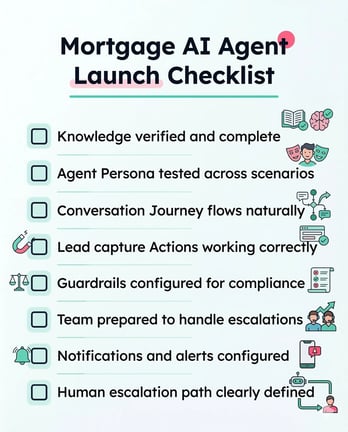
✅ Knowledge verified and complete
✅ Persona tested across scenarios
✅ Journey flows naturally
✅ Actions capture leads correctly
✅ Guardrails protect compliance
✅ Team knows what to expect
✅ Notifications configured
✅ Escalation path clear
Monitoring Performance
Track in the Dashboard:
Sessions: Total conversations, average length, peak times, drop-off points
Leads: New captures, quality scores, conversion rates, response times
Goals: Set custom goals like “Appointment Booked” or “Pre-Approval Started” and track completion
Engagement: Messages per session, common questions, knowledge gaps, satisfaction ratings
The First 48 Hours
Hours 1-6: Monitor initial traffic and test conversations. Take notes on patterns.
Hours 6-24: Real patterns emerge. See what questions come up most, where conversations stall, which CTAs work.
Hours 24-48: Volume stabilizes. Lead quality becomes clear. Make quick adjustments to Journey flow and add missing knowledge.
Optimization Cadence
Daily (First Week): Review all Sessions, add missing knowledge, adjust Persona, fix Actions
Weekly: Analyze lead quality trends, update Journey based on conversions, add content from common questions
Monthly: Deep performance review, update seasonal content, train team on new patterns
Quarterly: Major Journey overhaul if needed, competitive analysis, compliance audit
What You’ve Built
Your mortgage AI Agent can now:
✅ Engage website visitors in real conversations
✅ Answer questions using your knowledge base
✅ Qualify leads automatically
✅ Guide borrowers through complex decisions
✅ Capture contact information
✅ Transfer data to your systems
✅ Operate across web and SMS channels
✅ Maintain compliance standards
✅ Handle common objections
✅ Function outside business hours
All without coding. All customizable. All working while your team focuses on closing deals.
The Reality Check
You’ve just turned your website from a static brochure into an engagement engine. Visitors who might otherwise have browsed without engaging can now have real-time conversations. Questions that previously went unanswered can be addressed around the clock. Leads that might have gone cold may now be captured and routed to your team. Individual results vary based on traffic volume, agent configuration, and your team’s follow-up process.
This isn’t about replacing loan officers. It’s about giving them qualified, engaged leads who are ready for the next step. It’s about providing consistent, knowledgeable responses at any time of day, in any volume.
You’ve built infrastructure that scales your best conversations without scaling your headcount.
The mortgage industry continues to evolve. Borrowers increasingly expect timely, helpful responses and often compare options across multiple providers. Speed of response is widely cited as a factor in borrower engagement, though outcomes depend on many variables including lead quality, loan officer follow-up, and market conditions.
Your website can now compete.
Ready to get started? Go to magicblocks.ai and create your free AI Agent. Setup takes approximately 1-2 minutes.
Questions? That’s what your Agent is for now.
FAQ
“How long does it take to build a mortgage AI Agent?” Initial setup with Quick Agent Setup takes approximately 1-2 minutes. Customization (adding specific knowledge, refining persona, testing) typically takes 2-4 hours spread over a few days.
“Do I need technical skills or coding knowledge?” No. The entire setup uses visual interfaces and form fields. If you can use a website, you can build an Agent.
“Can the AI Agent schedule appointments with my loan officers?” Yes. Configure Actions to connect with your scheduling system, capture contact info, and coordinate follow-ups.
“What happens if the Agent doesn’t know the answer?” It will acknowledge the question and escalate to your team based on your Guardrail settings. It won’t make up answers or provide incorrect information.
**“How do I ensure my Agent stays compliant with lending regulations?”**Use Guardrails to define topic limits, required disclaimers, and human escalation triggers. MagicBlocks provides these tools to support your compliance workflows, but formal regulatory compliance remains the responsibility of your licensed team and legal counsel. We recommend periodic review of agent behavior with your compliance or legal team, particularly when regulations change.
“Can I have different Agents for purchase vs refinance?” Yes. You can build multiple specialized Agents within your workspace, each with different Journey flows and knowledge bases.
“Will this work on mobile devices?” Yes. The web embed and SMS channel both work on mobile. Test your Agent on smartphones during the testing phase.
“How do I know if my Agent is performing well?” Monitor the Dashboard for session length, lead capture rates, goal completions, and common questions. Compare lead quality to your current website conversion.
Want to see this in action?
See a demoRead the playbook. Now see it run.
Watch a 4-minute demo. No sales pitch. Then decide if you want to talk.