

What Are Some New Ways to Get Leads in 2026?
The playbook everyone's been running for the past decade? It's cracking. Fast. Here's what's actually working now and why the next 12 months will separate the companies that adapt from the ones that wonder where their pipeline went.
Discover the cutting-edge lead generation tactics revolutionizing B2B marketing in 2026 and learn how to adapt before your pipeline runs dry.
On this page9
- Why the Old Playbook Is Falling Apart
- Answer Engine Optimization (AEO): Get Found Before Anyone Googles You
- Signal-Led Growth: Replace Your Lists With Intent
- Community-Led Lead Generation: Where Trust Compounds
- Personalized Video Prospecting: Effort Is Visible
- Conversational AI & Autonomous Sales Agents: The Speed Game
- The Modern Lead Gen Stack: How It All Fits Together
- Quick Answers to the Questions Everyone’s Asking
- The Bottom Line
The playbook everyone’s been running for the past decade? It’s cracking. Fast. Here’s what’s actually working now and why the next 12 months will separate the companies that adapt from the ones that wonder where their pipeline went.
What You’ll Learn:
→ Why the Old Playbook Is Falling Apart
→ Answer Engine Optimization (AEO): Get Found Before Anyone Googles You
→ Signal-Led Growth: Replace Your Lists With Intent
→ Community-Led Lead Generation: Where Trust Compounds
→ Personalized Video Prospecting: Effort Is Visible
→ Conversational AI & Autonomous Sales Agents: The Speed Game
→ The Modern Lead Gen Stack: How It All Fits Together
→ Quick Answers to the Questions Everyone’s Asking
→ The Bottom Line
You already know lead generation is the lifeblood of every business. But here’s the thing, the way buyers discover, evaluate, and engage with you has shifted underneath your feet. Quietly. Brutally. And most companies haven’t noticed yet.
The most effective lead generation strategies in 2026 center around five game-changing shifts: Answer Engine Optimization, which gets your brand cited by AI systems like ChatGPT and Perplexity; signal-led growth, where intent data replaces cold lists; community-led acquisition, where trust compounds inside tight-knit online groups; personalized video prospecting, which cuts through inbox noise; and conversational AI agents that qualify and book leads the second someone shows up on your site.
Each of these channels is already generating real pipeline for the businesses that have figured them out. The ones that haven’t? They’re still pouring budget into tactics that are quietly bleeding ROI.
Why the Old Playbook Is Falling Apart
Let’s get real about something uncomfortable. Cold outreach, the backbone of B2B lead generation for the last 15 years, that is in freefall.
The average cold email open rate dropped to 27.7% in 2024, down from roughly 36% the year before, according to data from Snov.io and the Belkins B2B Cold Email Benchmark Report. The average response rate? A punishing 5.1%. That means 95 out of every 100 emails you send get zero reply.
Think about that for a second. You’re crafting messages, warming domains, A/B testing subject lines and the vast majority of it disappears into the void. Why? Because buyer behavior has fundamentally changed.
Automation Blindness Is Real
Decision-makers aren’t just busy anymore. They’re trained. Years of automated outreach have given B2B buyers an almost supernatural ability to spot templated messages in the first two seconds.
The core shift: Buyers don’t respond to interruption anymore. They respond to relevance and they’re increasingly demanding that relevance come to them on their terms, through channels and formats they actually trust.
The Numbers Are Sobering
Cold email open rates have dropped from around 36% to 27.7% year-over-year, per Snov.io’s Lead Generation Statistics report. Reply rates have fallen to 5.1%, down from roughly 7% the prior year, according to the Belkins 2024 B2B Cold Email Benchmark Report. The average business response time to an inbound lead sits somewhere between 29 and 47 hours, and more than 51% of leads are never contacted at all, both figures pulled from RevenueHero’s 2024 study across 1,000+ companies.
So the question isn’t whether cold outreach is struggling. It’s: what’s actually replacing it?
Answer Engine Optimization (AEO): Get Found Before Anyone Googles You
Here’s a stat that should genuinely alarm every marketing team out there: half of B2B software buyers now begin their purchasing journey in an AI chatbot, not Google. That’s according to a G2 survey from August 2025.
Half. Of B2B buyers. Starting with ChatGPT, Perplexity, or Gemini before they ever type a query into a traditional search engine. This isn’t some futuristic prediction anymore, it’s already happening.
The Gartner Wake-Up Call
Gartner predicted that traditional search engine volume would drop 25% by 2026, with search marketing losing market share to AI chatbots and virtual agents. Alan Antin, Vice President Analyst at Gartner, put it bluntly: generative AI solutions are becoming “substitute answer engines, replacing user queries that previously may have been executed in traditional search engines.” That prediction is playing out in real time.
What AEO Actually Means
Answer Engine Optimization is the practice of structuring your content so that AI-powered answer engines, such as ChatGPT, Google AI Overviews, Perplexity, Gemini, Copilot, can extract, cite, and attribute your brand as a trusted source when they generate responses.
Think of it this way: traditional SEO gets you a link on a results page. AEO gets you cited as the answer. And when AI Overviews appear, Pew Research found that users click traditional results about half as often. You’re not just competing for eyeballs anymore. You’re competing to be the source that AI trusts enough to quote.
The Scale Is Wild
- The AEO software category on G2 grew from 7 products to over 150 since March 2025 — a 2,000%+ increase, signaling an industry-wide scramble to optimize for AI discovery.
- Conductor’s AEO/GEO Benchmarks Report analyzed over 13,770 domains across 10 industries, examining 3.3 billion sessions and more than 100 million AI citations. Their finding? AI isn’t replacing search — it’s replacing your website as the first place customers engage with your brand.
- Early adopters of content optimized for generative engines are being discovered up to 10x faster than brands relying on organic SEO alone, according to the GEO Industry Report 2025.
- Semrush’s July 2025 AI Search study projects AI search traffic could surpass traditional search within two to four years.
In 2026, traffic matters less than being the answer. The brands that show up inside AI responses will define their categories. The ones that don’t will wonder where their visibility went.
How to Actually Win at AEO
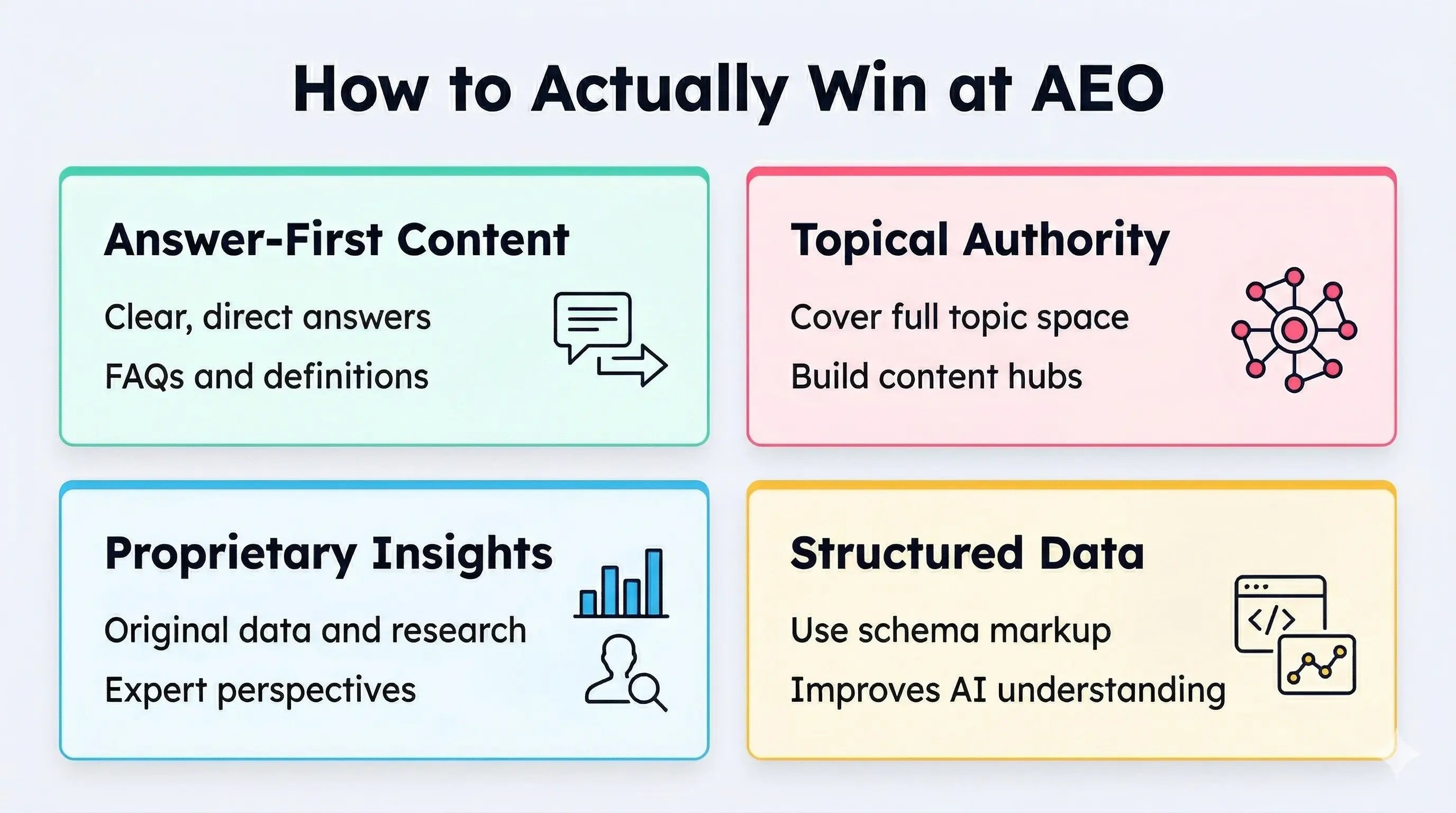
- Create answer-first content. Structure your pages with clear, direct answers near the top. AI systems love content that gets straight to the point — FAQ sections, concise definitions, and structured data all help.
- Build topical authority. Don’t just answer one question. Build interconnected content hubs that cover an entire topic space. AI models prefer sources that demonstrate deep, credible knowledge across related queries.
- Include proprietary data and expert commentary. Generative AI gravitates toward content with unique insights, original research, and expert perspectives. Generic takes don’t get cited.
- Use structured data markup. Schema markup (FAQ, Article, Organization) helps AI systems understand and trust your content. It’s not optional anymore — it’s table stakes.
How MagicBlocks Grew ChatGPT Visibility by 600% in 30 Days
Here’s proof this actually works. In November 2025, MagicBlocks had zero blog posts and practically no ChatGPT visibility. One month later, after executing a structured AEO workflow, ChatGPT visibility exploded by 600%.
The strategy was surgical: fix technical foundation (H1/H2 tags, alt text, Core Web Vitals), research high-intent commercial queries from Reddit, Google Search Console, and query fan-out tools, then publish content in citable formats — listicles, comparisons, case studies, and reviews. The team ramped from 6 blog posts in November to 21 in December, each one structured with answer-first paragraphs, semantically complete headings, and modular passages that AI engines could extract and remix.
The result? A 64.5% increase in users creating AI agents on MagicBlocks in January 2026, driven entirely by AI-referred traffic. Engagement with Scout, their AI Sales Agent, jumped 58%. Visitors sent 40% more messages per session and converted into qualified leads at 2× the rate of any other traffic source.
The people landing from ChatGPT and Perplexity weren’t tire-kickers. They were problem-aware, already hunting for a solution, and Scout met them exactly where they were. Full breakdown: How to Increase ChatGPT Visibility by 600%.
Signal-Led Growth: Replace Your Lists With Intent
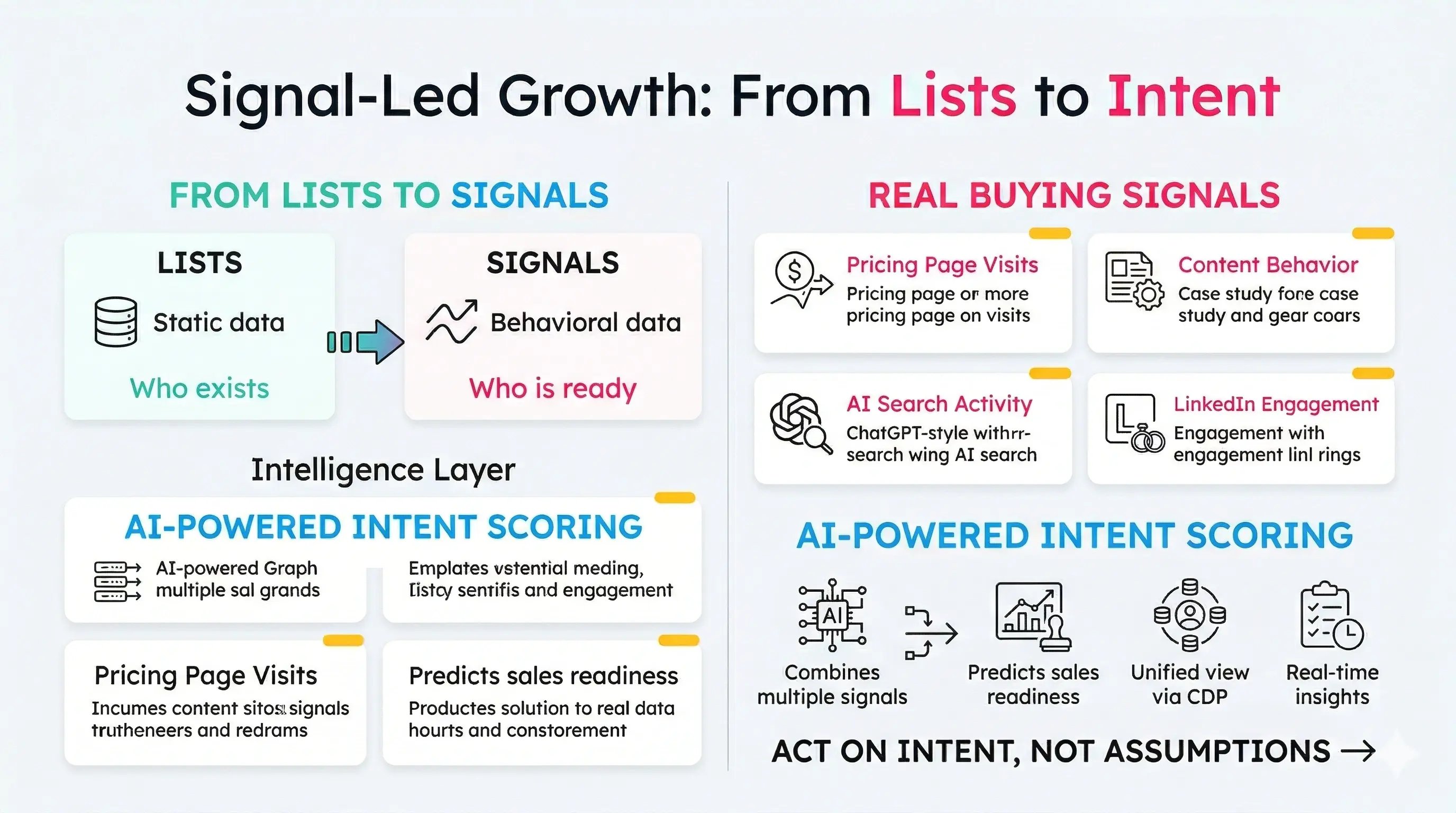
For years, lead generation lived and died by the list. You’d buy a database, scrape LinkedIn, download a contact sheet and blast it. The problem? A list tells you who exists. It tells you absolutely nothing about who actually wants what you’re selling right now.
Lists tell you who exists. Signals tell you who cares.
What Buying Signals Actually Look Like in 2026
Intent data is the evolution of lead lists and it’s dramatically more valuable. According to research from Inbox Insight, understanding buyer intent data provides a significant competitive advantage, enabling marketers to identify and engage prospects demonstrating interest signals before they actively interact with your brand.
The signals are everywhere, if you know where to look:
- Repeated pricing page visits. Someone visiting your pricing page three times in a week isn’t browsing. They’re evaluating.
- Content consumption patterns. A prospect who downloads your case study, then reads two blog posts, then searches for your competitor? That’s a buying signal firing in real time.
- AI search behavior. This one’s brand new. As buyers start researching through ChatGPT and Perplexity, the queries they’re running reveal their stage in the buying journey, if you’re monitoring them.
- LinkedIn engagement cadence. Commenting on your posts, engaging with your team’s content, or even just viewing your profile repeatedly — each one is a data point.
Intent Scoring Is Getting Smarter
According to McKinsey, businesses investing in AI are seeing a revenue uplift of 3% to 15% and a sales ROI uplift of 10% to 20%. A big chunk of that lift is coming from AI-powered intent scoring — machine learning models that analyze multiple behavioral signals simultaneously and predict which leads are actually sales-ready.
The tools making this possible have matured fast. HubSpot Buyer Intent tracks prospect engagement across your content ecosystem, flagging when someone’s consumption pattern shifts from casual browsing to active evaluation.
ZoomInfo layers in technographic data and contact-level intent signals, showing you not just which companies are researching your category — but exactly which decision-makers inside those companies are doing the searching.
Gojiberry goes a step further, tracking buying committee engagement across multiple channels and alerting your team the moment a prospect crosses into high-intent territory.
Customer data platforms (CDPs) tie it all together. They integrate data from your website, CRM, marketing automation tools, and third-party intent providers like Bombora, creating a unified profile that tells you not just who someone is — but exactly where they are in their decision-making process. The result? You’re not guessing anymore. You’re responding to actual buying signals in real time.
Community-Led Lead Generation: Where Trust Compounds
You know what’s wild? A single thoughtful comment from a respected tech manager on Reddit can carry more weight in a buyer’s mind than a full-page LinkedIn sponsored post. Communities have become the fastest trust-building environment on the internet — and savvy businesses are finally treating them as lead generation channels.
Reddit Isn’t Just for Memes Anymore
The shift toward Reddit as a B2B discovery channel is one of the more underappreciated trends happening right now. Enterprise decision-makers are using Reddit to research software solutions, evaluate vendors, and get honest peer feedback — the kind of unfiltered insight they can’t get from a vendor’s website or a sales call.
What makes this especially powerful in 2026? The AI feedback loop. Large Language Models like ChatGPT, Gemini, and Perplexity are aggressively pulling from community forums when generating answers. If someone asks an AI, “What’s the best CRM for a small agency?” — the AI isn’t just looking at your marketing site. It’s reading what real users said about you on Reddit six months ago. Your community presence is quietly feeding AI discovery, whether you’re paying attention to it or not.
Facebook Groups and Skool Are the New Power Bases
Facebook Groups have quietly become one of the most underrated B2B discovery channels. There are over 1.8 billion Facebook Groups globally, and the professional, industry-focused ones — think SaaS founders, agency owners, fractional CMOs — are where real buying decisions get influenced. These aren’t casual scroll-through communities. They’re tight-knit networks where members ask for vendor recommendations, share implementation experiences, and vet solutions before they ever talk to sales.
Then there’s Skool, which has exploded as the go-to platform for paid communities and courses. Since launching in 2019, Skool has become the default infrastructure for creators, consultants, and educators building premium communities around specific expertise. For B2B companies, Skool offers something Facebook Groups can’t: a distraction-free environment where engagement is the currency and every member has skin in the game. When someone in a Skool community recommends your product, it carries weight — because they paid to be there, and the signal-to-noise ratio is astronomically higher.
The Playbook: Sell Without Pitching
- Lead with value, aggressively. The fastest path to trust in a community is being genuinely, repeatedly helpful. Answer questions thoroughly. Share frameworks. Be the person everyone wants to hear from.
- Join before you promote. Spend weeks contributing before you ever mention your product. Communities have a finely tuned detector for spam — and it’s merciless.
- Monitor for buying intent signals. Keywords like “looking for,” “recommend,” “switching from,” and “frustrated with” are gold. These are people actively in research mode.
- Feed the AI models. Every thoughtful contribution you make in a Reddit thread, Facebook Group, or Skool community is training data for the AI systems your future customers will ask for recommendations.
Communities compress trust faster than any funnel you’ve ever built. And in 2026, they’re also quietly training the AI systems that will decide whether your brand gets recommended.
Personalized Video Prospecting: Effort Is Visible
Cold email reply rates are cratering. LinkedIn messages are getting templated to death. But there’s one channel that’s still cutting through, and it’s not complicated — it’s video.
Why Video Works When Everything Else Doesn’t
Video works because effort is visible. When a prospect sees you on camera, showing their website on your screen, referencing something specific about their business — the message is unmistakable: you actually spent time on them.
According to Wyzowl’s video marketing research, 91% of video marketers say video helps increase traffic, 90% say it generates leads, and 87% say it drives sales. Nearly 9 in 10 consumers have made a purchase as a direct result of watching a video. The medium is proven — the question is whether you’re using it with enough specificity to break through.
What Actually Converts
- Keep it under 90 seconds. You have roughly 3 seconds to earn the next 3 seconds. Get to the point fast.
- Show their website or product on screen. This is the single biggest signal of genuine personalization. It says: “I looked at what you’re building.”
- Reference something specific. A recent funding round, a new feature launch, a post they wrote — any piece of research that proves you did your homework.
- End with one clear ask. Not “let me know if you’re interested.” Something concrete: “Would 15 minutes on Thursday work to talk about [specific thing]?”
Conversational AI & Autonomous Sales Agents: The Speed Game
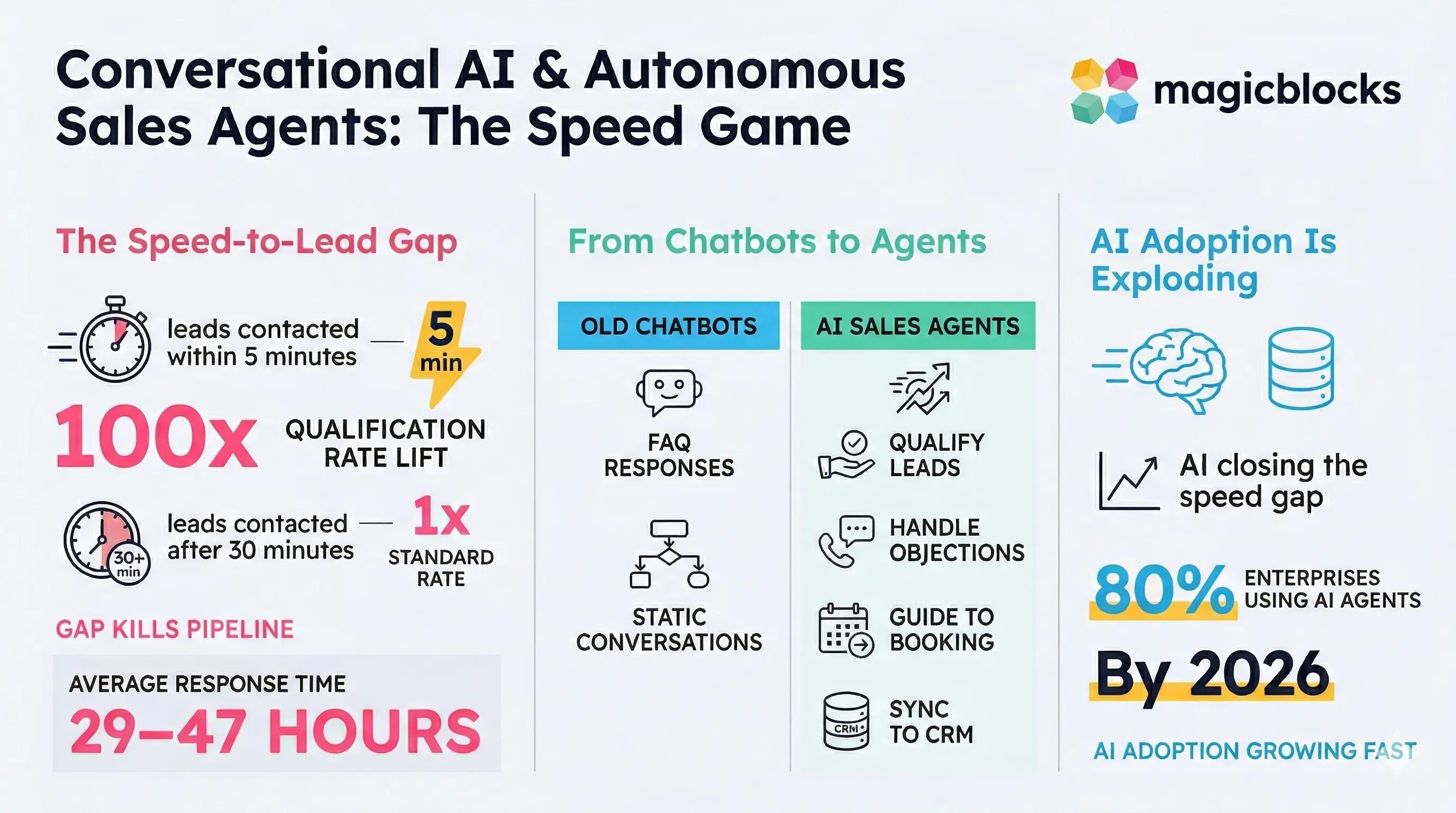
Here’s the stat that should keep every sales leader up at night: leads contacted within 5 minutes are up to 100x more likely to be qualified than those contacted after 30 minutes. That’s from the speed-to-lead research originally surfaced by Harvard Business Review. And the average business response time to an inbound lead in 2025? Somewhere between 29 and 47 hours, according to a RevenueHero study of over 1,000 companies.
One hundred times more likely. And the average response time is nearly two days. That gap — between what’s possible and what’s actually happening — is where most pipeline goes to die. And in 2026, AI is finally closing it.
What’s Changed About AI Sales Agents
For a while, “AI chatbot” was basically a synonym for “FAQ widget with a friendly tone.” You’d ask a question, it would spit back a canned answer, and the conversation would end. That was the generation of chatbots that made everyone skeptical.
The new generation is fundamentally different. We’re talking about autonomous agents that don’t just answer questions — they qualify leads, handle objections, guide conversations toward a booking, and sync everything to your CRM. All of it, in real time, the moment someone lands on your site.
The Economics Are Insane
Gartner predicts that by 2026, 80% of enterprises will be using AI agents to handle workflows or customer interactions. The adoption curve is steep and it’s accelerating.
What Autonomous Sales Agents Actually Do — Old Generation vs. Now
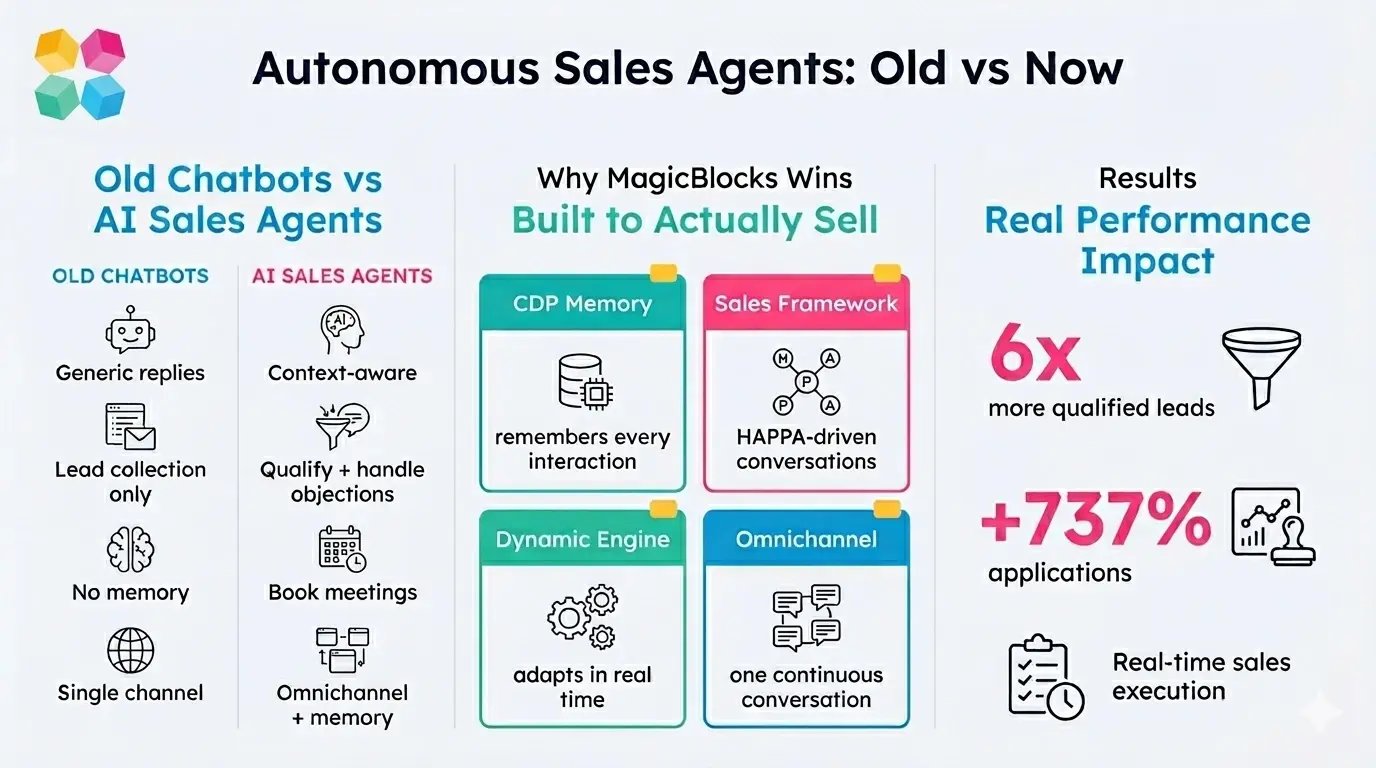
The old-gen chatbot responded instantly but generically. It collected a name and email, then linked you to a calendar page. It had no memory between conversations and lived only on your website chat widget.
The 2026 AI sales agent does something completely different. It responds instantly and contextually. It runs full intent scoring inside the conversation — not just collecting info, but actually qualifying. It addresses objections using proven sales frameworks instead of redirecting to an FAQ. It books meetings directly, offering options. It remembers everything across channels and over time. And it moves seamlessly from chat to SMS to email to DMs without the conversation resetting. Everything syncs to your CRM automatically, in real time.
MagicBlocks: The Proof That This Actually Works
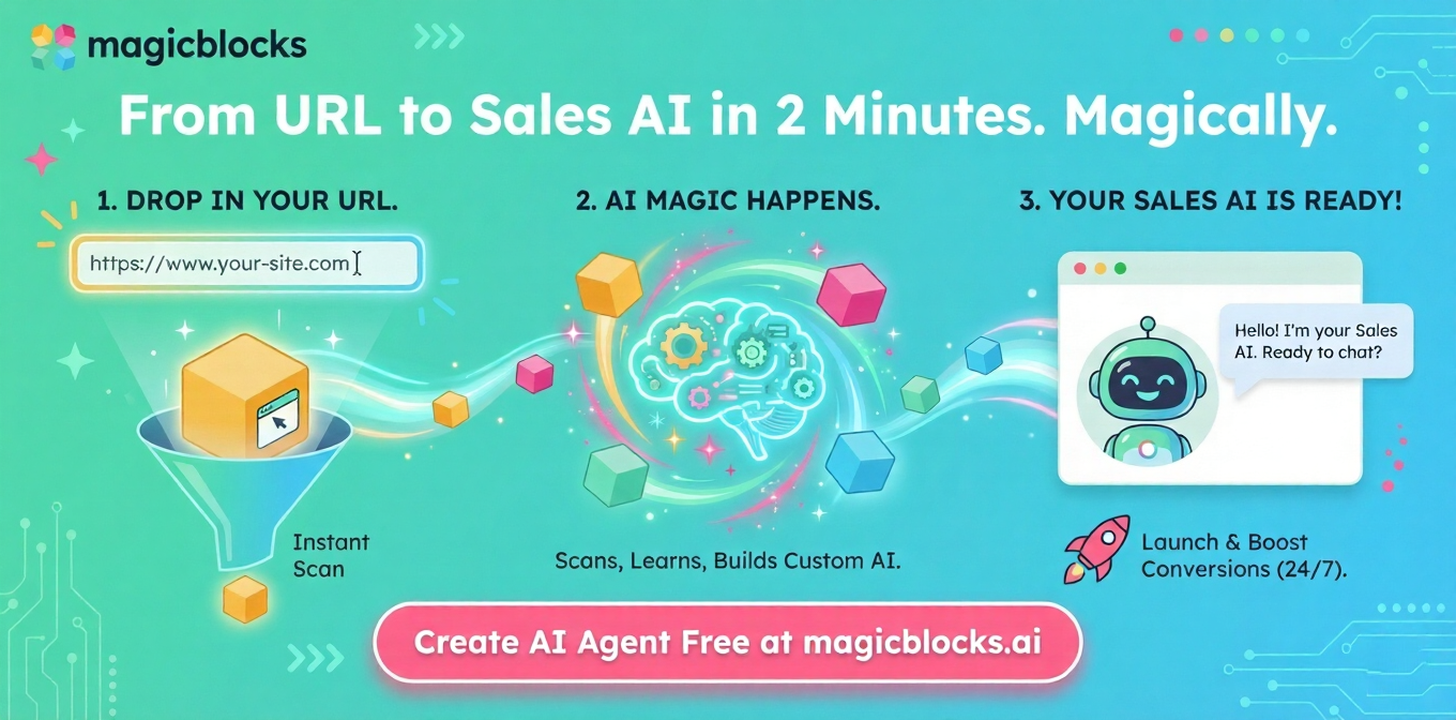
MagicBlocks is an Autonomous Relationship Sales Platform — which is a fancy way of saying: AI sales agents that actually sell, not just chat. Built on over $200 million worth of lead generation experience and a codified sales framework called HAPPA (Hook → Align → Personalize → Pitch → Action), MagicBlocks agents don’t just respond to leads. They run full sales conversations.
Here’s what makes them different from the chatbot generation everyone gave up on:
- CDP-native memory. Every agent remembers every customer — their history, preferences, behaviors, and past conversations — across channels and over time. No more “Day 1” resets.
- Real sales DNA. The HAPPA framework and curated sales playbooks mean these agents don’t just talk. They hook, qualify, personalize, pitch, and drive toward a clear next step — the way your best human rep would.
- Dynamic journey engine. Instead of rigid flowcharts, the system computes the next best move based on who the person is and what’s already happened. Edge cases don’t break it.
- Omnichannel continuity. One agent identity across chat, SMS, email, and DMs. The conversation doesn’t reset when the channel changes.
Early results have been wild. Per MagicBlocks’s early customer performance data, businesses using the platform have seen 6x more qualified leads and application increases of 737% in specific verticals. The agents qualify in real time, respond within seconds, send CTAs, book meetings, and sync to CRMs like GoHighLevel and HubSpot — all without a human touching the conversation until it’s ready to close.
The Modern Lead Gen Stack: How It All Fits Together
None of these channels work best in isolation. The businesses that are winning in 2026 aren’t picking one strategy and going all-in. They’re layering them into a system where each piece feeds the next.
The flow works like this: A buyer discovers you through an AI citation or community presence — that’s the AEO and community layer doing its job. The system then detects high-intent behavior in real time through signal-led scoring. That triggers a personalized touchpoint — either a video or a conversational AI agent — that meets the lead where they are. The AI agent qualifies the intent and collects the information needed. And then the meeting gets booked and the data flows to the sales team automatically.
The modern lead gen stack isn’t a funnel anymore. It’s a system — discovery feeds intent, intent triggers engagement, and engagement converts into revenue. Automatically.
What’s remarkable about this architecture is that every piece is either free or dramatically cheaper than the traditional equivalent. AEO content costs time, not ad budget. Community engagement costs relationship-building, not CPM. And conversational AI handles qualification at a fraction of the cost of an SDR team.
Quick Answers to the Questions Everyone’s Asking
Which lead gen channel is declining fastest?
Cold email, by a wide margin. Open rates dropped from 36% to 27.7% year-over-year, per Snov.io. Reply rates fell to 5.1%, according to Belkins’s 2024 B2B Cold Email Benchmark Report. And cold email conversion rates sit at roughly 0.2% — about one deal per 500 emails sent, per analysis by Martal. It’s not dead, but it’s no longer the engine it used to be.
Where are buyers discovering you today?
Increasingly, inside AI-generated answers. Half of B2B software buyers now start their research in an AI chatbot rather than Google, per G2’s August 2025 survey. Google AI Overviews appear on over 30% of searches by late 2025, according to Semrush. Communities like Reddit influence 75% of B2B purchasing decisions, per Single Grain’s research. The discovery surface has fragmented — and it’s still fragmenting.
Are you optimized for AI discovery?
Most companies aren’t. The AEO category grew 2,000% on G2 in less than a year because businesses are scrambling to figure this out. Early adopters are being discovered up to 10x faster than brands relying on organic SEO alone, per the GEO Industry Report 2025. If you haven’t audited your content for AI citation readiness — structure, authority signals, FAQ schema, and topical depth — you’re behind.
How fast do you need to respond to inbound intent?
Under 5 minutes for meaningful qualification. Under 1 minute for competitive advantage. Every minute of delay exponentially reduces your chance of converting that lead. If you can’t hit that window with a human, an AI agent is the answer.
The Bottom Line
Lead generation in 2026 isn’t broken. It’s evolved. The old playbook — buy a list, send a blast, wait for replies — is being replaced by a system that’s faster, smarter, and dramatically more efficient at connecting the right message with the right person at the right moment.
The five shifts that define this evolution are: optimizing for AI citation over search ranking; reading intent signals instead of relying on lists; building trust in communities before pitching; using personalized video to cut through the noise; and deploying conversational AI that qualifies and converts leads the instant they show up.
The businesses that figure this out in 2026 won’t just have better pipelines. They’ll have a fundamentally different relationship with their leads — one built on speed, relevance, and genuine understanding instead of volume and hope.
The fastest responder wins the deal. The most trusted source gets cited by AI. The most genuinely helpful brand earns community loyalty. 2026 is the year these three truths become the new lead generation playbook.
Try MagicBlocks Free
What’s actually working for you right now and what stopped working sooner than expected?
Visit magicblocks.ai to see it in action.
Want to see this in action?
See a demoRead the playbook. Now see it run.
Watch a 4-minute demo. No sales pitch. Then decide if you want to talk.