

Outbound Isn’t Dead! You’re Just Doing It Without an Autonomous Agent
And honestly? If you're still running outbound the way you did in 2019, they're right. Your open rates are tanking. Your reply rates are abysmal.
Unlock the full potential of outbound sales with AI autonomous agents that deliver speed, personalization, and scalable solutions, transforming your outreach strategy for the modern market.
On this page8
- The Real Problem: Your Outbound System Is Too Slow, Inconsistent, and Expensive
- The Shift: From Tools to Teammates
- How Autonomous Agents Fix Outbound
- Real-World Proof: What This Looks Like
- Not All “Autonomous Agents” Are Actually Autonomous
- The Conclusion
- So What’s Next?
- FAQ: What You’re Probably Wondering
You’ve heard it a thousand times by now.
“Outbound is dead.”
“Cold email doesn’t work anymore.”
“Nobody picks up the phone.”
And honestly? If you’re still running outbound the way you did in 2019, they’re right. Your open rates are tanking. Your reply rates are abysmal. Your SDRs are burning out after six months, and the leads that do respond are going cold while your team scrambles to keep up.
But here’s what’s wild.
Some teams are crushing it with outbound right now. Same market. Same buyers. Same crowded inboxes. Completely different results.
So what’s the difference?
It’s not that outbound is dead. It’s that manual outbound is dying and the teams winning have already figured out what comes next.
What we’ll cover:
- The Real Problem: Your Outbound System Is Too Slow, Inconsistent, and Expensive
- The Shift: From Tools to Teammates
- How Autonomous Agents Fix Outbound
- Real-World Proof
- Not All “Autonomous Agent” Are Really Autonomous
- The Conclusion
- What’s Next
The Real Problem: Your Outbound System Is Too Slow, Inconsistent, and Expensive
Let’s be honest about what’s happening.
Your reps are:
Too slow. Leads go cold in hours, not days. By the time your SDR logs in, checks the queue, and crafts a personalized email, that lead has already talked to three of your competitors who responded instantly.
Too inconsistent. Some leads get seven touches. Some get two. Some fall through the cracks entirely because your rep got pulled into a meeting or went on vacation. There’s no system. There’s just whoever remembers.
Too generic. You’ve got one cadence for everyone. Same sequence. Same timing. Same message. It doesn’t matter if they’re a hot lead who just filled out a demo form or a cold prospect from a list you bought six months ago, everyone gets the same treatment.
Too expensive. You can’t scale headcount fast enough to work every lead properly. Hiring, training, and replacing SDRs costs a fortune. And even when you do hire, they’re maxed out at 50-80 meaningful touches per day. That’s your ceiling.
The result? You’re leaving money on the table. Lots of it.
And while you’re trying to squeeze more productivity out of humans who are already maxed out, your competitors have moved on to something else entirely.
AI-Enabled Outbound Is the New Standard (And It’s Not Even Close)
This isn’t speculation. The research is already in.
Speed & Precision Beat Volume
McKinsey’s research on B2B sales found that successful tech- and AI-enabled sales teams are using granular market maps, microsegmentation, and propensity models to decide who to contact, when, and with what message. Meanwhile, teams still relying on manual list building and generic cadences are seeing lower returns and higher cost per lead.
The gap isn’t subtle. It’s a chasm.
Old-school outbound is spray-and-pray with the same sequence for everyone. AI-enabled outbound hits the right person at the right moment with the right message and the difference in performance is staggering.
AI Automates What You Can’t Scale
Here’s where it gets interesting.
McKinsey’s work on the future of B2B sales notes that sales leaders are now explicitly asking: “How do we automate pipeline generation with AI?” And here’s the kicker — AI-enabled omnichannel, data-driven sales is becoming the new standard, not a niche experiment.
We’ve moved past “Can AI help us?”
The question now is: “How fast can we deploy it before our competitors do?”
The Revenue Impact Is Real
Let’s talk numbers.
McKinsey found that B2B sales teams using AI to identify and prioritize opportunities can expect 5–15% sales uplift from gen-AI-automated account planning and similar use cases. The gains come from focusing effort on the right prospects instead of broad, manual outreach. Read that again: 5-15% uplift. You’re not just saving time. You’re closing more deals with the leads you already have.
Buyers Won’t Tolerate Generic Anymore
Harvard Business Review’s coverage of agentic AI in sales makes this clear: AI helps sales teams understand client needs faster and more precisely, enabling higher-quality outreach in a world where buyers are less willing to engage with generic pitches.
Your buyers can smell a mass email from a mile away. They know when you’re using a template. They can tell when you haven’t done your homework.
Personalization isn’t a nice-to-have anymore. It’s table stakes. And if you’re relying on humans to personalize every single outreach at scale, you’ve already lost.
AI Makes Better Decisions Than Humans (Sorry)
Here’s the uncomfortable truth.
Harvard Business Review found that organizations using AI to guide targeting and timing make faster, better outbound decisions than those relying on human judgment alone. The research explicitly states that “old-school” outbound underperforms when it ignores AI tools.
Why? Because your best rep as talented as they are can’t analyze 10,000 signals in real-time, cross-reference behavioral data, predict propensity to buy, and adjust messaging on the fly.
AI can. And it does it every single time.
The Problem: Most “AI Outbound” Tools Are Just Faster Spam
Okay, so AI-enabled outbound is crushing it. You get that now.
But here’s where most companies go wrong.
They buy an “AI outbound tool,” flip it on, and six weeks later they’re wondering why their reply rates haven’t moved.
Because most of what the market calls “AI outbound” is just automation with a chatbot slapped on top.
You know the tools I’m talking about:
- Auto-generated emails with tokens that still sound like they came from a robot
- Chatbots that reply fast but can’t actually sell anything
- Workflow automation that requires you to draw every possible edge case by hand
- Sequence builders that send the same message to everyone at the same time
Why this fails:
Stateless. Every interaction resets. No memory. No context. If a lead talked to you on your website yesterday and you email them today, the email has no idea that conversation happened.
Generic. Same message, different name. Buyers can tell. You’re not fooling anyone.
Support-first. These tools answer questions. They don’t qualify. They don’t pitch. They don’t close. They’re FAQ bots with better grammar.
Channel-bound. You’ve got a website bot here, an email tool there, an SMS platform somewhere else — and none of them talk to each other. Every channel is a fresh start.
The result? You’re just automating bad outbound. You’re doing the same thing you were doing before, only faster.
And faster spam is still spam.
The Shift: From Tools to Teammates
So let’s reframe the question.
It’s not: “Can AI help with outbound?”
It’s: “Can AI own outbound?”
Because if AI is just assisting your reps, drafting emails, suggesting next steps, pulling data, you’re still capped by human bandwidth. You’re still limited by how many people you can hire, train, and retain.
But if AI can own the entire outbound motion from first touch to qualified handoff, you’ve fundamentally changed the game.
That’s what autonomous agents do.
And here’s what they need to pull it off:
- Memory. They have to remember every lead’s history, behavior, preferences, and past interactions. No resetting. No “remind me what we discussed” moments.
- Sales DNA. They need to know how to hook attention, align to intent, personalize the pitch, and drive action. Not just respond. Not just answer questions. Sell.
- Persistence. They follow up for weeks or months without dropping anyone. No forgetting. No getting pulled into other meetings. Just relentless, intelligent follow-up.
- Omnichannel continuity. They show up as the same agent across chat, SMS, email, DMs. The conversation doesn’t reset when the channel changes.
- Dynamic intelligence. They adjust the next move based on state — who this person is, what’s happened so far, where they are in the journey — not a static playbook you drew six months ago.
This is the leap from tools to teammates.
How Autonomous Agents Fix Outbound
Alright, so what does this actually look like in practice?
A. They’re Fast and Good
Instant response. No lead waits four hours for your SDR to log in and check their queue. The agent engages immediately.
But here’s the key: they’re context-aware from message one. They already know who you are, what you’re looking for, and what you’ve done so far. It’s not just fast. It’s fast and relevant.
And that quality is consistent across thousands of conversations. No off days. No rep who’s having a rough morning and sends a lazy email. Every interaction is sharp.
B. They Remember Everything
This is where most tools fall apart. But autonomous agents are built on a CDP-native memory engine.
Every interaction gets stored. Every behavior gets tracked. Every preference gets noted.
So when a lead comes back three weeks later, the agent doesn’t say “Sorry, can you remind me what we discussed?” It picks up exactly where the conversation left off — because it never forgot.
Trust compounds over time. Relationships build. And every interaction makes the next one better.
C. They Actually Know How to Sell
Here’s the thing most people miss about AI sales tools: they can chat, but they can’t sell.
They’ll answer your questions. They’ll be polite. They’ll sound friendly. But they won’t hook your attention, qualify your intent, personalize the pitch, and drive you toward a decision.
That’s where the HAPPA framework comes in:
Hook → Grab attention with context and relevance, not generic openers like “Hope you’re having a great day!”
Align → Qualify intent and surface real pain. Figure out if this person is worth pursuing and what they actually need.
Personalize → Tailor the pitch to the person, their situation, their goals — not just their industry segment.
Pitch → Frame value in commercially intelligent ways. This is where objections get handled and offers get positioned.
Action → Drive toward the next clear step. Book a call. Start a trial. Fill out an app. Hand off to a human at the right moment.
Most AI tools can do the first part. Maybe the second. But they fall apart on pitch and action because they don’t have real sales craft baked in.
Autonomous agents do. They know how to move a conversation forward, not just keep it going.
D. They Follow Up Forever
Humans forget. They get busy. They move on to the next shiny lead.
Agents don’t.
They run multi-step, multi-channel journeys over days, weeks, months. Every follow-up is relevant — no robotic “just checking in” messages that make everyone cringe.
If a lead goes dark for two weeks, the agent picks back up with something useful. A case study. A new insight. A relevant question. It’s not random. It’s strategic.
And here’s the wild part: this happens for every single lead. Not just the hot ones. Not just the ones your rep remembered to tag. Everyone gets the same relentless, intelligent follow-up.
E. They Scale Without Headcount
One agent handles thousands of leads simultaneously.
No hiring. No training. No turnover. No PTO. No rep who quits after six months because they’re burned out from cold calling.
Your cost per lead drops. Your quality goes up. And you can finally work your entire database instead of just the top 10% your team has bandwidth for.
Real-World Proof: What This Looks Like
Let’s get concrete.
High-ticket lead-gen: Companies using autonomous agents see instant contact with every lead (no 4-hour lag), plus weeks of intelligent follow-up that adapts based on behavior. Result? 6× more qualified leads compared to manual outreach.
PLG SaaS: Activation agents nudge signups toward their aha moment with personalized prompts, in-app guidance, and timely follow-ups. One company saw a 737% increase in applications after deploying autonomous agents trained on the HAPPA framework.
Revenue at scale: Agents built on proven sales playbooks have generated over $200M in leads across industries from solar to SaaS to mortgage.
What do these have in common?
They didn’t just automate outreach. They automated relationships.
Not All “Autonomous Agents” Are Actually Autonomous
Quick reality check.
The market’s getting flooded with tools calling themselves “autonomous agents” that are really just workflow builders with better marketing.
Here’s what to watch out for:
Brittle workflows disguised as “intelligence.” If you’re still drawing flowcharts with “if this, then that” logic for every possible scenario, it’s not autonomous. It’s just complicated automation.
No memory. If the agent forgets who you are between channels or between sessions, it’s not relationship-driven. It’s a stateless chat.
Generic prompts. If it’s just a wrapper on ChatGPT with your company info copy-pasted into the system prompt, it has no sales DNA. It’s improvising every time.
Real autonomy looks like this:
✅ Dynamic journey engine — not a workflow canvas you drew by hand
✅ Persistent identity across channels — same agent, same memory, everywhere
✅ Embedded sales craft — not just model behavior, but codified expertise
If you’re not getting all three, you’re not getting autonomy. You’re getting automation with a chatbot face.
The Conclusion
Outbound isn’t dead.
Manual outbound is.
The teams winning with outbound right now have:
- Moved from human-only to AI-augmented to AI-owned
- Replaced generic sequences with intelligent, adaptive journeys
- Stopped treating outbound as a volume game and started treating it as a relationship game
The new reality:
Your competitors are already deploying autonomous agents. They’re contacting leads faster, following up longer, and selling better. Every day you wait is revenue you’re leaving on the table.
So What’s Next?
You’ve got two choices.
Option 1: Keep running outbound the old way. Keep hiring SDRs who burn out. Keep watching leads go cold because no one followed up on day 6. Keep spending more on ads to compensate for the pipeline you’re leaking.
Option 2: Deploy an autonomous agent that actually knows how to sell.
We built MagicBlocks for exactly this. Our AI agents run on the HAPPA framework — the same sales DNA that’s generated over $200M in leads. They remember every lead. They follow up for weeks without dropping anyone. They show up across chat, SMS, email, and DMs as the same switched-on rep who knows your history and knows how to close.
And you can see it in action right now.
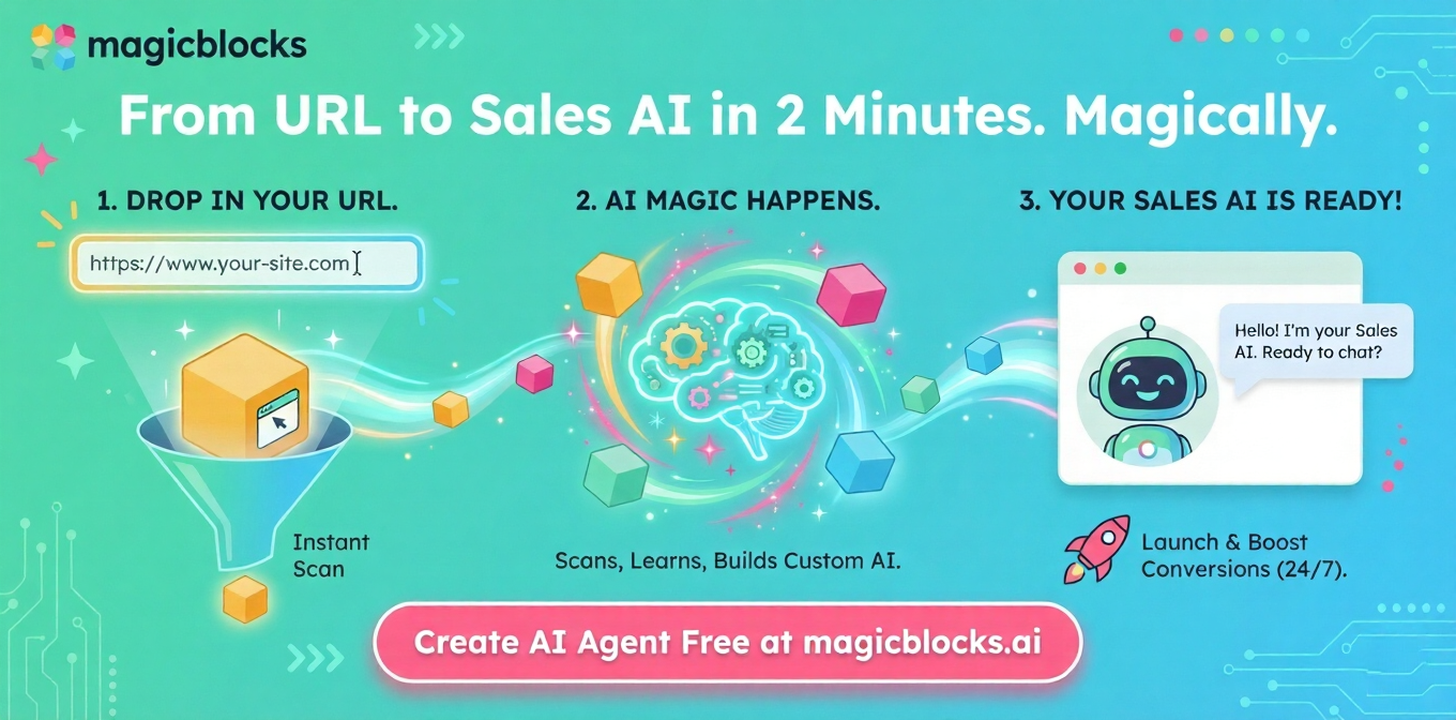
Drop your website URL into MagicBlocks. Watch it build an agent trained on your business. No code. No complex setup. Just an AI sales rep that starts working your pipeline immediately.
The leads are already there. The pipeline’s already sitting in your CRM. You’re just missing the system that can work all of it, all the time, without adding headcount.
Try it now at magicblocks.ai — because every lead your team isn’t following up on right now is a lead your competitor’s agent is.
FAQ: What You’re Probably Wondering
Q: Won’t AI outbound feel impersonal?
Only if it’s generic. Autonomous agents with memory and sales DNA feel more personal than mass email blasts from human SDRs who forgot what you talked about last week. When an agent remembers your history, references your behavior, and tailors the pitch to your situation, buyers notice. They engage. They convert.
Q: How is this different from email automation?
Email automation is stateless and single-channel. It sends the same sequence to everyone at the same time, regardless of what’s happening. Autonomous agents remember context, adapt in real-time based on behavior, and follow leads across every channel — chat, SMS, email, DMs as the same persistent identity.
Q: Do I need to replace my human team?
No. Autonomous agents handle the high-volume, repetitive work — first touch, qualification, follow-up, nurture — so your humans can focus on high-value deals and strategic relationships. Think of it like this: the agent works the entire database, and your reps close the best opportunities the agent surfaces.
Q: What if my industry is too complex for AI?
That’s exactly why you need AI. Complex industries have more variables, more objections, more edge cases — which means more cognitive load for human reps. Autonomous agents can handle complexity at scale better than humans because they don’t forget, don’t get overwhelmed, and don’t make emotional decisions. Plus, industry-specific playbooks let you encode your expertise into the agent so it sells the way your best reps do.
Want to see this in action?
See a demoRead the playbook. Now see it run.
Watch a 4-minute demo. No sales pitch. Then decide if you want to talk.