

The Sales Role of the Future: The AI Revenue Automation Specialist
The sales role of the future isn't SDRs clicking through Salesforce or reps chasing cold leads.
Discover the future of sales with AI Revenue Automation Specialists who optimize and orchestrate AI Sales Agents to handle entire pipelines efficiently and effectively.
On this page8
The sales role of the future isn’t SDRs clicking through Salesforce or reps chasing cold leads.
It’s a Revenue Automation Specialist, the person who deploys, optimizes, and orchestrates AI Sales Agents that run entire pipelines automatically.
This role exists because platforms like MagicBlocks can finally do what humans can’t: remember every lead, sell with real playbooks, follow up forever, and run multi-channel conversations with zero drop-off, all while sounding human.
MagicBlocks becomes the engine. The Revenue Automation Specialist becomes the operator.
What we’ll cover:
- The Old Sales Role is Breaking (And the Math Proves It)
- Enter the AI Revenue Automation Specialist
- How Human Sellers Evolve (Not Disappear)
- The Competitive Reality (Time is Running Out)
- How to Build This Function
- The Future is Already Here
- How MagicBlocks Makes This Role 10× More Powerful
The Old Sales Role is Breaking (And the Math Proves It)
Let’s get real about what sales reps actually do all day.
According to McKinsey research, high-performing sales reps spend just 20 to 25 percent more time with customers than lower-performing reps. But here’s the kicker: even the best reps are only spending about 20-25% of their total time actually selling. The rest? It’s buried in admin work, data entry, research, and follow-up that could be automated with today’s technology.
McKinsey’s analysis shows that approximately a third of all sales tasks can be automated right now, making sales one of the most promising functions for automation. Yet only one in four companies has automated even a single sales process. That gap? That’s where fortunes are being made and lost.
Here’s what’s actually breaking in the traditional sales model:
Speed is measured in hours when it should be seconds. Your lead fills out a form at 9pm. Your rep sees it at 9am the next day. By then, they’ve already talked to three of your competitors. You’ve lost before the game even started.
Follow-up dies after email number two. Humans get tired. They get busy. They have other deals to chase. That warm lead from last month? It’s cold now, sitting in your CRM like a ghost. Not because your rep is lazy—because they’re drowning in volume and can’t physically maintain 47 simultaneous conversations.
Every lead gets the same pitch. You know personalization matters. McKinsey found that 71 percent of consumers expect personalized interactions, and 76 percent get frustrated when it doesn’t happen. But personalizing at scale when you’re manually crafting every email? Impossible.
Context gets lost in the handoffs. SDR qualifies the lead, passes notes to the AE, who eventually hands off to CS. Every transition is a game of telephone where critical details disappear. The customer has to repeat themselves three times.
And here’s the cost nobody wants to talk about: you’re not just losing deals. You’re burning out your best people by forcing them to do work they hate. Your A-players didn’t get into sales to update Salesforce fields and schedule meetings. They got in to solve problems and close deals.
Revenue is leaking everywhere. Not in obvious ways, but in the thousand conversations that never happened because nobody had time. In the follow-ups that came three days too late. In the personalization that would’ve closed the deal but took too long to craft.
Companies are sitting on piles of leads and letting them rot. Not because the leads are bad—because the operational model of “more reps = more revenue” has hit a wall.
Enter the AI Revenue Automation Specialist
So what do the winning companies have that everyone else doesn’t?
They’ve created a new role. You might not find it on LinkedIn yet with this exact title, but it exists. And it’s changing everything.
The AI Revenue Automation Specialist isn’t a traditional sales ops. They’re not just admins with better tools. They’re revenue architects who orchestrate AI agent teams to handle the entire sales engine.
Here’s what they actually do:
They design and deploy AI agents that work your entire pipeline 24/7. These aren’t chatbots that wait for someone to ask a question. These are autonomous agents that reach out, follow up, remember context, handle objections, and move deals forward across email, SMS, chat, and DMs simultaneously.
They build memory systems. Every interaction with every customer is stored, understood, and accessible. When an AI agent talks to a lead for the fifth time, it knows everything from conversation one. When a human seller jumps in, they have perfect context instantly.
They create sales playbooks that AI agents execute with scary consistency. Take your best rep’s objection handling, qualification framework, and closing techniques then let AI run those plays a thousand times a day without getting tired, distracted, or forgetting the script.
They monitor performance like sales managers, but their team never sleeps. They’re tracking: which message sequences convert, which timing works best, which objection handling closes deals. Then they optimize continuously based on real data, not gut feel.
They work alongside sales leaders to map out where human touch actually matters versus where automation wins. Not everything should be automated. But way more than you think can be and should be.
The skill stack is unique.
Deep sales intuition. These people have been in the trenches. They know what good selling looks like because they’ve done it.
Systems thinking. They see workflows and handoffs, not just individual tasks.
Data fluency. They read conversion metrics like a language and know which numbers actually matter.
AI literacy. They understand what agents can and can’t do. They know the difference between a chatbot and an autonomous agent. They can be configured, not just used.
Change management. Getting humans comfortable working alongside AI isn’t trivial. These specialists know how to bridge that gap.
McKinsey’s research on agentic AI deployment shows that companies realizing meaningful impact aren’t just deploying agents, they’re redesigning entire workflows around them. The European insurer they studied re-architected its commercial model around connected AI agents in just 16 weeks. The results? Conversion rates 2-3x higher, average call times cut by 25 percent, and continuous learning loops that manual reviews could never match.
That transformation didn’t happen because they had better AI. It happened because they had someone who understood how to deploy it strategically across the entire customer journey.
Real example:
A US homebuilder analyzed by McKinsey trained AI sales agents to emulate their top-performing human sellers. They analyzed over 500,000 sales transcripts to identify patterns, greeting styles, objection handling, follow-up cadence, closing techniques. Then they built agent personas with unique conversational approaches.
Every AI conversation was benchmarked against human baselines. Dashboards highlighted where agents were dropping off or missing the mark. The team tuned continuously.
The result? Conversion-to-appointment rates tripled. Weekly appointments doubled. The best-performing agents reached human-level performance in empathy and flow.
Here’s what matters: the human sales team didn’t shrink. They grew. Because suddenly they had qualified appointments filling their calendars instead of cold calls filling their days.
How Human Sellers Evolve (Not Disappear)
I know what you’re thinking. If AI can handle all that, what’s left for human sellers?
Everything that actually matters.
Here’s the division of labor that’s emerging in companies deploying this correctly:
AI agents handle: instant response (seconds, not hours), relentless follow-up (they literally never stop), data synthesis (pulling context from every interaction), pattern recognition (spotting buying signals across hundreds of conversations), qualification (asking the right questions consistently), objection handling at scale (same framework, infinite patience).
Human sellers handle: complex negotiation where creativity matters, relationship deepening with high-value accounts, strategic problem-solving that requires context beyond the data, emotional intelligence in high-stakes moments, account planning that shapes deals over months.
McKinsey’s data on agentic AI shows that effective deployments deliver 3-5% annual productivity improvements and can lift growth by 10 percent or more. But here’s what’s wild: the companies seeing these gains aren’t cutting headcount. They’re reallocating it.
Sales teams are actually growing in organizations that deploy AI effectively. Why? Because they’re finally capturing revenue that was slipping through the cracks. Those leads that went cold? They’re converting now. That follow-up that never happened? It’s happening automatically.
Research from McKinsey shows that companies empowered by automation report efficiency upticks of 10-15 percent, with sellers spending significantly more time in front of customers and less time on back-office activities like pipeline management.
The new human seller works like this:
They spend 70-80% of their time in high-value conversations instead of 20-25%. They manage a portfolio of AI agents as their “team”—reviewing performance, providing feedback, jumping in where human touch matters.
They focus on deals that require nuance, relationships that compound over time, and problems that need creative solutions. They become trusted advisors instead of pitch machines.
They arrive at every conversation armed with perfect context. The AI agent has already had five interactions with this prospect. It summarized the key points, flagged the objections, and identified the buying signals. The human seller walks in knowing exactly what matters.
This isn’t a theory. An airline studied by McKinsey used AI to personalize compensation offers for flight disruptions, differentiating between frequent fliers and occasional travelers based on predictive insights. The impact: 210 percent improvement in targeting at-risk customers, 800 percent rise in customer satisfaction, and 59 percent reduction in churn among high-value travelers.
That kind of precision at scale? Impossible with humans alone.
The Competitive Reality (Time is Running Out)
While you’re reading this, your competitors are building this capability.
McKinsey surveyed commercial leaders and found that 85 percent of those deploying generative AI report being “very excited” about the technology. They’re excited because they’re seeing results: improved efficiency, top-line growth, and better customer experiences.
But here’s the gap: only 21 percent report full enterprise-wide adoption of AI in B2B buying and selling. That window—where early movers gain massive advantage—is open right now.
Companies already winning with this:
That European insurer I mentioned earlier deployed knowledge agents that centralized over 1,000 policy documents, coaching agents that automatically reviewed 95 percent of sales calls versus 3 percent previously, and integration agents that connected everything into their CRM with real-time dashboards. Call times dropped 25 percent. Conversions multiplied.
Fortune 250 companies are seeing campaign creation and execution speed up 15-fold according to McKinsey analysis. Not 15 percent faster. Fifteen times faster.
An advanced-industries company featured in McKinsey research automated its bid process and reduced proposal time from three weeks to two hours. That’s not just efficiency—that’s competitive advantage that compounds. They can respond to more RFPs, iterate faster, and capture deals competitors can’t even bid on in time.
What’s at stake isn’t subtle:
Speed is becoming the defining competitive advantage in sales. The company that responds in seconds while you respond in hours wins the deal. The company that follows up for months while you give up after week two captures the customer.
McKinsey predicts that agentic AI will power more than 60 percent of the increased value that AI generates in marketing and sales. Companies without this capability won’t just be less efficient—they’ll be fundamentally unable to compete.
The gap between companies with AI Revenue Automation Specialists and those without will be measured in millions of dollars, not percentage points.
The job market is already shifting:
This role is being created right now, often without this exact title. I’m seeing “Revenue Operations Manager” job descriptions that are really this role. “Sales Automation Lead” postings that require sales intuition plus AI literacy. “Growth Systems Architect” roles that bridge sales strategy and agent deployment.
It’s being invented by sales ops people who learned AI, or technical people who came from sales. The talent pool is small right now because the role is new. That’s the opportunity.
Within 24 months, every growth-stage company will have at least one person in this function. In five years, sales teams without AI Revenue Automation Specialists will look as outdated as companies without websites in 2010.
How to Build This Function
If you’re a sales leader:
Start by auditing where your team’s time actually goes. Not where you think it goes—where it actually goes. Track it for a week. You’ll be horrified.
Identify the highest-volume, most repetitive activities that still drive revenue. Lead follow-up. Qualification calls. Proposal generation. Meeting scheduling. These are your automation targets.
Look internally first. You probably already have someone who gets both sales and systems. Maybe they’re in sales ops. Maybe they’re that rep who’s always building spreadsheets and optimizing processes. Give them the mandate and tools to start automating.
According to McKinsey, the most effective model includes an automation center of excellence that provides enterprise-wide AI tools and expertise. But start small—pick your most promising use case and pilot it.
McKinsey’s research shows that 90 percent of companies that successfully scale automation invest more than half their budgets in change management and capability building. Your sales team needs to trust this new approach. That takes time, training, and proof.
If you’re in sales or sales ops:
This could be your career unlock.
The companies winning with AI aren’t looking for data scientists. They’re looking for sellers who can think in systems. People who understand the psychology of sales AND can configure autonomous agents to execute at scale.
Learn the basics. Understand how AI agents work, what they can and can’t do. Learn prompt engineering. Understand workflow automation and memory systems.
Volunteer to pilot automation initiatives in your org. Even if your company isn’t ready to create this role officially, start building the capability. You’ll either create the role or get recruited into it somewhere else.
What platforms enable this:
You need systems built for autonomous relationship sales. Not chatbots that react. Not campaign tools that blast. Platforms that combine customer data, AI agents, and proven sales playbooks in one place.
Systems with real memory that persist across channels and time. When your agent talks to a customer on chat, then follows up via SMS, then sends an email—it remembers everything.
Tools that work omnichannel as one unified agent. Your customers don’t live in one channel. Your AI agents shouldn’t either.
The investment pencils out fast:
One AI Revenue Automation Specialist managing agent teams can do the work of 10-20 SDRs. Not in theory—in practice, right now.
The ROI shows up in weeks. McKinsey found that companies deploying automation see impact from prioritized use cases within six months, with full implementation in 12-18 months.
You’re not replacing humans. You’re multiplying their impact. That VP of Sales I mentioned at the start? She hired her first AI Revenue Automation Specialist four months ago. Her human team is closing 40% more deals because they’re only talking to qualified prospects who are ready to buy.
The Future is Already Here
The sales role isn’t dying. It’s evolving into something more powerful.
Human sellers get to do what they’re actually good at—building relationships, solving complex problems, closing deals that require creativity and emotional intelligence.
AI agents handle the grind work that was burning everyone out—the follow-up, the qualification, the context management, the relentless consistency that compounds trust over time.
The AI Revenue Automation Specialist is the bridge between these two worlds. They’re the conductors who orchestrate this new sales engine.
And here’s the reality: this role exists right now. Not in the future. Not in theory. Companies are hiring for it today, even if they’re calling it different things.
In 2-3 years, every sales team will have this function. The sales leaders who built it in 2024 and 2025 will have insurmountable advantages over those who waited.
McKinsey’s research makes it clear: gen AI in sales isn’t a question of “if” but “when” and “how.” The fundamental role of the seller may not change, but how selling gets done is transforming completely.
The question is: will you be early or late?
If you’re building a sales team, start defining this role now. Figure out what it looks like in your org. Start small if you need to, but start.
If you’re in sales, start learning how to work alongside AI agents. The sellers who figure out this partnership early will be the ones leading teams in five years.
The future of revenue isn’t about replacing sellers. It’s about giving them superhuman capabilities through autonomous AI that never forgets a customer and never stops working the pipeline.
The AI Revenue Automation Specialist makes that future possible.
And that future? It’s not coming.
It’s already here.
How MagicBlocks Makes This Role 10× More Powerful
Here’s the thing about the Revenue Automation Specialist role: it only works if the platform underneath is actually capable of autonomous selling at scale.
Most “AI sales tools” are just fancy form fillers or chatbots with better grammar. They capture contact info and hand it off. They can’t actually sell.
MagicBlocks is different. And that difference is what makes this entire role possible.
Let me show you the specific capabilities that turn a Revenue Automation Specialist from “person who manages chatbots” into “person who runs a 24/7 sales operation that outperforms human teams.”
Instant Agent Creation: From Zero to Selling in Minutes
First magic moment: you don’t need months of implementation and custom development to get AI agents selling.
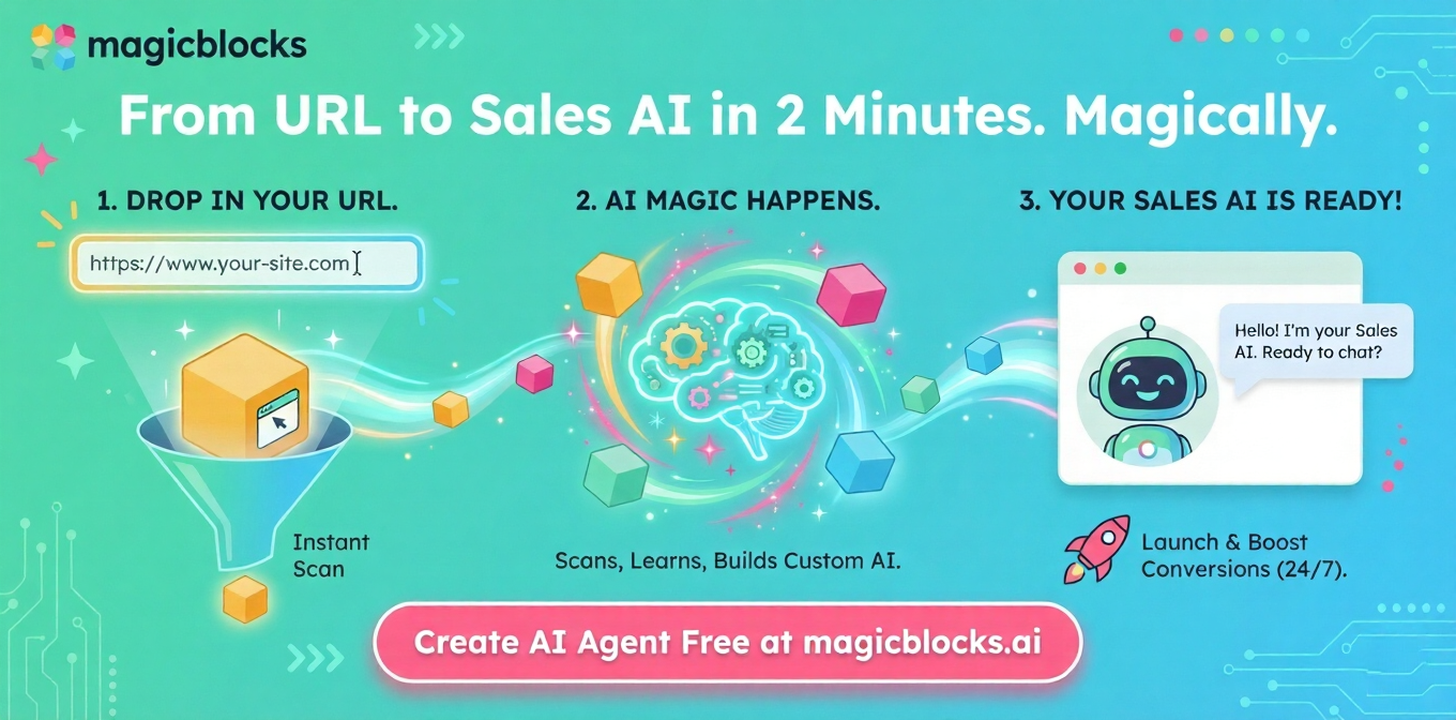
Drop in your website URL. MagicBlocks analyzes your offers, extracts your value propositions, understands your market positioning, and generates a fully functional sales agent.
Not a demo. Not a prototype. A live agent that can start having real sales conversations immediately.
Want to test a new pitch angle? Spin up a variant agent. Want to target a different segment? Create a specialized agent for that audience. Want to A/B test messaging? Deploy multiple agent personas and see which one converts.
What used to take a dev team weeks now takes a Revenue Automation Specialist minutes.
One company launched agents for three different product lines in a single afternoon. By end of the week, they knew which messaging worked best because they had real conversation data from hundreds of interactions.
Relationship Memory: The Superpower That Changes Everything
This is where it gets wild.
MagicBlocks agents don’t just remember what happened in the current chat session. They remember everything across every channel over unlimited time.
A lead fills out a form on your site Monday morning. The agent reaches out via SMS that afternoon. They chat for a few messages, then the lead gets busy and disappears. Wednesday, they respond to a follow-up email. Friday, they engage on Instagram.
Through all of this, the agent remembers: what they’re interested in, what objections they’ve raised, what questions they’ve asked, what content they’ve viewed, what their timeline looks like.
When they come back two weeks later, the conversation picks up exactly where it left off. “Hey Marcus, you mentioned you needed to talk to your co-founder about the enterprise plan. How’d that conversation go?”
No “How can I help you today?” No starting from scratch. Just a continuation.
Legacy tools lose context the moment someone closes a tab. MagicBlocks agents build relationships over time, just like your best human reps do.
The Revenue Automation Specialist can see the entire relationship history for every single lead and customer. They can spot patterns, what objections come up most, what timing works best, what messages drive action. Then they can tune the agents to handle those patterns even better.
Playbook Intelligence: HAPPA Persuasion Built In
Most AI tools generate responses on the fly with no real sales methodology. They sound conversational but they don’t actually know how to sell.
MagicBlocks agents are built on HAPPA, a proven sales framework derived from decades of hands-on experience and over $200M in lead generation:
Hook: Grab attention with something relevant, not generic
Align: Understand what they actually need and qualify them properly
Personalize: Tailor the pitch based on their specific situation and history
Pitch: Make a compelling case that addresses their context
Action: Drive toward a clear next step that moves the deal forward
This isn’t prompt engineering guesswork. It’s behavioral science-driven selling, automated.
The Revenue Automation Specialist doesn’t have to be a sales expert or a prompt engineer. The methodology is already baked into the platform. They just configure which playbooks to use for which segments and situations.
One company saw qualified leads increase 6× after switching from a generic chatbot to MagicBlocks agents running HAPPA. Same traffic. Same offer. The difference was agents that actually knew how to sell.
Dynamic Journeys: Agents That Think, Not Just React
Here’s what separates autonomous agents from glorified chatbots:
Chatbots follow scripts. Agents make decisions.
MagicBlocks agents use dynamic journey engines that choose the next best commercial move based on where the customer is, what’s happened, and what the goal is.
Someone browsing pricing but hasn’t engaged yet? The agent might proactively reach out with a relevant case study.
Someone who raised a pricing objection three days ago and just came back to the site? The agent might offer a ROI calculator or a comparison with competitors.
Someone who’s viewed the demo video twice but hasn’t booked a call? The agent might offer a personalized walkthrough or answer technical questions.
The agent decides. The Revenue Automation Specialist sets the goals, guardrails, and priority logic — then the agents execute autonomously.
No giant workflow canvas to maintain. No brittle if-then trees that break when someone says something unexpected. Just intelligent agents that adapt to every situation.
Omnichannel Continuity: One Agent, Every Channel
Finally, MagicBlocks agents aren’t trapped in a widget on your website.
They work across web chat, SMS, and email with one persistent identity and perfect context continuity.
Your customer starts a conversation on your site, continues via text, follows up through email, and engages on social. To them, it’s one continuous conversation with the same knowledgeable rep. Behind the scenes, it’s a MagicBlocks agent orchestrating seamlessly across channels.
The Revenue Automation Specialist can see the entire omnichannel journey in one dashboard. They can spot where conversations drop off, which channels drive best engagement, which hand-offs need optimization.
Then they can tune the strategy: “Leads from this campaign convert better when we follow up via SMS within an hour. Leads from organic search prefer email. High-value leads need a phone call if they haven’t responded in three days.”
The agents execute the strategy automatically, at scale, across thousands of simultaneous conversations.
FAQ
**Will AI replace SDRs?**Not if companies shift reps into higher-value, human-only tasks. AI handles follow-up; humans handle nuance.
**Do you need technical skills?**No. MagicBlocks is built for non-engineers. You need sales instincts and curiosity more than code.
**How fast can a company see ROI?**When follow-up is instant and relentless, you see lift in days.
**Who hires Revenue Automation Specialists?**Agencies, DTC, SaaS, real estate, mortgage, home services, anyone sitting on a gold mine of unworked leads.
Want to see this in action?
See a demoRead the playbook. Now see it run.
Watch a 4-minute demo. No sales pitch. Then decide if you want to talk.