

Voiceflow vs MagicBlocks: Which Is Best for 2026?
You had a thought that shook the foundation of conversational AI: What if the best conversation design platform isn't a design platform at all?
Discover the best AI platform for your business in 2026 with our in-depth comparison of Voiceflow and MagicBlocks, focusing on conversation design versus automated revenue capture.
On this page7
You had a thought that shook the foundation of conversational AI: What if the best conversation design platform isn’t a design platform at all?
Voiceflow is the undisputed champion for visual conversation design, prototyping, and building complex support flows. It’s what you use when you want to build a chatbot or design an advanced AI assistant from the ground up, block by block.
But for agencies and builders focused purely on revenue and sales execution, Voiceflow’s meticulous, flow-building process is actually a massive liability.
That’s why MagicBlocks is creating a new category: The Automated Revenue Capture Engine. It’s not about design; it’s about instant, scalable sales performance with the persistent memory and sales DNA Voiceflow was never built for.
The comparison isn’t about which tool is better for conversational AI, it’s about choosing which tool is right for your business objective in 2026.
What we’ll cover:
- Core Difference: Conversation Design vs. Revenue Capture
- Setup Speed & Implementation: Build vs. Auto-Generate
- Sales Intelligence & Conversation Performance
- Multi-Channel & Memory Architecture
- Technical Architecture & Developer Control
- Pricing, ROI & Operational Efficiency
- Limitations and Use Cases
Core Difference: Conversation Design vs. Revenue Capture
Voiceflow and MagicBlocks occupy fundamentally different categories, which completely changes the outcomes for your clients and your team.
Category Definitions: What Each Platform Is
- Voiceflow is a Conversation design, prototyping, and workflow builder for teams. It’s a low-code AI platform that provides the visual canvas to design, test, and ship AI agents faster, ensuring every interaction is grounded in a canonical source of truth.
- MagicBlocks is an Autonomous Relationship Sales Platform and Automated Revenue Capture Engine engineered specifically for selling, not customer support or prototyping. It’s built to “turn website visitors and leads into paying customers” with 24/7 multi-channel sales execution.
What Each Platform Is Not
- Voiceflow is not built on sales psychology, and it doesn’t include a native sales methodology. The ROI depends entirely on the designer’s skill.
- MagicBlocks is explicitly not a traditional chatbot builder. It positions itself as “AI sales execution, not just RAG” (Retrieval-Augmented Generation).
| Platform Category | Primary Outcome | Core Value for Agencies |
| Voiceflow | Custom conversational flow, prototyping, and customer support automation. | Deep customization for enterprise support contracts. |
| MagicBlocks | Instant, quantifiable revenue capture and conversion. | Speed-to-revenue and scalable client performance. |
Setup Speed & Implementation: Build vs. Auto-Generate
For agencies and builders (including those specializing in NAD and CRM expertise), time-to-value is the key metric. The cost of manual effort severely impacts the pricing tiers you can offer clients.
MagicBlocks
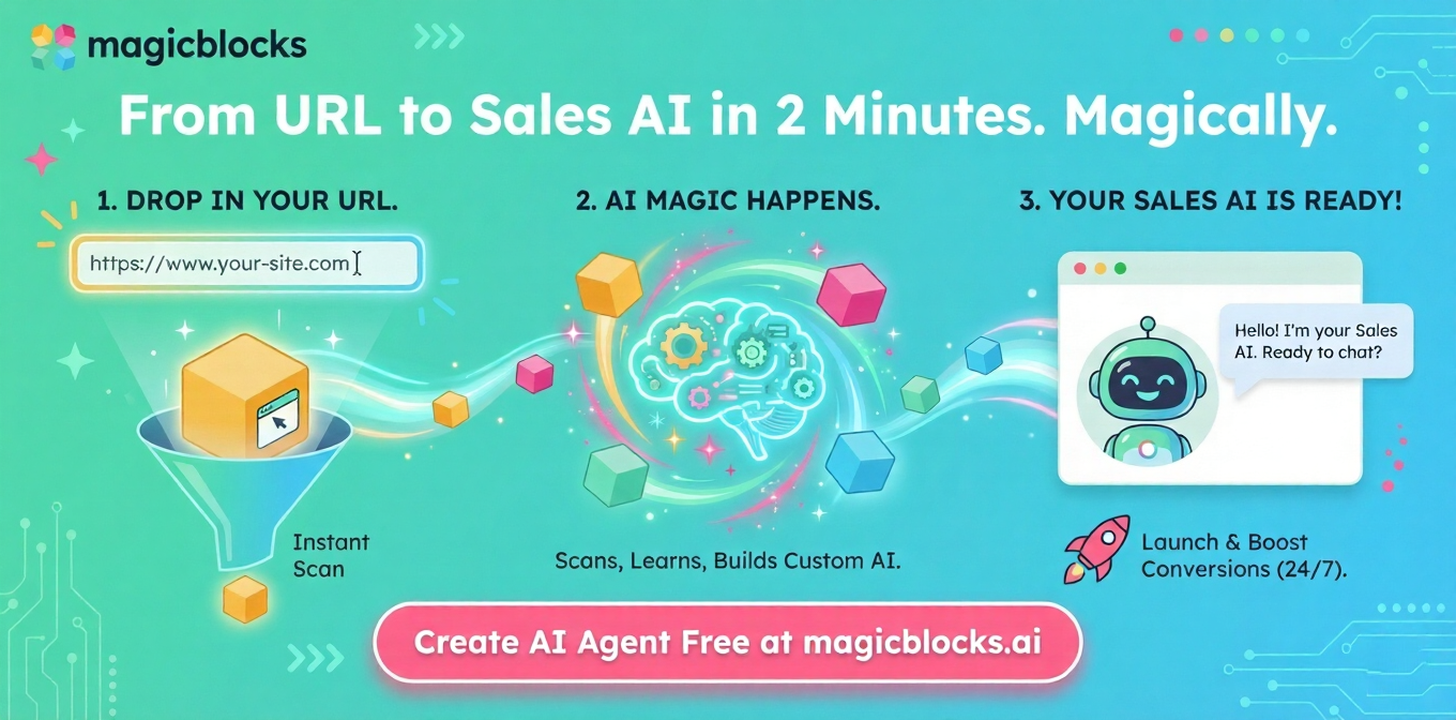
MagicBlocks is moving aggressively toward the “AI that builds AI” trend, allowing for workflow-free, no-code setup. The process for agencies is revolutionary:
- Drop URL: You simply provide the client’s website URL.
- Auto-Build: The platform automatically scans the site to learn the offer, brand voice, and social proof.
- Deploy: It launches a fully functional, personalized AI sales agent in about two minutes.
This shift eliminates the need for complex, manual drag-and-drop builders. You get an AI-powered sales force ready to deploy instantly.
Voiceflow
Getting a conversational agent live using Voiceflow requires significant conversation design expertise. You must:
- Design Flows: Manually design conversation flows, including the happy path and all error handling.
- Knowledge Base: Explicitly define the knowledge base tab and upload data, as traditional ai chatbots rely on RAG (Retrieval-Augmented Generation) to answer customer queries.
- Build Logic: Construct the multi-step workflows using the drag-and-drop canvas, logic blocks, and API calls.
Systems that auto-build hyper-personalized agents from a single URL will outperform platforms requiring manual design. MagicBlocks’ no-code, workflow-free strategy aligns strongly with the demand for Unmatched Speed to Value. You don’t have to spend days using Voiceflow to design a flow when the AI can generate the sales playbook for you.
Sales Intelligence & Conversation Performance
The market is flooded with AI tools that can answer a query, but few can actually close a deal. The core difference here is Sales DNA.
MagicBlocks Sales DNA (HAPPA Framework)
MagicBlocks agents are not generic AI; they are purpose-built as an AI assistant designed to sell. They execute structured sales playbooks using the proprietary H.A.P.P.A. Framework (Hook, Align, Personalize, Pitch, Action).
- Persuasion Built-in: This behavioral sales methodology is codified from over $200 million in lead-gen experience.
- Deep Engagement: MagicBlocks agents engage in an average of 8+ intelligent messages per chat, far deeper than typical industry exchanges of 2–3.
- Emotionally Intelligent: Crafted by behavioral scientists, the custom AI agent adjusts its tone and pace to handle objections and build trust, delivering empathetic conversations.
This structured approach provides persuasive, objection-handling, and emotionally intelligent conversations, making it an ideal conversational agent for high-intent sales funnels.
Voiceflow Conversation Design
Voiceflow’s foundation is neutral design. You can build a chatbot with complex dialog mapping, but persuasion, objection handling, and sales intent must be manually encoded by the user.
- Focus on Structure: Voiceflow excels at building the architecture for customer support AI agents, which is perfect for structured dialogs and enterprise workflow integrations.
- Manual Sales Logic: The platform requires you to leverage LLMs like GPT or Claude, but the quality of the sales outcome depends entirely on the designer’s prompt engineering skill, as there is no built-in sales methodology.
Outcome Comparison: MagicBlocks is purpose-built to get 10x more conversations and 6x conversions, specializing in lead qualification and speed to sell. Voiceflow is best for designing sophisticated architecture for repetitive tasks and support AI.
Multi-Channel & Memory Architecture
The modern customer journey moves fluidly across multiple channels. An AI system that can’t maintain real-time context across these channels is a broken system.
MagicBlocks CDP + Unified Conversation Flow
MagicBlocks includes a Native Customer Data Platform (CDP) that enables persistent memory. It stores “free-form memories and structured facts” from every interaction across web chat, SMS, email, and social DMs.
- Seamless Handoff: The AI agent literally picks up conversations exactly where they left off, ensuring a seamless handoff and true multi-channel orchestration. A prospect can start on the website and continue the conversation later via WhatsApp or text without the ai assistant ever losing context.
- Context-Aware Selling: This architecture enables context-aware selling, allowing the conversational agent to reference prior inputs, customer preferences, or past behavior for hyper-personalized engagement.
Voiceflow Memory + Integrations
Voiceflow uses variable storage and supports API integrations. It is not a persistent CDP.
- Integration Burden: Creating cross-channel continuity—for example, bridging a web chat to a facebook messenger sequence—requires custom logic and integration work using services like Zapier to store and recall external data.
- Low Concurrent Calls: Voiceflow’s pricing plans are often limited by low concurrent voice calls, which can be a major bottleneck for high-volume sales or voice interaction use cases.
What makes 2026 Trend Fit? Persistent, unified customer memory is a non-negotiable requirement for high-impact lifecycle automation. MagicBlocks’ CDP-native architecture is strategically positioned ahead of design platforms like Voiceflow that rely on bolted-on integrations for memory.
Technical Architecture & Developer Control
For developers, agencies, and CRM experts, control over the core logic is everything.
MagicBlocks: Multi-Prompt, Compliance, and Speed
MagicBlocks is an automation platform built for performance. Its unique architecture uses multi-prompt logic to manage conversations. This allows separate ‘Blocks’ for Greeting, Qualification, Pitch, and Close, ensuring that if one part of the flow needs refining, you only test that specific natural language module.
- Ultra-Low Latency: Agents are deployed on the edge via Cloudflare Workers for real-time responses in milliseconds, satisfying the modern buyer’s demand for instant gratification.
- Compliance: The Guardian Engine provides native guardrails to enforce brand tone and ensure regulatory compliance—a critical feature for industries like finance.
- CRM Handoff: It offers seamless lead handover and direct appointment scheduling with HubSpot, GoHighLevel, Calendly, and Google Calendar.
Voiceflow: The Visual Developer’s Tool
Voiceflow’s strength is providing a visual UI for complex logic. Developers can add API calls, run custom JavaScript blocks, and extend functionality with custom nodes.
- Prototyping Focus: It is powerful for prototyping research for LLM workflows. However, for high-volume voice interaction (like true voice agents), the latency and limited testing capabilities make it unsuitable for serious full deployment.
- Enterprise Features: Voiceflow offers enterprise features like SSO and private cloud hosting on its highest pricing plans, which is essential for AI for large organizations handling sensitive data.
Pricing, ROI & Operational Efficiency
The bottom line is whether the platform helps you convert customers and boost sales without disproportionately scaling cost.
MagicBlocks ROI Proof
MagicBlocks is committed to quantifiable ROI. Its design philosophy is: Deliver done-for-you sales performance to automate customer engagement and sales.
- Case Study Proof: The Beeline case study showed a 6x increase in qualified leads and a 737% increase in completed applications.
- Unmatched Conversion Rates: MagicBlocks agents achieve 10x conversations and 6x conversions, targeting a 10–20X ROI minimum.
- Zero Repetitive Tasks: The AI assistant handles repetitive tasks like initial chat and lead qualification, ensuring human reps focus only on hot, qualified conversations.
Voiceflow Operational Cost
Voiceflow’s cost structure is more complex, primarily using a credit system per action, which can lead to unpredictable costs for high-volume use cases.
- Cost Barrier: The price is tiered based on ‘editor seats’ ($60–$150 per editor per month) plus usage credits, making it expensive for larger, collaborative teams.
- Internal Cost: ROI depends entirely on internal build quality. The platform essentially trades a monetary subscription cost for a high investment in designer/engineer cycles.
Limitations and Use Cases
Choosing the right AI platform means understanding where each tool’s core strength lies.
| Platform | Strengths (Ideal Use Cases) | Weaknesses (Who Should Avoid) |
| MagicBlocks | High-intent sales funnels, SMS reactivation, revenue recovery, and abandoned funnel rescue. Agencies needing revenue impact fast. | Deep enterprise supports automation, complex prototyping that requires full visual custom flow control. |
| Voiceflow | Enterprises designing custom AI assistants, omnichannel support agents, and prototyping LLM workflows. | Teams prioritizing conversion performance, those requiring minimal build effort, and businesses with tight budgets for unpredictable pricing tiers. |
MagicBlocksis essentially a pre-configured sales expert that agencies can white label and embed with a single line of code. Voiceflow is a powerful, flexible large language model integration tool where you, the builder, must become the sales expert.
This is the shift from building technology to purchasing an automated, scalable sales outcome. The revenue you need is already in your funnel; the question is whether you want to dedicate design resources to build a chatbot or instantly deploy an AI that can followup, close, and manage multilingual conversations right out of the box.
Start building your free agent and see how the multi-prompt architecture and HAPPA framework work to capture revenue right now.
Want to see this in action?
See a demoRead the playbook. Now see it run.
Watch a 4-minute demo. No sales pitch. Then decide if you want to talk.