

What Is an AI Sales Agent? The Definitive Guide to Lead Conversion Engines
An AI sales agent is an autonomous system that engages, qualifies, follows up, and reactivates leads through conversational interactions, without human intervention.
Discover the transformative power of true AI Sales Agents in driving revenue through proactive engagement and omnichannel orchestration, far beyond traditional chatbots.
On this page16
- TL;DR
- What You’ll Learn
- What Is an AI Sales Agent?
- Why AI Sales Agents Matter for Lead Conversion
- How AI Sales Agents Work to Increase Conversion Rates
- The Sales Methodology Behind It: The HAPPA Framework
- Key Components of a Production-Grade AI Sales Agent
- Real-World Results: What Happens When You Deploy One
- How AI Sales Agents Are Different from Chatbots
- AI Sales Agent vs. Human Sales Representative
- How to Build or Deploy an AI Sales Agent
- Compliance and Trust: What Enterprise Deployment Requires
- AI Sales Agent vs. Alternatives
- Who AI Sales Agents Are Actually Built For
- Frequently Asked Questions
- Your Pipeline Is Leaking. Let’s Fix It.
TL;DR
An AI sales agent is an autonomous system that engages, qualifies, follows up, and reactivates leads through conversational interactions, without human intervention. The best ones respond in under five seconds, maintain persistent memory across every channel, and run a proven sales methodology behind every message. They don’t just chat. They convert.
What You’ll Learn
- What an AI sales agent actually is, and what separates good ones from chatbots dressed up in a suit
- The four jobs every AI sales agent needs to do (and the four leaks it closes)
- The sales methodology running behind the best-performing agents: the HAPPA framework
- Real-world proof: what happened when Beeline deployed one
- How to deploy one, what compliance looks like, and who it’s actually built for
What Is an AI Sales Agent?
Most companies are losing valuable leads. They pay $30 to $80 to acquire each one, then lose most of them to slow response times, inconsistent follow-up, and SDR teams that can’t physically keep up with demand. The leads don’t disappear. They just go cold while your team is busy elsewhere.
An AI sales agent is the fix. It’s an autonomous or semi-autonomous software system that engages leads the moment they show interest, qualifies them through conversational discovery, follows up persistently across weeks or months, and reactivates the ones who went quiet. All of it happens without a human having to do anything until the lead is ready to talk.
The important distinction: we’re not talking about a chatbot. Chatbots handle one-off queries and forget everything the moment the session ends.
An AI sales agent maintains a relationship: persistent memory, multi-channel continuity, and a structured sales methodology embedded at the architecture level. To understand how AI sales agents actually work under the hood, read our deep-dive on how AI sales agents actually work, or see MagicBlocks in action to see the category in practice.
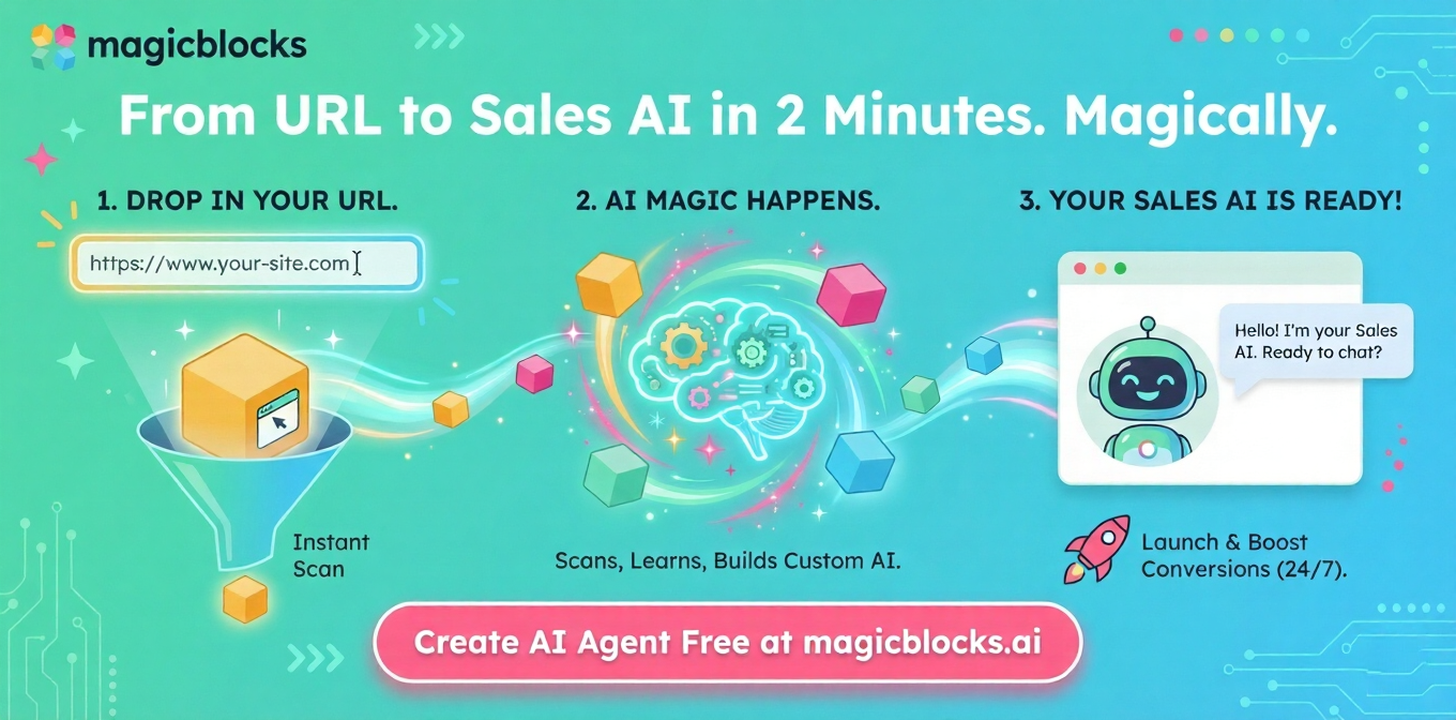
MagicBlocks is an AI sales agent, not a chatbot. It’s a lead conversion engine purpose-built to eliminate lead decay and lead leakage across time, built for teams of all sizes, including enterprise. It sits between your lead sources and your sales team, working every lead 24/7.
Why AI Sales Agents Matter for Lead Conversion
The Four Leaks Killing Your Pipeline
Here’s what’s actually happening across most high-ticket sales operations, regardless of how good the product is or how big the ad budget is:
- Leak 1: Slow first response. Contact rates drop 80% after five minutes. After 30 minutes, you’re essentially cold-calling someone who came to you warm.
- Leak 2: Inconsistent qualification. Some reps ask the right questions. Some don’t. Some days the team is great; other days they’re slammed and leads get rushed through.
- Leak 3: Follow-up that stops. The average sales rep makes two to three contact attempts before giving up. Most qualified leads need five to eight.
- Leak 4: Aged leads collecting dust. Every database has thousands of leads that went cold, often worth a significant percentage of total pipeline value, sitting untouched.
AI sales agents are built specifically to close these leaks. Response happens instantly, qualification is structured and consistent, follow-up runs indefinitely, and reactivation campaigns can mine aged lead databases at scale.
McKinsey research confirms the scale of the opportunity. AI-powered marketing and sales applications are generating some of the highest value across the enterprise, and agents built specifically for growth are where the most measurable impact is landing. The gap between companies that have deployed AI in their sales funnel and those that haven’t is widening every quarter.
How AI Sales Agents Work to Increase Conversion Rates
There’s a lot of marketing noise around “AI agents” right now. Most of it overpromises and underdelivers. So let’s be concrete about the mechanics: what’s actually happening inside a production-grade AI sales agent.
Step 1: Instant Lead Engagement
The moment a lead submits (from a website form, a marketplace listing, a paid social ad, anywhere) the agent fires a real, context-aware opening message. Not a template acknowledgment. An actual conversation starter that references what the lead just did.
MagicBlocks runs on edge compute across 3,000+ global servers. That’s why it can respond in under five seconds every time, regardless of volume. At 3 AM on a Sunday. During a campaign spike. At scale.
Curious about the mechanics of that five-second window? Read: engage every inbound lead in under five seconds.
Step 2: Conversational Lead Qualification
This is where most chatbots fall apart. Static qualification flows are brittle: a lead says something unexpected and the bot breaks the conversation or repeats itself.
A true AI sales agent conducts dynamic discovery. It listens to what the lead says, adapts its questions accordingly, and builds a qualification profile across the conversation.
The underlying frameworks it uses, BANT, MEDDIC, or a custom vertical-specific methodology, run beneath the surface. The lead just feels like they’re having a helpful conversation.
For a concrete example: automated lead qualification for home buyers shows exactly how this works at the vertical level.
Step 3: Product Knowledge Retrieval
AI sales agents use Retrieval-Augmented Generation (RAG) to pull accurate, up-to-date answers from your product documentation, pricing pages, and knowledge bases. This means the agent can handle detailed product inquiries, handle objections with specifics, and stay accurate, without hallucinating answers it doesn’t have.
MagicBlocks separates this into two distinct layers: the Brain (the knowledge the agent can draw on) and Jobs to Do (the task instructions that govern what the agent actually does with that knowledge at each stage of the conversation). Most AI sales tools conflate these, and that’s why they underperform in production.
Step 4: Follow-Up Without Dropping Anyone
Humans burn out. AI doesn’t. An AI sales agent runs persistent follow-up across weeks or months without losing steam. It remembers what the lead said in conversation three, references it in conversation seven, and adjusts timing based on behavioral signals.
This is the Memory Engine at work. For a deeper read on why this changes everything: persistent follow-up without dropping anyone.
Step 5: Reactivation of Aged Leads
Every lead database has a graveyard: leads that opted in, started a conversation, then went quiet. Most teams write these off. AI sales agents can systematically reactivate them via targeted SMS campaigns with context-aware messaging.
See how this works in practice: reactivate aged leads via SMS.
Step 6: Routing and Conversion Actions
Once a lead clears the qualification threshold, the agent takes action: books a meeting, routes to a human rep, triggers a CRM workflow, or sends a targeted follow-up sequence. The handoff to a human happens at the exact right moment, not too early (wastes rep time), not too late (lead goes cold).
MagicBlocks integrates directly with Calendly so it can book meetings directly from the conversation without any human touch.
The Sales Methodology Behind It: The HAPPA Framework
Most AI sales tools generate plausible-sounding text. They have no underlying sales logic: no judgment about when to push, when to pull back, when to pivot. They sound human, but they don’t sell like one.
MagicBlocks runs on the HAPPA framework, a five-stage sales methodology distilled from $200M+ in lead generation across dozens of verticals and grounded in behavioral science. Here’s what each stage does:
- Hook: Open the conversation with a message calibrated to the lead’s context and intent, not a generic greeting.
- Align: Establish shared understanding of the lead’s situation, goals, and timeline.
- Personalise: Tailor the pitch to what actually matters to this lead, based on what they’ve said.
- Pitch: Present the solution in terms of the lead’s specific problem, not a feature list.
- Action: Create forward momentum. Always close on a next step, never just an open door.
HAPPA isn’t a script. It’s decision logic, encoded into the architecture of every conversation so the agent knows not just what to say, but when and why. Building this required decades of hands-on selling and $200M+ in real production experience. You can’t prompt-engineer it. You can’t copy it by reading a website.
To understand why methodology matters so much in practice: why your AI agent needs a sales playbook. And for GoHighLevel agency owners looking for a practical implementation: AI sales playbook for HighLevel agencies.
McKinsey’s work on B2B sales leaders winning with tech and AI underscores the same point: technology without a sales process doesn’t convert. The companies that see the biggest lift are the ones that encode proven methodology into their AI systems, not just deploy a chatbot and hope.
Key Components of a Production-Grade AI Sales Agent
Not all AI sales agents are built the same. Here’s what separates the ones that work in production from the ones that work in demos:
Relationship Memory (CDP-Native)
The agent remembers every conversation, across every channel, and carries that context forward. A lead who texted three weeks ago and just clicked an email gets a message that references both. This is CDP-native, persistent memory, not session-level short-term recall.
Dynamic Journey Engine
A real-time next-best-action engine computes what to do next based on relationship state, lead behavior, lifecycle position, and outcome history. You set the destination. The engine figures out the route. You don’t draw flowcharts; you define goals and guardrails.
Guardian Engine (Compliance Layer)
Every outbound message is scanned for compliance before it sends: TCPA/DNC rules, quiet hours, opt-out requirements, brand voice, custom business rules. If it breaks a rule, the Guardian Engine rewrites it automatically. This is what makes enterprise deployment possible in regulated verticals like mortgage and insurance.
Deep-dive on keeping agents accurate and trustworthy: how to keep your AI agent accurate and compliant.
Multi-Prompt Architecture
Monolithic AI prompts (where one massive prompt tries to handle everything) collapse under real-world pressure. MagicBlocks uses a multi-prompt, state-aware architecture where each stage of the conversation has its own instruction set. Task completion rates are 98% vs. 59% for single-prompt systems.
CRM and Stack Integration
The agent connects to Salesforce, HubSpot, GoHighLevel, Calendly, Twilio, AppointWise, and other GTM tools: creating leads, updating pipeline stages, logging conversations, and triggering automation workflows without manual handoffs.
Real-World Results: What Happens When You Deploy One
The Beeline Case Study
Beeline is a mortgage lender. Their co-founders, Jay Stockwell and Sean Clark, built Bob, an AI agent, to handle the gap between inbound lead volume and available loan officers. The results weren’t incremental. They were a category-defining proof point.
| Metric | Result |
| Increase in completed applications | 737% |
| Growth in qualified leads | 484% |
| Conversation-to-lead conversion rate | 48.72% |
| More completed applications vs. human-led chat | 8x |
| Monthly origination within six months | $30M |
Beeline CEO Nick Liuzza published these results in a NASDAQ shareholder letter, not a marketing case study. The numbers were real enough to put in front of investors.
Full context on the mortgage vertical: 737% increase in completed applications and AI sales agent in mortgage. Both show how the economics work at the vertical level.
McKinsey’s analysis of unlocking profitable B2B growth through gen AI identifies exactly this pattern: the highest-value AI applications in sales are the ones that sit closest to revenue, responding in real time to buying intent. That’s the Beeline playbook.
How AI Sales Agents Are Different from Chatbots
The chatbot category and the AI sales agent category are not adjacent. They’re different disciplines solving different problems.
A chatbot answers questions. It handles one-off queries, resolves support tickets, and provides information on demand. When the session ends, the slate is wiped clean. Next conversation starts from zero. There’s no sales logic, no persistent memory, no conversion intent.
An AI sales agent runs a relationship. It tracks the lead across every touchpoint, maintains persistent memory of every interaction, and applies a structured methodology designed to move the lead toward a commercial outcome. It knows what the lead said two weeks ago. It knows what they clicked. It knows when to push and when to hang back.
For a full breakdown of the architectural difference: what makes an AI agent human-quality. And if you’re evaluating specific tools in the chatbot-adjacent space: AI chatbot services built for sales.
AI Sales Agent vs. Human Sales Representative
The goal isn’t to replace human reps: it’s to give them the leads worth their time. Here’s how the two stack up across the dimensions that matter most:
| Capability | AI Sales Agent | Human SDR |
| Response speed | Under 5 seconds, every time | Minutes to hours (if at all) |
| Scalability | Unlimited simultaneous conversations | Limited by headcount and hours |
| Lead qualification | Structured, consistent, data-logged | Variable, depends on the rep |
| Follow-up cadence | Never drops a lead, runs indefinitely | Burns out, forgets, moves on |
| Cost per worked lead | $3–$4 per lead | $30–$80 per lead acquired |
| Relationship memory | Persistent, cross-channel, CDP-native | CRM-dependent, often incomplete |
| Compliance | Every message pre-checked (Guardian Engine) | Training-dependent, inconsistent |
| Closing complex deals | Hands off to human at right moment | High: relationship-driven |
Best hybrid model: AI handles engagement, qualification, and persistent follow-up. Human reps close the deals that need a real relationship. The AI ensures every lead gets worked. The rep ensures every close gets the human touch it deserves.
How to Build or Deploy an AI Sales Agent
Building a production-grade AI sales agent from scratch requires conversation design, qualification logic, multi-prompt architecture, compliance layers, CRM integration, and a proven sales methodology. That’s months of work; most teams never finish.
MagicBlocks is purpose-built to shortcut that process. It comes with the HAPPA framework pre-encoded, the Guardian Engine running compliance on every message, the Dynamic Journey Engine handling routing, and the Memory Engine maintaining relationship continuity. Expert-guided deployment gets you live in one to two weeks.
Start here: how to build an AI sales agent. For GoHighLevel agency owners specifically, the AI sales agents for GoHighLevel agencies guide covers the full stack integration.
Compliance and Trust: What Enterprise Deployment Requires
In regulated verticals, mortgage, insurance, fintech, compliance isn’t optional. One non-compliant message can trigger TCPA violations, GLBA exposure, or DNC complaints. Most AI sales tools punt on this. They let you configure compliance yourself, which means the risk is also yours.
MagicBlocks built compliance in at the architecture level. The Guardian Engine pre-checks every outbound message against TCPA, GLBA, SOC 2, ISO 27001, GDPR, quiet hours rules, opt-out requirements, and custom business guardrails. If a message breaks a rule, the Guardian Engine rewrites it before it sends. Every time. At scale.
For SMS specifically, the channel with the highest conversion rates and the most regulatory exposure, A2P 10DLC compliance is managed through customers’ own Twilio accounts, keeping the compliance footprint clean.
Full detail on accuracy and compliance architecture: how to keep your AI agent accurate and compliant. SMS-specific compliance: A2P compliance for SMS agents.
AI Sales Agent vs. Alternatives
Not every tool claiming the ‘AI sales agent’ label is one. Here’s how MagicBlocks compares to the alternatives most teams are already considering:
MagicBlocks vs. Chatbase: Chatbase is a knowledge-base chatbot. Strong at answering questions. Zero sales methodology, no persistent memory, no conversion logic.
MagicBlocks vs. GoHighLevel AI Agent: GHL’s AI is a workflow automation layer with a chat widget. Useful for simple qualification flows. Falls apart under edge cases and complex multi-touch journeys.
MagicBlocks vs. Voiceflow: Voiceflow is a conversation design tool, a builder platform for agencies. Flexible for custom flows. But you’re building the sales logic from scratch, which means you’re also absorbing all the risk of getting it wrong.
Who AI Sales Agents Are Actually Built For
AI sales agents aren’t for everyone. They’re for operators who are measured on conversion outcomes and who understand that the biggest untapped revenue source in their business is often the leads they’re already generating but not fully working.
The highest-fit use cases: mortgage and financial services (expensive leads, multi-touch cycles, heavy compliance requirements), insurance, solar, auto, home services, GoHighLevel agency owners managing multiple client campaigns, PLG SaaS with high signup volume but weak activation, and any high-AOV ecommerce with real repeat potential.
The sales function is evolving. Read about the emerging role of AI Revenue Automation Specialist to understand how forward-looking teams are restructuring around AI sales agents, and what that means for hiring, ops, and quota.
Frequently Asked Questions
Q: What is an AI sales agent and how does it increase lead conversion?
An AI sales agent engages prospects the instant they show interest, asks structured qualification questions, and guides them toward a booked meeting or purchase. Speed is the core mechanism: contact rates drop 80% after five minutes. When the AI responds in under five seconds instead of eight to twelve minutes, conversion rates shift dramatically.
Q: How do AI sales agents differ from traditional chatbots?
Chatbots follow fixed scripts and forget everything between sessions. AI sales agents maintain persistent relationship memory across channels, personalize responses based on prior interactions, apply structured sales methodology (like HAPPA), and integrate with your CRM to trigger workflows. The gap isn’t incremental: it’s architectural.
Q: Can AI sales agents handle objection handling?
Yes. Agents built on knowledge bases and product documentation answer common objections in real time. The MagicBlocks Guardian Engine also pre-checks every response for accuracy and compliance before it sends, so the agent doesn’t just sound good; it stays on-brand and on-script.
Q: What’s the ROI of deploying an AI sales agent?
Beeline deployed MagicBlocks’ AI agent and achieved a 737% increase in completed applications, 484% growth in qualified leads, and a 48.72% conversation-to-lead conversion rate, reaching $30M in monthly mortgage origination within six months. The math is direct: leads cost $30–$80 to acquire. The AI works each one for $3–$4.
Q: What industries see the strongest results?
Mortgage, insurance, solar, auto, home services, PLG SaaS, real estate, and high-AOV ecommerce. Any vertical with expensive leads, multi-touch sales cycles, and an SDR bottleneck is a natural fit.
Q: What are the current limitations?
Complex negotiations, highly nuanced enterprise deals, and situations that require deep emotional rapport still benefit from a human closer. The best-performing setup is a hybrid: AI handles engagement, qualification, and follow-up, then routes high-intent leads to a human rep at the optimal moment.
Q: How does an AI sales agent integrate with Salesforce or HubSpot?
Through APIs: creating leads, updating contact records, logging conversations, and triggering automation workflows. MagicBlocks also integrates with GoHighLevel, Calendly, Twilio, and other tools in the GTM stack.
Your Pipeline Is Leaking. Let’s Fix It.
Every day your inbound leads wait more than five minutes for a response, you’re handing revenue to whoever gets there first. Every time follow-up stops at attempt two or three, you’re leaving pipeline on the table. Every aged lead sitting in your database untouched is money your team already paid for.
MagicBlocks closes all four leaks. The HAPPA framework runs the sales logic. The Guardian Engine handles compliance. The Dynamic Journey Engine computes the next best action in real time. The Memory Engine makes sure no lead gets dropped.
The Beeline team proved what this looks like at scale: 737% more completed applications, $30M in monthly origination, 48.72% conversation-to-lead conversion rate. That architecture is now deployable across any vertical, any lead source, any team size.
Create your AI Sales Agent with MagicBlocks and start converting the leads you’re already paying for.
Want to see this in action?
See a demoRead the playbook. Now see it run.
Watch a 4-minute demo. No sales pitch. Then decide if you want to talk.