

Why Enterprise Conversion Rates Plateau (And How AI Sales Agents Break the Ceiling)
The enterprise conversion ceiling isn't a talent problem. It's a systems problem. Here's the structural diagnosis and the architecture that breaks it.
Discover why enterprise conversion rates stagnate and how AI sales agents from MagicBlocks can break through structural friction to drive higher revenue.
On this page5
The enterprise conversion ceiling isn’t a talent problem. It’s a systems problem. Here’s the structural diagnosis and the architecture that breaks it.
Enterprise conversion rates plateau because of compounding structural friction, not talent gaps or market conditions.
Buying committees now average 13+ stakeholders, 40–60% of deals end in “no decision” rather than a competitor win, sales reps spend only 28% of their time actually selling, speed-to-lead times average 42 hours when the research says 5 minutes is the qualification threshold, and volume-first MQL strategies fill pipeline with leads that were never going to close.
AI sales agents break this ceiling by compressing speed-to-lead to seconds, qualifying consistently at scale using encoded ICP criteria, threading multiple stakeholders simultaneously, and re-engaging dormant CRM contacts before their intent disappears, all without the bandwidth limits, burnout, or inconsistency that make human-only scaling hit diminishing returns.
Hiring more SDRs scales cost linearly while structural friction compounds nonlinearly. The ceiling lifts when structure replaces manual chaos.
What You’ll Learn
- The structural causes behind enterprise B2B conversion flattening
- Internal funnel bottlenecks that stall deals before they close
- The psychological drivers of buyer fatigue and why they’re accelerating
- Why the “Leaky Bucket” syndrome keeps draining your marketing spend
- Why human SDR scaling hits diminishing returns (every time)
- How AI sales agents powered by MagicBlocks break the conversion ceiling
- AI agents vs. human SDRs: performance and ROI
- How to design AI sales systems that compound over time
- CRM integration patterns, KPI restructuring, and compliance frameworks
- The future of AI SDRs in 2025–2026
TL;DR
Enterprise conversion plateaus because:
- Buying committees have expanded to 13+ stakeholders and keep growing
- 40–60% of B2B deals end in “no decision,” not a competitor win
- Sales cycles lengthen, compounding buyer fatigue and status quo bias
- Reps spend roughly two-thirds of their time not selling
- Speed-to-lead decay destroys qualification probability in hours
- Volume-first MQL strategies generate pipeline that never converts
MagicBlocks breaks the ceiling by:
- Structuring AI sales agent deployment across the full funnel
- Mapping internal conversion bottlenecks before they become revenue leaks
- Designing multi-thread stakeholder workflows that don’t depend on rep memory
- Automating qualification and personalization at a scale humans can’t match
- Building escalation logic and human-in-the-loop controls that protect deal quality
- Enabling closed-loop performance optimization that compounds month over month
Most AI tools automate the conversation. MagicBlocks automates the outcome**.**
From the first touchpoint to closed revenue, every bottleneck mapped, every stakeholder thread covered, every follow-up fired at exactly the right moment. No rep memory required. No revenue left leaking.
See how MagicBlocks deploys across your full funnel
The key takeaway: Hiring more SDRs scales cost linearly while friction compounds nonlinearly. The ceiling lifts when structure replaces manual chaos.
Why Do Enterprise Conversion Rates Plateau?
Here’s a question most CROs don’t want to sit with: what if the problem isn’t the pipeline?
You’ve optimized the ads. You’ve A/B tested the landing pages. You’ve hired more SDRs, invested in sequencing tools, and rebuilt the CRM workflows. And still the conversion rate refuses to move. It’s stuck. Flat. Like it hit a wall.
It did hit a wall. And it’s structural.
Enterprise conversion rates plateau because of friction that compounds quietly, deal by deal, quarter by quarter, until one day the board is asking why pipeline keeps growing but revenue isn’t following.
The Structural Causes Behind Enterprise B2B Conversion Flattening
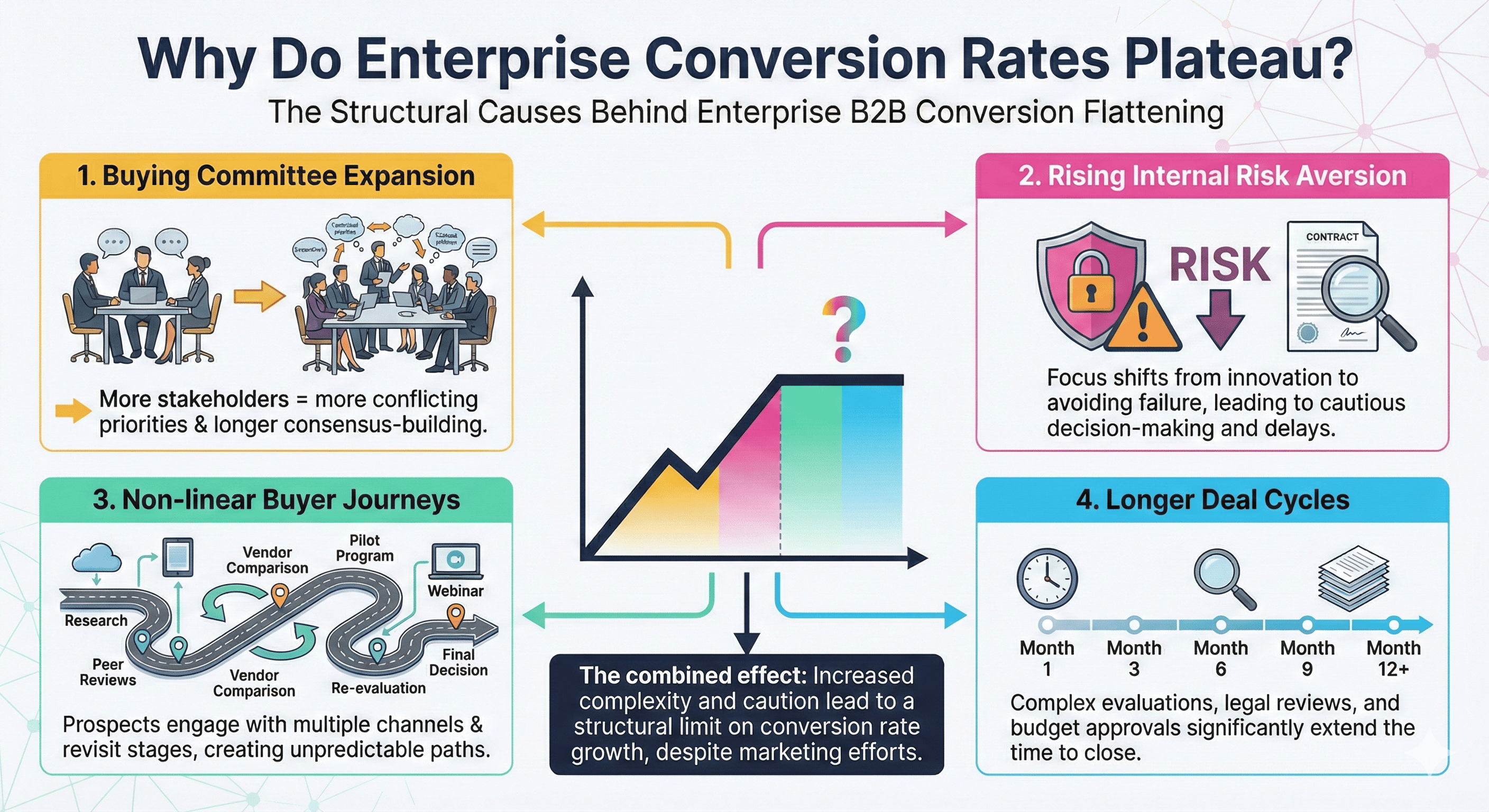
Buying committee expansion. Enterprise deals have always involved multiple stakeholders. What’s changed is the scale. Forrester’s State of Business Buying 2024 found that the average enterprise purchase now involves 13 internal stakeholders. Their 2026 update adds 9 external influencers on top of that. You’re not selling to a buyer. You’re selling to a committee that’s still forming.
Rising internal risk aversion. Gartner’s B2B Buying Journey research found that buyers spend only 17% of their purchase journey with suppliers. The other 83% happens internally: debating, second-guessing, building fragile consensus. When that consensus can’t hold, deals don’t close. Gartner found that 40–60% of B2B deals end in “no decision.” You’re not losing to a competitor. You’re losing to inertia.
Non-linear buyer journeys. McKinsey’s Customer Decision Journey research confirmed that the B2B purchase process is “anything but linear.” Buyers loop back. They re-evaluate criteria mid-cycle. They bring in new stakeholders after you’ve already closed the case. Their B2B Pulse survey of 21,000+ decision-makers found that customers now require 10+ interaction channels. Miss one touchpoint and the deal can quietly unravel.
Longer deal cycles. The longer a deal drags, the more opportunity there is for loss aversion to kick in. Status quo bias strengthens. Champions get promoted, change roles, or leave entirely. HBR’s research showed email response rates declined 30% over the period studied, and 68% of organizations missed sales targets.
Organizational silos. Sales-marketing disconnect, CRM data fragmentation, lead routing delays, and qualification inconsistency all contribute to stage duration creep, with deals moving slower through a pipeline that isn’t designed for the buying journey that actually exists.
What Metrics Signal an Approaching Plateau?
Watch for these five signals before the ceiling becomes obvious:
- Rising no-decision rate: deals aren’t losing to competitors; they’re just dying
- Stage duration creep: average time in each pipeline stage increasing quarter over quarter
- Declining speed-to-lead: response time from inquiry to first meaningful contact slipping
- Flat demo-to-close ratio: more demos, same number of closed deals
- Revenue per rep stagnation: headcount growing faster than revenue
If three or more of these are trending the wrong direction simultaneously, you’ve hit structural friction. Hiring won’t fix it.
Internal Bottlenecks That Stall Enterprise Deals
The friction isn’t always visible from the outside. Most of it lives inside the organization, in the gaps between systems, teams, and processes that nobody owns.
What Organizational Factors Cause Conversion Stalls?
Incentive misalignment. Marketing is optimized for MQL volume. Sales is optimized for closed revenue. When those metrics diverge, the handoff between them becomes a dead zone where leads go to decay.
Sales-marketing disconnect. HubSpot’s research found that only 5% of salespeople rate marketing leads as “very high quality.” That’s not a relationship problem. It’s a structural one. When qualification criteria aren’t shared, the leads that reach sales were never going to convert.
CRM data fragmentation. When lead data lives in disconnected systems like CRM, marketing automation, data warehouse, and call recordings, no rep has a full picture. Personalization degrades. Context disappears between touchpoints.
Lead routing delays. The moment between a lead’s first inquiry and their first real conversation is where intent lives. Every minute that passes, that intent cools. Lead routing delays caused by territory rules, shift schedules, rep availability, or manual assignment processes are silent conversion killers.
Qualification inconsistency. When qualification depends on individual reps, quality varies. The best reps qualify rigorously. The rest let deals advance that shouldn’t. When those deals stall at close, the whole funnel looks broken.
How RevOps Should Audit Lead Leakage
The starting point isn’t technology. It’s diagnosis. Before you can fix the ceiling, you need to know exactly where the floor is leaking.
MagicBlocks Funnel Decomposition Engine maps this systematically:
- Map each stage drop-off: identify precisely where leads are exiting the funnel and at what volume
- Identify structural friction: distinguish between lead quality issues and process failures
- Model the impact of faster engagement: what does a 30-second speed-to-lead improvement actually do to your close rate?
- Simulate AI intervention lift: before deploying anything, model where AI produces the highest marginal conversion impact
Instead of guessing where to fix the funnel, CROs can model it. That’s a different kind of confidence going into a board conversation.
Why Human SDR Scaling Hits Diminishing Returns
This is the uncomfortable arithmetic that most sales leaders have encountered but few talk about directly.
Why Traditional Outbound Eventually Plateaus
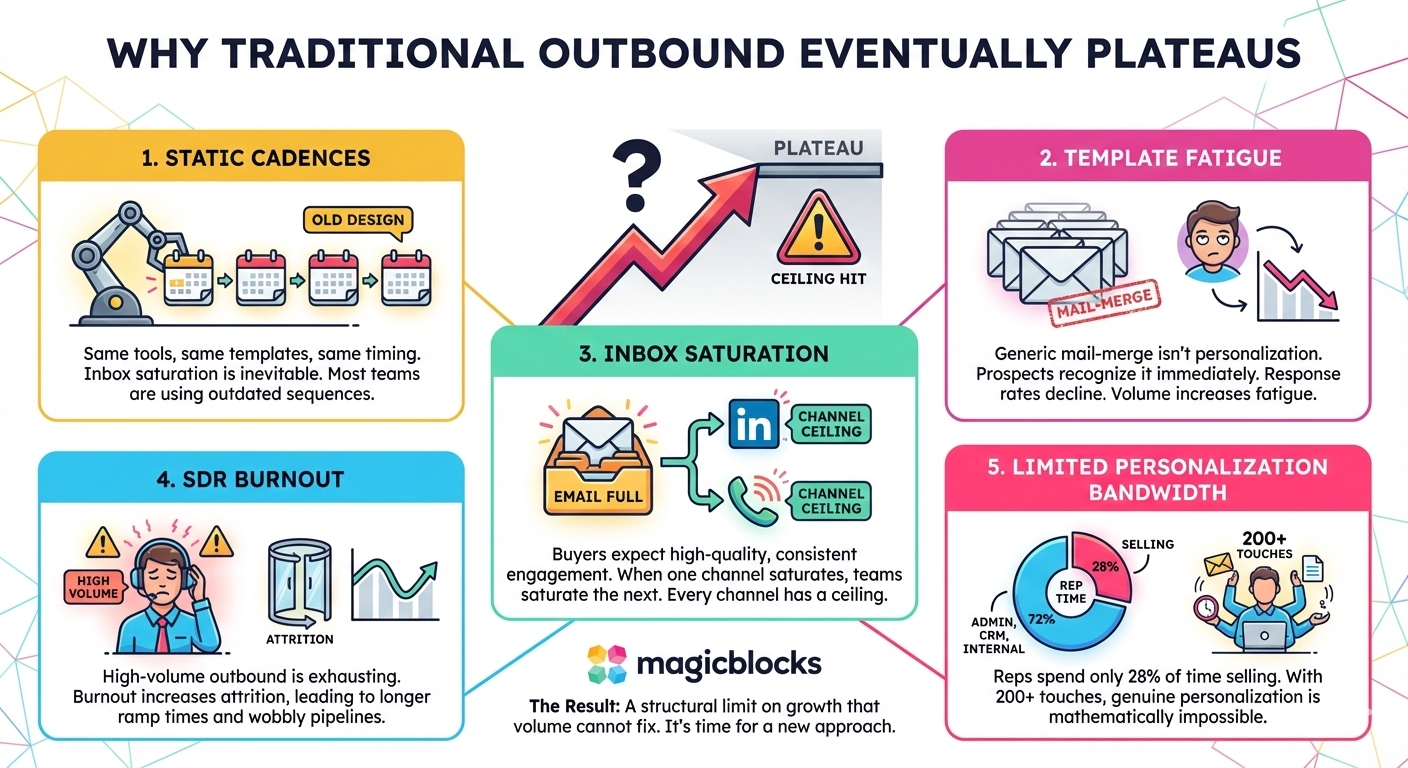
Static cadences. Most SDR teams are running sequences designed years ago. When everyone’s using the same tools, the same templates, and the same timing patterns, inbox saturation isn’t a question of if. It’s when.
Template fatigue. Personalization that’s actually just mail-merge isn’t personalization. Prospects recognize it immediately. Response rates decline. Teams push harder with higher volume, which accelerates the fatigue cycle.
Inbox saturation. McKinsey’s omnichannel research found that 80%+ of B2B buyers now say performance guarantees are critical and that they expect consistent, high-quality engagement across every channel they use. When email is saturated, teams pile into LinkedIn. When LinkedIn saturates, they try calling. Every channel hits its own ceiling.
SDR burnout. High-volume outbound is exhausting. Burnout increases attrition. Attrition means new reps, longer ramp times, and a pipeline that wobbles every quarter while experienced SDRs are replaced with inexperienced ones learning to do the same thing that was already plateauing.
Limited personalization bandwidth. Salesforce’s State of Sales 6th Edition found that reps spend only 28% of their time actually selling. The other 72% is admin, CRM updates, and internal coordination. When a rep is running 200+ active touches, genuine personalization is mathematically impossible.
Why Hiring More Reps Doesn’t Fix Structural Friction
McKinsey’s analysis of nearly 500 B2B companies found that top-quartile performers who offloaded 50% of non-selling tasks generated 20% more sales capacity and 2.5× the gross margin of their peers.
Manual scaling creates three compounding problems:
- Increases coordination complexity: more reps means more territory disputes, more handoff friction, more management overhead
- Increases management overhead: every new SDR requires ramp time, coaching, and supervision that pulls senior reps and managers away from revenue-generating activity
- Does not solve response-time decay: adding headcount doesn’t compress the 12-hour average B2B response time; it just distributes the same slow response across more people
MagicBlocks reframes scaling from headcount expansion to intelligence amplification. The question stops being “how many more reps do we need?” and starts being “how do we make the system smarter?”
Long Sales Cycles and Buyer Fatigue
Long deals don’t just waste time. They actively work against you, and the psychology behind this is well-documented.
Psychological Causes of Enterprise Buyer Fatigue
Status quo bias. The longer a decision takes, the more the default option, doing nothing or staying with the current vendor, gains psychological weight. Buyers aren’t irrational; they’re risk-averse. Prolonged indecision gives the status quo more time to feel “safe.”
Decision fatigue. Buying committees that have been evaluating options for months aren’t sharper. They’re depleted. Depleted decision-makers default to the safest, most familiar choice, which is almost never the new vendor they’ve been evaluating.
Loss aversion. The longer the cycle, the more a buyer has heard about what could go wrong with your solution. Gartner’s research via ComputerWeekly found that 74% of buying teams exhibit “unhealthy conflict” internally and that achieving consensus makes a deal 2.5× more likely to close with high quality. That consensus is harder to reach the longer the process runs.
Internal political friction. Champions retire. Budgets get reallocated. Reorganizations shift priorities. Every week a deal sits open is another week for the organizational landscape to shift beneath it.
How Prolonged Cycles Increase “No Decision” Outcomes
The CEB/Gartner Challenger Customer research documented this clearly: larger decision teams combined with longer cycles create a stronger pull toward the status quo. When no individual stakeholder feels confident enough to champion the change, the group defaults to inaction.
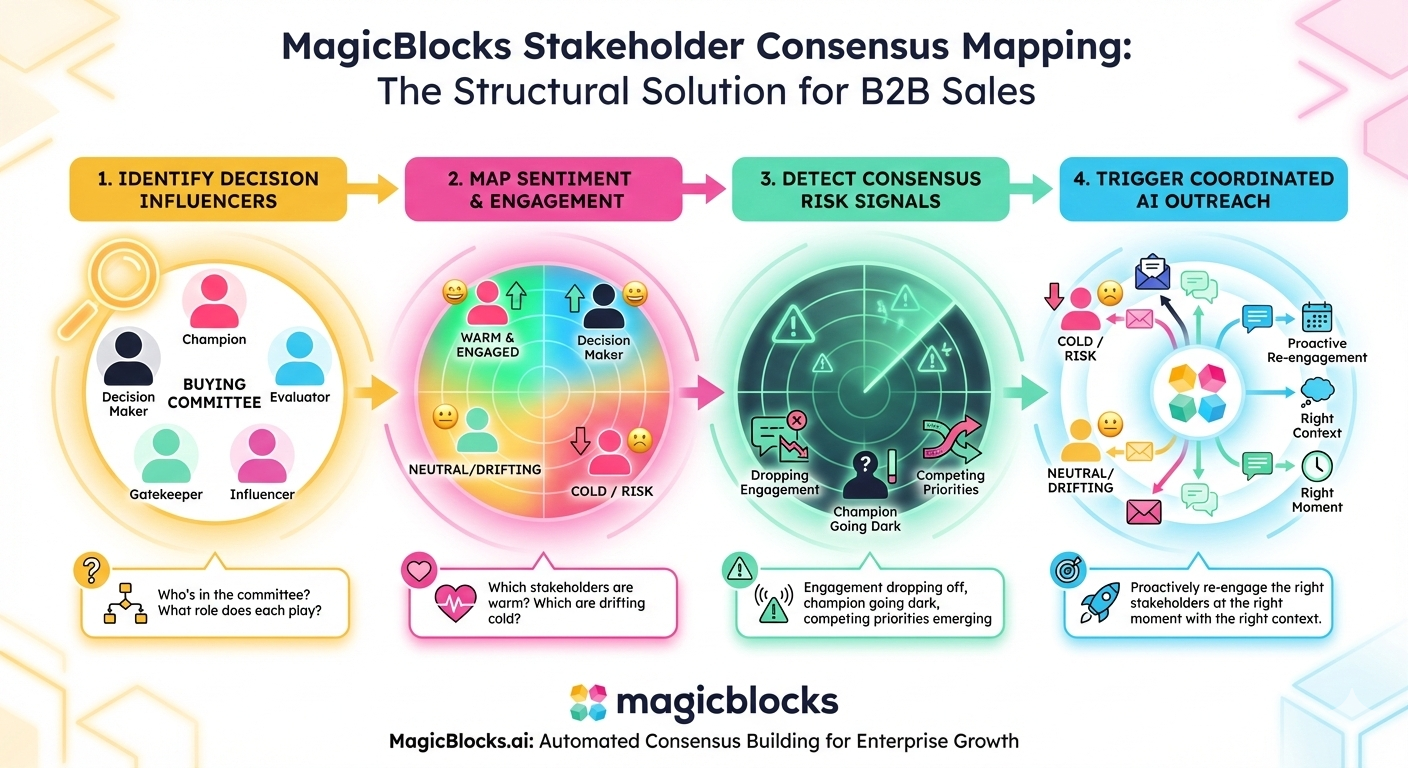
MagicBlocks Stakeholder Consensus Mapping addresses this structurally:
- Identify decision influencers: who’s in the buying committee and what role does each play?
- Map sentiment and engagement: which stakeholders are warm? Which are drifting cold?
- Detect consensus risk signals: engagement dropping off, champion going dark, competing priorities emerging
- Trigger coordinated AI outreach: proactively re-engage the right stakeholders at the right moment with the right context
Instead of waiting for momentum to die and then scrambling to revive it, MagicBlocks structures proactive consensus reinforcement throughout the deal cycle.
The “Leaky Bucket” Syndrome in Enterprise Marketing
Here’s the honest math: 70–80% of leads that enter most enterprise funnels never convert. They enter, touch a few stages, and disappear. The marketing budget that generated them is gone. The rep time that touched them is gone. The revenue potential sits dormant in a CRM that nobody’s looking at.
Why Leads Don’t Convert
Volume-first MQL strategy. A 2026 analysis by Marrina Decisions found that MQL scoring has stagnated, overweighting surface-level engagement signals while downstream conversion rates declined even as MQL volumes rose. More pipeline, less revenue. The definition of a leaky bucket.
Poor qualification consistency. When qualification depends on individual rep judgment, quality varies wildly. High-intent leads can slip through to nurture sequences they’ll never engage with. Low-intent leads advance to demos and waste AE time.
Slow follow-up. HBR’s landmark study of 1.25 million leads across 42 companies found that organizations responding within one hour were 7× more likely to qualify leads than those who waited longer. The Lead Response Management Study (Oldroyd, McElheran, Elkington) pushed that further: contact within 5 minutes made a lead 21× more likely to qualify versus waiting 30 minutes. Drift’s research found the average B2B response time is 42 hours. SaaS companies average 12 hours. The research says 5 minutes. The industry is delivering 42 hours.
Cold database decay. A Scott Roy analysis of 70 B2B SaaS companies found that high MQL volume correlated with 40% longer sales cycles. The pipeline fills up. The revenue doesn’t follow. And the contacts from 6 months ago sit in a database nobody’s touching because the team is too busy chasing new inquiries.
What Happens to Stagnant Databases?
Revenue sits dormant inside your CRM. Not dead, but dormant. The intent that was there six months ago may have evolved, shifted, or reignited. The lead who went cold in Q2 might be actively evaluating vendors again in Q4. Without a system to detect and re-engage that, you’re leaving recoverable revenue on the table permanently.
MagicBlocks Database Reactivation Framework turns dormant contacts into active pipeline:
- Segment dormant leads by intent signals: behavioral data, technographic shifts, company news, and re-engagement triggers
- Deploy AI-driven re-engagement flows: personalized conversations that feel relevant, not like a drip email from a CRM sequence from 2023
- Prioritize by revival probability: not all dormant leads are equally worth pursuing; the system ranks them
- Escalate qualified leads automatically: when a cold lead re-engages with buying intent, the right human is notified immediately
The database stops being a graveyard and becomes a revenue engine. One that’s already paid for.
How MagicBlocks-Powered AI Sales Agents Break the Conversion Ceiling
Let’s be precise. The category is flooded with tools calling themselves “AI sales agents.” Most are chatbots with a prompt wrapped around them. They work in demos. They fail in production conversations.
What Are AI Sales Agents, Actually?
Autonomous, LLM-based systems that don’t just answer questions. They:
- Engage inbound leads in seconds, not hours or “when the next rep is available”
- Conduct structured discovery conversations following a proven framework, not a static script
- Qualify in real time against your specific ICP criteria, dynamically
- Multi-thread across stakeholders, maintaining parallel conversations without rep involvement
- Escalate intelligently, handing off to humans with full context at precisely the right moment
MagicBlocks is built on $200M+ in lead generation and conversion data. The HAPPA Framework (Hook, Align, Personalize, Pitch, Action) isn’t theoretical. It’s forward-engineered from decades of real conversion outcomes and behavioral science. The system knows how humans make buying decisions because those decisions have been studied at scale.
How MagicBlocks Enhances AI Sales Agents
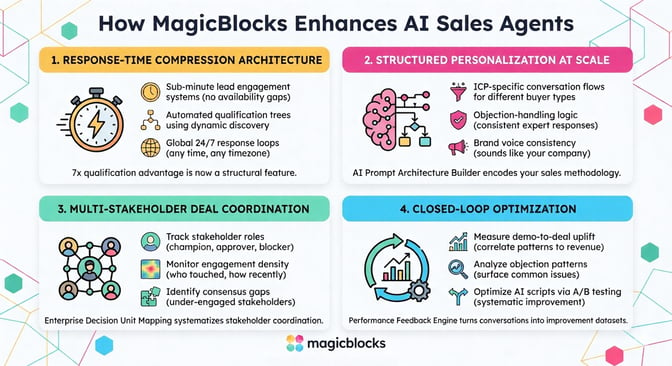
1. Response-Time Compression Architecture
The 7× qualification advantage from the HBR speed-to-lead research is now a structural feature, not a rep-dependent outcome.
MagicBlocks designs:
- Sub-minute lead engagement systems with no shift schedules, no availability gaps, no “I’ll follow up tomorrow”
- Automated qualification trees using dynamic discovery that adapts based on prospect responses in real time
- Global 24/7 response loops so a lead from Singapore at 2am gets the same quality engagement as a lead from New York at 2pm
2. Structured Personalization at Scale
MagicBlocks AI Prompt Architecture Builder encodes your sales methodology into the AI system:
- ICP-specific conversation flows with different paths for different buyer types, company sizes, use cases, and verticals
- Objection-handling logic encoding the responses your best reps give into every conversation, consistently
- Brand voice consistency so the AI sounds like your company, not a generic bot
- Escalation triggers defining moments where human judgment is required and the handoff happens cleanly
3. Multi-Stakeholder Deal Coordination
MagicBlocks Enterprise Decision Unit Mapping systematizes the stakeholder coordination that currently depends on your best reps remembering to do it:
- Track stakeholder roles including champion, technical evaluator, financial approver, end user, and blocker
- Monitor engagement density to see which roles have been touched and how recently
- Identify consensus gaps showing which stakeholders are under-engaged or expressing risk signals
- Deploy targeted follow-ups sending the right message to the right person at the right stage, automatically
4. Closed-Loop Optimization
MagicBlocks Performance Feedback Engine turns every conversation into a dataset for improvement:
- Measure demo-to-deal uplift to identify which conversation patterns correlate with closed revenue
- Analyze objection patterns to surface the most common objections and how they’re being handled
- Optimize AI scripts via A/B testing for systematic improvement against real conversion outcomes
- Continuously refine qualification logic so the system gets smarter with every deal, not just every quarter
AI Sales Agents vs. Human SDRs: Performance and ROI
Comparative Impact
| Dimension | Human Scaling | MagicBlocks + AI |
| Speed-to-lead | Minutes to hours (often days) | Seconds, every time |
| Cost scaling | Linear (headcount) | Non-linear (intelligence) |
| Personalization | Limited, rep-dependent | Context-aware NLP |
| Coverage | Business hours only | 24/7 global |
| Stakeholder coordination | Manual, memory-dependent | Structured, automated |
| Follow-up persistence | Drops off after 2–3 attempts | Persistent, adaptive, no burnout |
| Cold database revival | Rarely touched | AI re-engagement workflows |
| Consistency | Varies by rep | Encoded, consistent |
ROI Drivers
McKinsey’s research on AI in B2B sales found that a 12-week AI sales pilot moved conversion rates from 1.8% to 3.0%, representing $120M in incremental potential for the organization in the study. That’s not a marginal improvement. The ROI drivers compound:
- Increased qualification rate: more leads reaching the right stage faster
- Reduced no-decision outcomes: proactive consensus reinforcement keeps deals moving
- Higher demo-to-deal conversion: better-qualified opportunities, better-prepared AEs
- Lower cost per opportunity: AI handles early-stage engagement at a fraction of SDR cost
- Expanded rep selling time: reps spend time on the 28% that actually matters, which is closing
MagicBlocks models ROI before deployment. Not projections based on industry averages. Models based on your actual lead volume, your ACV, your current conversion rates, and your specific bottlenecks.
AI Sales Agents vs. Rule-Based Chatbots
This distinction matters. Most “AI” deployed in sales is:
- Scripted: follows a fixed decision tree and doesn’t adapt
- Static: the same response to the same trigger, every time
- Keyword-triggered: pattern-matching, not reasoning
MagicBlocks-structured AI agents are architecturally different:
- Context-aware: understands what’s been said in the conversation and adapts
- Adaptive: adjusts approach based on prospect behavior and sentiment signals
- Sentiment-driven: detects frustration, urgency, enthusiasm, and responds appropriately
- Objection-capable: handles real objections with real responses, not deflections
- Escalation-intelligent: knows when to hand off and does it with full context
The difference is reasoning depth and structural integration. One answers FAQs. The other sells.
Designing AI Sales Systems with MagicBlocks
Deploying AI agents isn’t a plug-and-play decision. The organizations that see the biggest results treat it as an architectural project, designed deliberately, integrated deeply, and optimized continuously.
Step 1: Conversion Ceiling Diagnosis
Before any technology gets deployed:
- Identify bottlenecks: where exactly are deals dropping off and at what volume?
- Simulate AI lift: what does a specific intervention actually produce in revenue terms?
- Prioritize intervention points: not every stage benefits equally from AI; start where the marginal impact is highest
Step 2: AI Workflow Architecture
Design the system before you build it:
- Lead qualification logic: what are the specific criteria that define a qualified lead in your model?
- Conversation flows: what discovery questions, objection responses, and pivot points does each buyer type encounter?
- Escalation thresholds: what signals trigger a human handoff, and to whom?
- Multi-thread strategy: which stakeholders get touched, in what sequence, with what messaging?
Step 3: CRM Integration Blueprint
AI agents don’t live in isolation. MagicBlocks Integration Layer connects bidirectionally:
- Salesforce bi-directional sync: AI activity, qualification outcomes, and conversation insights flow into CRM in real time
- HubSpot workflow triggers: AI engagement events trigger automation sequences, lifecycle stage changes, and rep notifications
- Data warehouse enrichment: conversation data feeds analytics for ongoing optimization
- Marketing automation coordination: AI and nurture sequences work in parallel without duplicating touches
Step 4: KPI Restructuring After AI Deployment
When AI handles early-stage engagement, the metrics that matter change. Redefine:
- SDR metrics: shift from volume (calls made, emails sent) to quality (qualified conversations initiated, ICP accuracy)
- AE engagement depth: measure how prepared AEs are entering demos, not just demo volume
- Consensus velocity: how quickly is the buying committee reaching alignment?
- Opportunity acceleration rate: is AI compressing the time between stages?
MagicBlocks provides KPI reweighting frameworks so you’re not flying blind during the transition.
Compliance, Governance and Risk Controls
Enterprise AI deployment without governance isn’t a strategy. It’s a liability. The risks are real.
Key Risks
- Data privacy exposure: AI conversations touching PII require compliant handling across jurisdictions
- AI hallucination: LLMs can generate confident, plausible, incorrect statements; in a sales context, that’s misrepresentation
- Brand misrepresentation: AI that drifts off-brand or makes unauthorized commitments creates legal and reputational exposure
- Regulatory violations: GDPR, CCPA, TCPA, and industry-specific compliance requirements apply to AI outreach
MagicBlocks Governance Framework
- Human-in-the-loop escalation: defined triggers that route conversations to humans before high-stakes moments
- Brand voice encoding: the AI operates within documented brand and compliance guardrails, not open-ended generation
- Prompt guardrails: structural constraints on what the AI can and cannot say, claim, or commit to
- Audit logging: full conversation records for compliance review, coaching, and legal protection
- Escalation triggers: moments of legal, ethical, or strategic sensitivity automatically route to human judgment
AI augments high-stakes persuasion. It doesn’t replace it. The human remains accountable. The system ensures that accountability is protected.
A/B Testing AI Sales Agents
Deploying AI isn’t a set-it-and-forget-it decision. The organizations seeing compounding results treat it as an ongoing optimization program.
Enterprise Marketing Director Testing Framework
Test AI agents against your actual conversion KPIs:
- Speed-to-lead: is the AI actually engaging faster? By how much?
- Demo booking rate: what percentage of AI-engaged leads are scheduling conversations with AEs?
- Demo-to-deal conversion: are AI-qualified opportunities closing at a different rate than rep-qualified ones?
- Sales cycle compression: is AI engagement shortening time from MQL to close?
- Revenue per lead: what’s the actual revenue outcome per AI-touched lead versus the control group?
MagicBlocks AI Script Optimization Lab runs this systematically:
- Compare AI scripts vs. human-managed cadences with controlled tests and clean attribution
- Optimize objection response patterns to find which responses to which objections drive better outcomes
- Identify conversion lift drivers to pinpoint what specific elements of the AI conversation are moving the needle
What Happens to Cold Leads After AI Deployment?
This is where a lot of immediate ROI lives, and it’s often underestimated.
MagicBlocks reactivates:
- Dormant CRM contacts: leads that entered the funnel, went cold, and haven’t been touched in months or years
- Incomplete discovery leads: prospects who engaged once but never completed qualification
- Long-cycle stalled deals: opportunities that were “almost there” six months ago and then stopped
AI re-engagement conversations don’t feel like a drip campaign from a dead sequence. They’re personalized, contextual, and timed to re-engage when intent signals suggest readiness. The result: revival probability increases without consuming rep bandwidth. Your existing database starts working for you again.
Build the System That Breaks Your Ceiling
Enterprise conversion ceilings are structural. The fix is structural. And the companies designing that architecture right now are building advantages their competitors won’t be able to close.
Before hiring more SDRs, do this:
- Diagnose structural bottlenecks: audit your funnel stage by stage and find where the real friction lives
- Model ROI of AI intervention: run the math before the budget conversation, not after
- Design stakeholder coordination systems: map the buying committee and build a system that threads it
- Architect escalation logic: define when the AI hands off and what context it passes forward
- Restructure KPIs for AI-augmented teams: measure the outcomes that actually matter post-deployment
MagicBlocks builds the system that breaks your conversion ceiling. Not more activity. More structure. More intelligence.
Create Your AI Sales Agent at MagicBlocks, upgrade your plan. The ceiling was never your market. It was your system.
Frequently Asked Questions
What is an enterprise conversion rate plateau and how do I know if I’m hitting one?
An enterprise conversion rate plateau is when your pipeline volume keeps growing but your close rate stays flat or declines despite adding headcount, increasing marketing spend, or deploying new sales tools. You’re hitting one if three or more of these are trending the wrong way simultaneously: your no-decision rate is rising, stage duration is creeping up quarter over quarter, speed-to-lead is slowing, your demo-to-close ratio is flat, or revenue per rep has stagnated. It’s not a performance problem. It’s a structural one, with friction compounding inside the funnel that additional activity can’t overcome.
How do AI sales agents improve enterprise B2B conversion rates?
AI sales agents improve enterprise conversion rates by eliminating the structural friction that causes plateau: they engage leads in seconds (not hours), qualify consistently using encoded ICP criteria rather than rep judgment, follow up persistently without burnout, thread multiple stakeholders simultaneously, and re-engage dormant database contacts before their intent disappears. The McKinsey research on AI in B2B sales found a 12-week pilot moved conversion rates from 1.8% to 3.0%, representing $120M in incremental potential. The mechanism isn’t magic; it’s speed, consistency, and coverage at a scale human teams can’t match.
What’s the difference between MagicBlocks AI sales agents and a regular sales chatbot?
Rule-based chatbots are scripted, static, and keyword-triggered. They follow a fixed decision tree and fail the moment a prospect goes off-script. MagicBlocks AI sales agents are context-aware, adaptive, and sentiment-driven. They understand what’s been said in a conversation and respond accordingly, handle real objections with real responses rather than deflections, detect frustration or urgency and adjust tone, and escalate to humans with full conversation context at precisely the right moment. The underlying difference is reasoning depth: one pattern-matches, the other thinks through the conversation.
How quickly can MagicBlocks AI sales agents be deployed for an enterprise team?
Deployment follows a four-step process: conversion ceiling diagnosis (mapping your specific bottlenecks and modeling AI lift), AI workflow architecture (designing qualification logic, conversation flows, and escalation thresholds), CRM integration (Salesforce bi-directional sync, HubSpot workflow triggers, data warehouse enrichment), and KPI restructuring (redefining metrics for an AI-augmented team). The timeline depends on the complexity of your CRM stack and how many buyer segments you’re targeting, but MagicBlocks models ROI before deployment so you’re not committing budget without a grounded projection.
Will AI sales agents replace our SDR team?
No, and this is worth being direct about. AI agents handle the parts of the SDR role where humans have structural disadvantages: consistent qualification at scale, 24/7 availability, persistent follow-up without fatigue, and simultaneous multi-threading across stakeholders. That frees human SDRs to focus on what they’re actually good at: strategic persuasion, relationship orchestration, navigating internal politics, and complex deal negotiation. The organizations seeing the best results aren’t choosing between humans and AI. They’re designing systems where each does what it does best.
How does MagicBlocks handle compliance and data privacy for enterprise deployments?
MagicBlocks includes a governance framework built specifically for enterprise compliance concerns: human-in-the-loop escalation for high-stakes moments, brand voice encoding and prompt guardrails that define what the AI can and cannot say, full audit logging of all AI conversations for legal and compliance review, and escalation triggers that route sensitive conversations to human judgment before any commitments are made. The system is designed to augment high-stakes persuasion, not replace the human accountability that enterprise deals require.
What ROI should we expect from deploying AI sales agents?
ROI compounds from multiple drivers simultaneously: increased qualification rate (more leads reaching the right stage faster), reduced no-decision outcomes (proactive consensus reinforcement keeps deals alive), higher demo-to-deal conversion (better-qualified opportunities entering the AE pipeline), lower cost per opportunity (AI handles early-stage engagement at a fraction of SDR cost), and expanded rep selling time (freeing humans from the 72% of time currently spent not selling). MagicBlocks models expected ROI against your actual lead volume, ACV, and current conversion rates before deployment, not industry averages applied to your situation.
How do AI sales agents handle multi-stakeholder enterprise deals?
Multi-stakeholder coordination is one of the highest-leverage applications. MagicBlocks Enterprise Decision Unit Mapping tracks stakeholder roles across the buying committee (champion, technical evaluator, financial approver, end user, blocker), monitors engagement density to identify who’s gone cold, detects consensus risk signals before they kill the deal, and deploys targeted outreach to the right stakeholders at the right stage automatically. The coordination that currently depends on your best rep’s memory and calendar discipline gets systematized across every deal in your pipeline simultaneously.
Can MagicBlocks reactivate old leads in our CRM database?
Yes, and this is often where the fastest immediate ROI lives. The Database Reactivation Framework segments dormant contacts by intent signals and behavioral data, deploys personalized re-engagement conversations (not drip emails from a dead sequence), prioritizes outreach by revival probability, and automatically escalates re-engaged leads with buying intent to the right human. Dormant leads aren’t dead leads. They’re leads whose intent may have reignited. Without a system to detect and act on that, recoverable revenue stays permanently on the table.
How does MagicBlocks integrate with our existing CRM and sales stack?
MagicBlocks Integration Layer connects bidirectionally with Salesforce (syncing AI activity, qualification outcomes, and conversation insights into CRM in real time), HubSpot (triggering workflow automations and lifecycle stage changes based on AI engagement events), data warehouses (feeding conversation data into analytics for ongoing optimization), and marketing automation platforms (coordinating AI and nurture sequences so they work in parallel without duplicating touches). The integration is designed to make your existing stack more intelligent, not replace it.
Want to see this in action?
See a demoRead the playbook. Now see it run.
Watch a 4-minute demo. No sales pitch. Then decide if you want to talk.