

How to Avoid Hallucinations in AI Sales Agents
AI sales agents hallucinate because they're designed to predict language, not verify truth.
Learn how to prevent AI sales agent hallucinations with structured knowledge, guardrails, and controlled creativity to ensure compliance and accuracy in customer interactions.
On this page10
- What You’ll Learn
- Why AI Sales Agents Hallucinate in the First Place
- Why Prompting Alone Will Never Be Enough
- Guardrails: Defining What the AI Is Allowed to Do
- Persona Creativity: Controlling Confidence Without Guessing
- Knowledge & Priority Knowledge: Grounding Every Answer
- Sales Journeys with Conditions and Actions: Keeping Agents on Track
- Why This Matters Most for Compliance-Heavy Companies
- The Mental Model That Actually Works
- Bottom Line
AI sales agents hallucinate because they’re designed to predict language, not verify truth.
The only reliable way to stop hallucinations, especially in compliance-heavy sales environments, is to constrain what agents know, how they behave, and when they’re allowed to respond. MagicBlocks achieves this through guardrails, controlled creativity, structured knowledge, and condition-based sales journeys.
What You’ll Learn
In this guide, you’ll discover:
- Why AI Sales Agents Hallucinate in the First Place
- Why Prompting Alone Will Never Be Enough
- Guardrails: Defining What the AI Is Allowed to Do
- Persona Creativity: Controlling Confidence Without Guessing
- Knowledge & Priority Knowledge: Grounding Every Answer
- Sales Journeys with Conditions and Actions: Keeping Agents on Track
- Why This Matters Most for Compliance-Heavy Companies
- The Mental Model That Actually Works
Why AI Sales Agents Hallucinate in the First Place
Here’s the uncomfortable truth: when your AI sales agent confidently tells a prospect something completely wrong, it’s doing exactly what it was designed to do.
Large language models don’t think. They predict the most likely next word based on patterns they’ve seen before—not the most accurate one. According to McKinsey, organizations deploying gen AI use cases face significant inaccuracy risks from model hallucination or outdated information, particularly in customer-facing applications like chatbots.
The data gets even more concerning. Research shows that approximately 17% of AI-generated content contains some form of hallucination or factual error, according to Stanford’s Human-Centered Artificial Intelligence study. In sales environments, that’s not a tech glitch—that’s a compliance disaster waiting to happen.
Hallucinations occur when:
- Data is incomplete or biased – The model fills gaps with statistically likely responses rather than admitting uncertainty
- Prompts are vague or industry-specific – Without clear context, the LLM defaults to generic patterns that may not apply
- The model is forced to answer even when unsure – Most LLMs will generate something rather than say “I don’t know”
In sales, hallucinations equal compliance risk, trust erosion, and lost deals. McKinsey research indicates that 51% of companies have encountered AI errors, hallucinations, misclassifications, or unauthorized outputs—usually due to poor governance or lack of human oversight.
Better prompts won’t fix this. Structure will.
Why Prompting Alone Will Never Be Enough
You’ve probably heard this before: “Just write better prompts.”
Yeah, we tried that. So did every other company building AI agents. And you know what happened? The agents still hallucinated, just in slightly different ways.
Prompting is reactive and fragile. It’s like trying to keep a car on the road by constantly adjusting the steering wheel instead of building guardrails. Prompt-only agents:
- Rely on unstructured documents. They’re essentially doing keyword searches in a pile of PDFs and hoping for relevance
- Have no concept of “allowed vs not allowed” knowledge. Everything in the training data is fair game, including outdated policies or irrelevant information
- Cannot reliably say “I don’t know”. The LLM’s job is to generate text, so it will generate text, accurate or not
According to Gartner’s 2024 research, over 35% of companies using large language models have encountered hallucinated outputs, often leading to poor decisions and compliance risks. By 2028, AI regulatory violations will result in a 30% increase in legal disputes for tech companies.
Here’s the reframe that changes everything:
The LLM should not be the brain. It should follow a brain.
Guardrails: Defining What the AI Is Allowed to Do
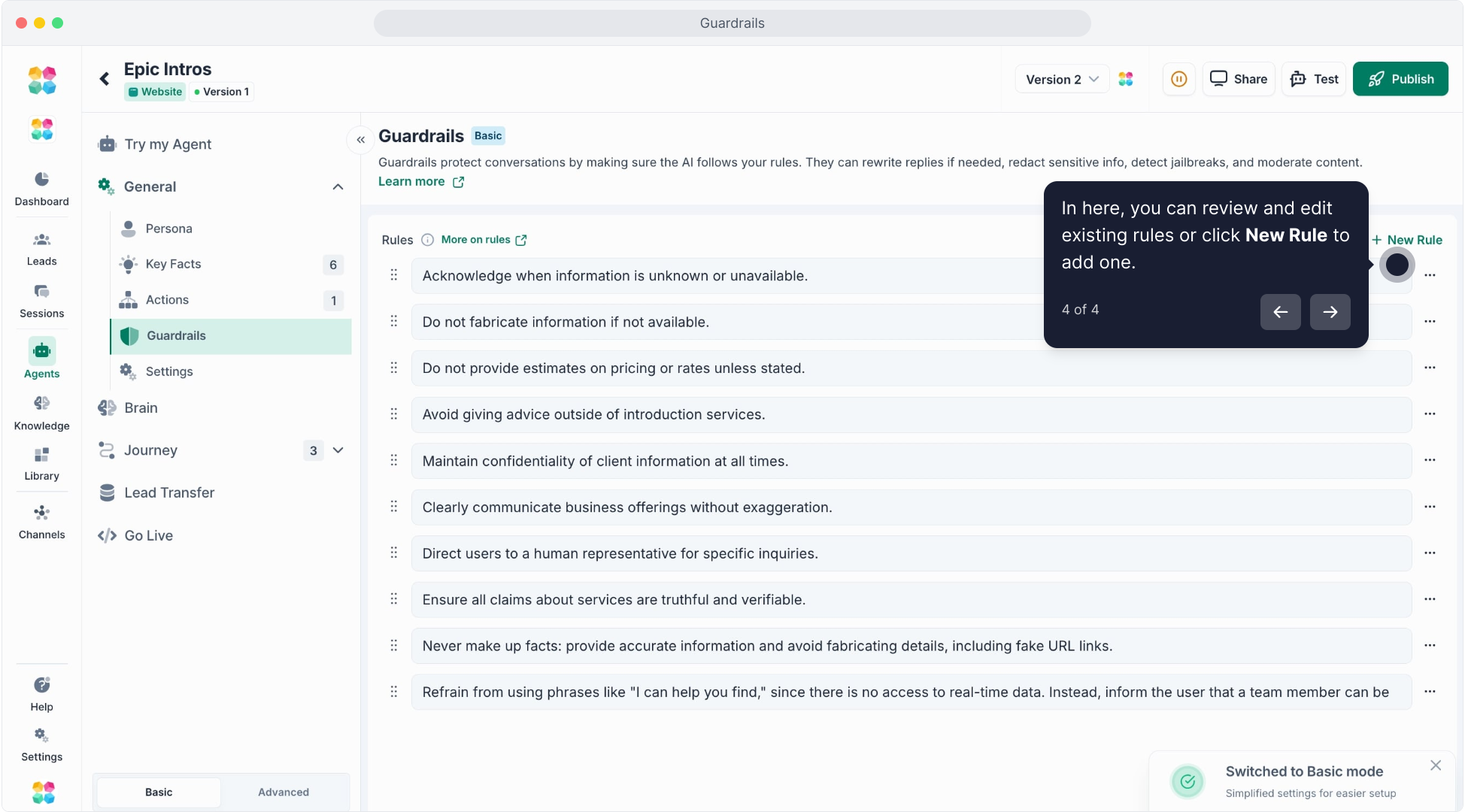
Think of guardrails as the explicit boundaries that prevent your AI agent from wandering into dangerous territory.
Guardrails define:
- What topics the agent can answer – Product features, pricing, availability. Not legal advice, medical claims, or competitor comparisons it doesn’t have data for.
- What it must refuse or escalate – Questions about contracts, compliance issues, or anything requiring human judgment get routed to the right person.
- How it should respond under uncertainty – When the agent doesn’t have verified information, it says so instead of guessing.
McKinsey’s research on building gen AI capability emphasizes that guardrails should automatically audit LLM prompts and responses to prevent data policy violations, validate compliance of LLM outputs, and detect hallucinations and data leakages.
This prevents:
- Overconfident fabrication. The agent won’t invent policy details or make promises the company can’t keep
- Off-brand or non-compliant responses. Industry-specific compliance requirements are built into the system, not left to chance
The outcome? The agent stays within safe, approved boundaries by design, not by luck.
Persona Creativity: Controlling Confidence Without Guessing
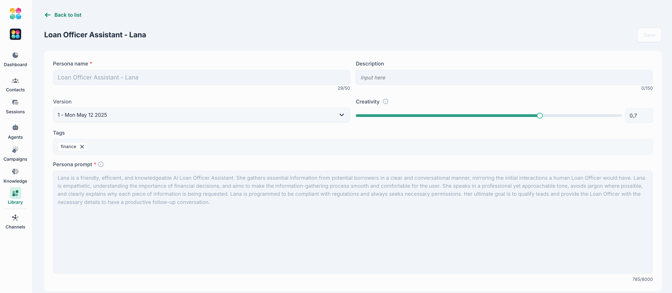
Here’s the paradox: you want your AI sales agent to sound human and engaging, but not so confident that it starts making stuff up.
High creativity settings make agents sound natural and persuasive, right up until they confidently state something completely false. Low creativity settings make them robotic and unhelpful, killing the conversation before it starts.
MagicBlocks solves this with adjustable persona creativity levels that clearly separate:
- Expression style (tone, warmth, persuasion). How the agent says things
- Factual authority (what the agent can assert). What the agent is allowed to claim as true
Research on AI hallucinations shows that when models are not grounded in real-time business data, they default to what they “remember” from training data which may be outdated, irrelevant, or simply incorrect. McKinsey reports that 60% of executives rank AI reliability as their top concern in enterprise deployments.
The result? Human-like conversations without invented facts. Your agent can be warm, personable, and persuasive while only asserting what it definitively knows.
Knowledge & Priority Knowledge: Grounding Every Answer
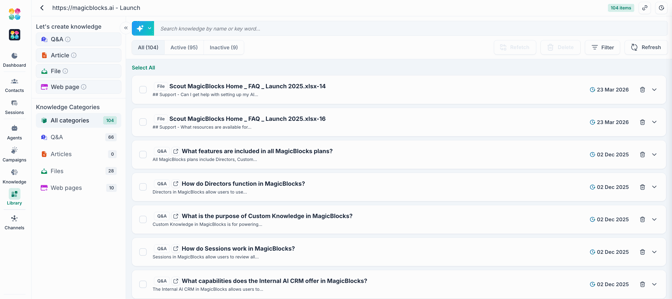
Here’s where most AI agents fail: they’re given a pile of documents and told to “figure it out.”
That doesn’t work. LLMs need structured knowledge, verified sources that define what’s true, what’s current, and what takes precedence when information conflicts.
Retrieval-Augmented Generation (RAG): The Foundation
According to IBM Research, Retrieval-Augmented Generation (RAG) is an AI framework for retrieving facts from an external knowledge base to ground large language models on the most accurate, up-to-date information. Meta’s original 2020 research paper defined RAG as “a general-purpose fine-tuning recipe” that can link any LLM to any internal or external knowledge source.
The key is understanding that LLMs know how words relate statistically, but not what they mean. RAG addresses this by grounding the model on external sources of knowledge, making it “the difference between an open-book and a closed-book exam,” as IBM researchers note.
The MagicBlocks Approach: Priority Knowledge
MagicBlocks goes beyond basic RAG with priority knowledge that:
- Overrides generic assumptions – Company-specific policies and current offers take precedence over general information
- Anchors responses to expert-approved facts – Every claim the agent makes can be traced back to a verified source
- Defines clear boundaries of certainty – The system knows what it knows, what it doesn’t, and when to stop instead of guessing
According to AWS research on grounding and RAG, grounding in external, domain-specific knowledge delivers both factual accuracy and contextual relevance—essential for enterprise applications where trust and compliance are non-negotiable.
What this solves:
Agents know:
- What they definitively know – Verified product information, current pricing, availability
- What they don’t – Topics outside their knowledge base or areas requiring human expertise
- When to stop instead of guessing – The agent can escalate or defer rather than fabricate
No structured knowledge equals hallucination risk. It’s that simple.
Sales Journeys with Conditions and Actions: Keeping Agents on Track
Here’s where MagicBlocks’ approach gets really different from prompt-only chatbots.
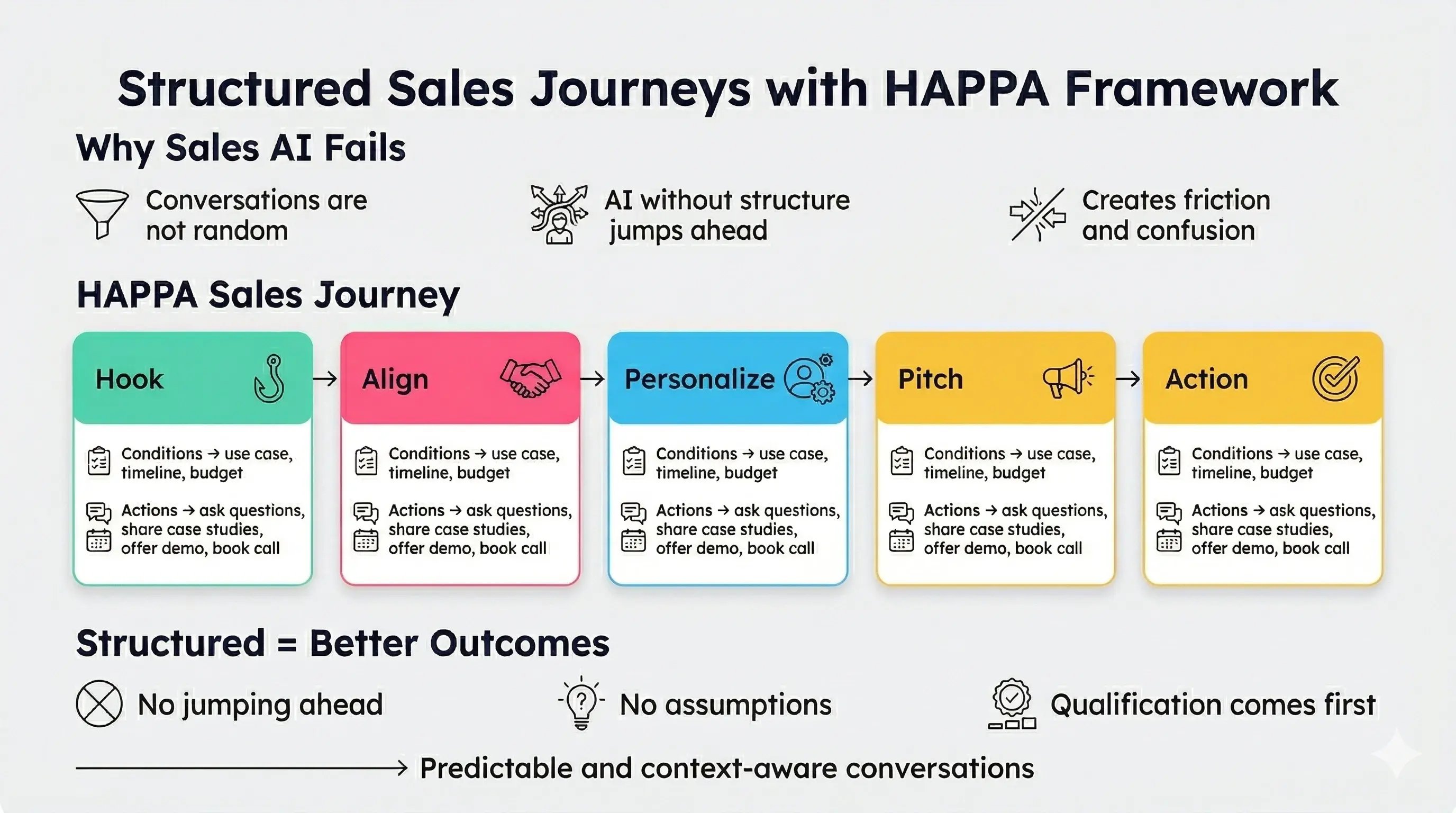
Sales conversations aren’t random. They follow predictable patterns—discovery, qualification, education, commitment. When AI agents don’t understand this structure, they jump ahead, make assumptions, and create friction.
The HAPPA Framework in Action
MagicBlocks’ HAPPA Framework (Hook → Align → Personalize → Pitch → Action) models sales journeys explicitly. Each step is governed by:
- Conditions (what must be true) – Has the prospect shared their use case? Do we know their timeline? Is budget qualified?
- Actions (what the agent can do next) – Ask qualifying questions, share relevant case studies, offer a demo, or book a call
Harvard Business Review research on AI in sales emphasizes that AI effectiveness depends on when and how it’s implemented across the relationship and process levels. Simple AI works for transactional contexts, but sophisticated sales environments require advanced AI that analyzes opportunities and customer needs.
Why This Matters
This structure prevents agents from:
- Jumping ahead in the sales process – No pitching before understanding needs
- Making assumptions about buyer intent – The agent asks instead of guesses
- Offering solutions before qualification – Budget, authority, need, and timing are verified first
The outcome? Predictable, compliant, and context-aware conversations that actually move deals forward instead of creating confusion.
Why This Matters Most for Compliance-Heavy Companies
If your company operates in a regulated industry, you can’t afford to guess whether your AI agent will say the right thing.
Industries at Highest Risk
- Fintech – Misrepresenting terms, rates, or eligibility can trigger regulatory violations
- Healthcare – HIPAA compliance isn’t optional, and patient information must be handled correctly
- Legal – Unauthorized practice of law or misleading legal information creates liability
- Enterprise SaaS – Contract terms, data privacy, and security claims must be accurate
According to Gartner’s 2025 research on AI governance, by 2030, fragmented AI regulation will spread to cover 75% of the world’s economies, driving $1 billion in total compliance spend. Organizations need centralized inventory, policy enforcement, and runtime controls to manage AI at scale.
McKinsey’s analysis shows that 40% of organizations identify explainability as a key risk in adopting gen AI, yet only 17% are actively working to mitigate it. The gap between awareness and action is dangerous.
The MagicBlocks Advantage
Reliability is designed in—not patched later. MagicBlocks agents are:
- Easier to audit – Every response can be traced to its source knowledge and the conditions that triggered it
- Easier to correct – Update the knowledge base or modify conditions, and all agents reflect the change immediately
- Safer to deploy at scale – Guardrails, structured knowledge, and sales journey controls reduce risk systematically
The Mental Model That Actually Works
Stop thinking about AI agents as “smart chatbots.” Start thinking about them as intelligent interns working with expert playbooks.
Here’s the simple framework:
- LLM = intelligent intern – Smart, articulate, capable of learning—but needs guidance and structure
- Structured knowledge + journeys = expert playbook – The verified information and proven processes that define success
- Continuous evaluation = manager oversight – Monitoring, feedback, and refinement to improve performance
IBM’s research on RAG for enterprises emphasizes that grounding LLM responses in external knowledge sources is essential for enterprise applications requiring accuracy, compliance, and trustworthiness.
Without this stack, AI agents don’t become autonomous—they become confidently wrong.
Bottom Line
If your AI sales agent relies mostly on prompts and unstructured data, hallucinations are inevitable.
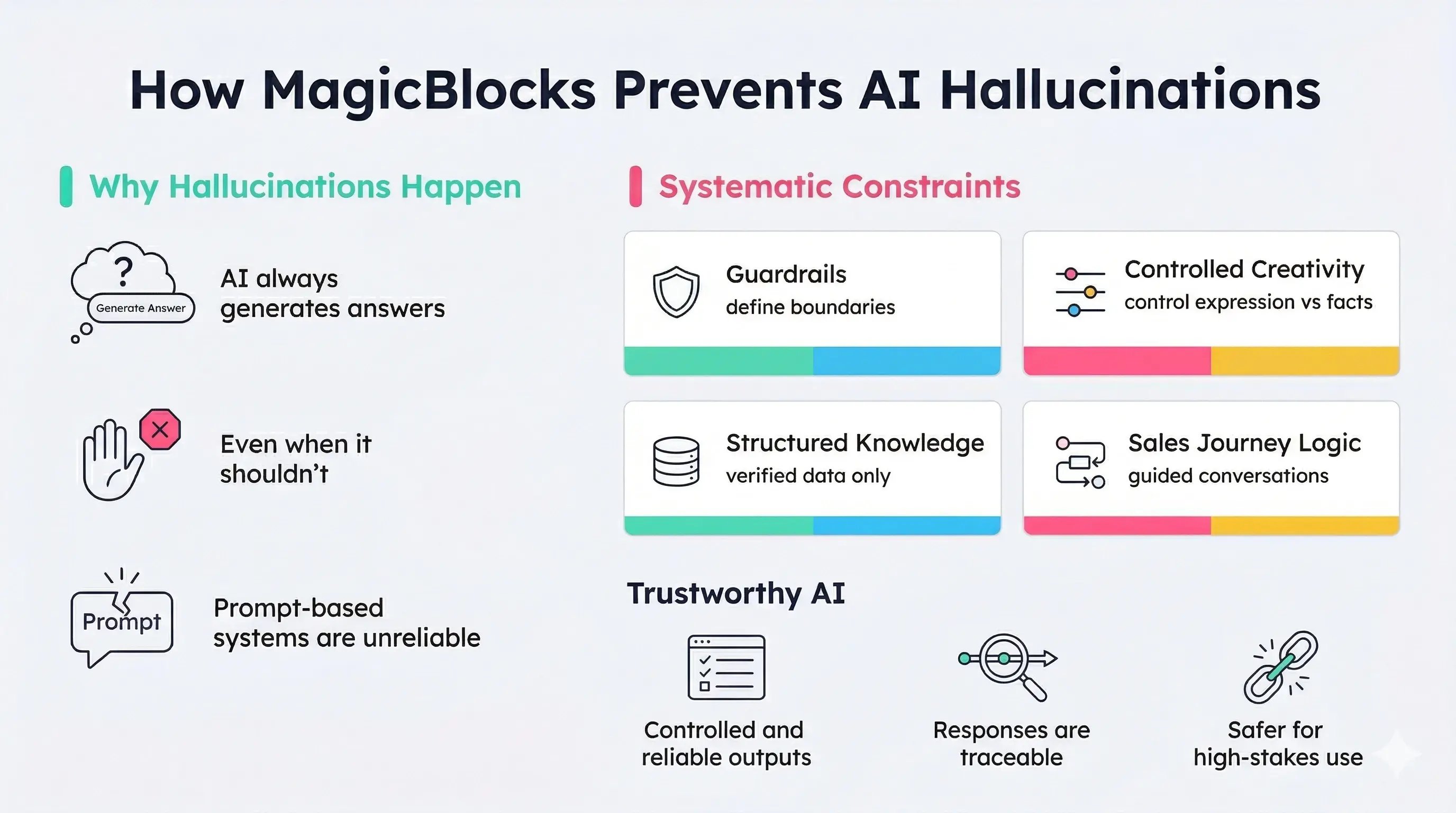
The probabilistic nature of LLMs means they will always try to generate an answer—even when they shouldn’t. The only way to prevent this is through systematic constraints:
- Guardrails define what the agent can and cannot do
- Controlled creativity separates expression from factual authority
- Structured knowledge grounds every response in verified information
- Sales journey conditions keep conversations on track through explicit logic
MagicBlocks enables trustworthy agentic AI by combining all four of these elements—making it a safer choice for teams that can’t afford mistakes.
According to McKinsey, when implemented correctly, platform-based approaches that include automated data preparation, guardrails, and observability can assist in tracing LLM responses back to original source data—critical for enterprises that need to audit and verify AI-generated content.
The Choice Is Clear
You can keep struggling with prompt engineering, hoping your agent doesn’t say something catastrophic. Or you can build on a foundation that treats reliability as a design principle—not an afterthought.
Build AI sales agents that know when to speak—and when not to—with MagicBlocks.
Want to see this in action?
See a demoRead the playbook. Now see it run.
Watch a 4-minute demo. No sales pitch. Then decide if you want to talk.