

How AI Sales Agents Actually Work
AI sales agents decide actions, not just generate responses. They use memory, intent detection, and decision engines to choose strategies dynamically.
Discover how AI sales agents autonomously drive sales by using memory, intent detection, and decision engines to dynamically choose strategies and optimize outcomes.
On this page20
- What Is an AI Sales Agent?
- What Does “Real Autonomy” Mean in Sales AI?
- Chatbots vs AI Sales Agents: The Functional Difference
- The Core Architecture of an AI Sales Agent
- Memory Systems: Why Agents Don’t Forget
- Why Decision Engines Replace Workflow Trees
- How AI Sales Agents Choose the Next Best Action
- How AI Sales Agents Handle Objections
- How AI Sales Agents Operate Over Time
- Why Omnichannel Continuity Matters in Sales
- AI Sales Agents vs Chatbots (Explicit)
- AI Sales Agents vs Workflow Automation
- High-Ticket & Inbound Sales Use Cases
- Lead Recovery & Re-Engagement
- From “Speed to Lead” to “Speed to Sell”
- What Actually Defines a Real AI Sales Agent (Checklist)
- Three Ways to Implement AI Sales Agents
- Example: How One Platform Implements This Architecture
- The Bottom Line: Automation vs Autonomy
- See a Real AI Sales Agent in Action
AI sales agents decide actions, not just generate responses. They use memory, intent detection, and decision engines to choose strategies dynamically. They operate without pre-mapped workflows, optimizing for qualification, objection handling, and progression over time.
Chatbots retrieve information and answer questions. Agents execute sales strategy and drive outcomes.
What you’ll learn:
-
Automation vs Autonomy
 Key Takeaways
 -
AI sales agents are autonomous systems that conduct goal-driven sales conversations over time, using persistent memory, intent detection, and decision engines that choose strategies rather than follow scripts.
-
Unlike chatbots that retrieve information reactively, AI sales agents proactively qualify prospects, handle objections with context-aware reasoning, and progress deals across multiple sessions and channels toward revenue outcomes.
-
Autonomy means adaptive intelligence: The system operates context-aware (knows customer history), goal-driven (optimizes for revenue outcomes), and state-based (adjusts tactics based on conversation progress)—not through predetermined workflows or keyword triggers.
-
Agents build relationships that compound: Every interaction becomes accumulated intelligence that improves qualification, personalization, and conversion rates over time.
-
The architectural difference matters: Decision engines that reason vs workflows that match, memory that persists vs sessions that reset, strategies that adapt vs scripts that repeat.
What Is an AI Sales Agent?
An AI sales agent is an autonomous system that conducts multi-step sales conversations across channels and over time, using memory, intent detection, and strategic reasoning to qualify prospects, handle objections, and progress deals toward revenue outcomes.
Unlike chatbots that answer questions reactively, AI sales agents proactively guide conversations using context from past interactions, behavioral signals, and learned sales patterns. They’re not workflow automation tools that follow fixed paths—they’re reasoning systems that adapt their approach based on who they’re talking to, what’s happened so far, and what outcome matters most.
Think of it this way: A chatbot is a FAQ system with natural language. An AI sales agent is a sales rep with perfect memory and infinite patience.
What Does “Real Autonomy” Mean in Sales AI?
When we talk about autonomy in AI sales agents, we’re not talking about sci-fi. We’re talking about practical, measurable capabilities that directly impact revenue.
Autonomy in sales means the system can:
- Operate context-aware. It knows who this person is, what they’ve said before, where they are in the buying journey, and what matters to them.
- Act goal-driven. Every response moves toward a clear outcome: qualification, next step, or close. It’s not just generating replies—it’s driving toward revenue.
- Maintain state-based reasoning. The agent tracks the conversation’s progress and adjusts tactics based on current state, not predefined scripts.
Autonomy is NOT:
- Scripts. If it follows a rigid conversational path regardless of context, it’s automation, not autonomy.
- Flowcharts. If you have to draw every possible conversation branch by hand, it’s workflow logic, not intelligent reasoning.
- Trigger-based replies. If it pattern-matches keywords and fires canned responses, it’s a sophisticated FAQ bot.
Real autonomy means the system chooses strategies, not just responses. It decides when to qualify, when to nurture, when to pitch, and when to back off—based on signals, not scripts.
Chatbots vs AI Sales Agents: The Functional Difference
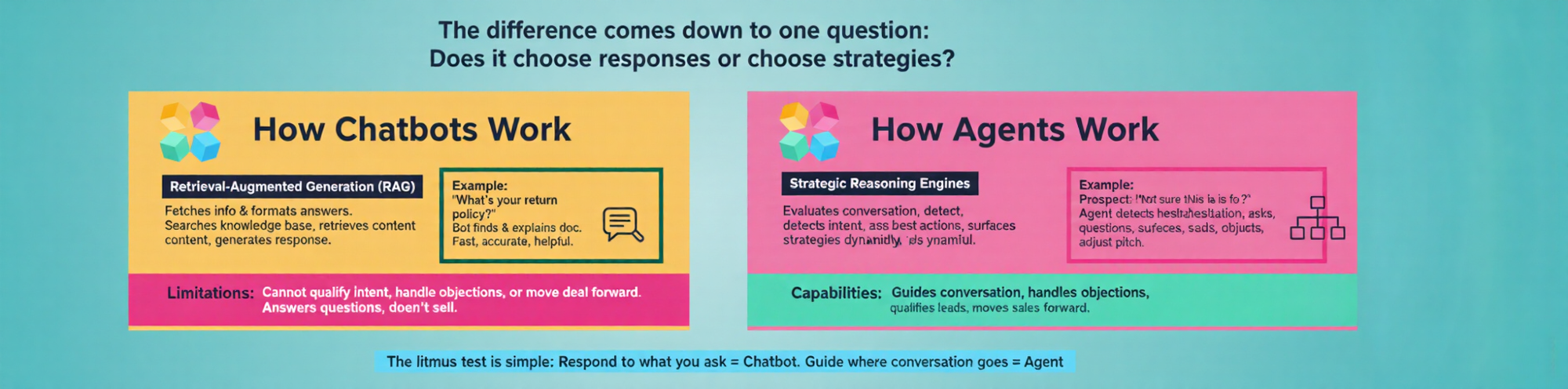
The difference comes down to one question: Does it choose responses or choose strategies?
How Chatbots Work
Chatbots use Retrieval-Augmented Generation (RAG) to fetch information and format answers. When you ask a question, the bot searches its knowledge base, retrieves relevant content, and generates a natural-sounding response.
This works great for support. Someone asks “What’s your return policy?” and the bot finds the policy doc and explains it clearly. Fast, accurate, helpful.
But here’s what chatbots can’t do: They can’t qualify intent. They can’t handle objections. They can’t move a deal forward over multiple touchpoints. They answer questions—they don’t sell.
How Agents Work
AI sales agents use strategic reasoning engines. Instead of just retrieving information, they evaluate conversation state, detect intent signals, assess next-best actions, and select sales strategies dynamically.
When a prospect says “I’m not sure this is for me,” a chatbot might explain features. An agent detects hesitation, asks qualifying questions, surfaces specific objections, and adjusts its pitch based on what matters to this person.
The litmus test is simple: If it can only respond to what you ask, it’s a chatbot. If it can guide where the conversation goes, it’s an agent.
The Core Architecture of an AI Sales Agent
Every effective AI sales agent is built on four foundational layers. Think of them as the essential components that turn chat into commerce:
- Memory System Stores who this person is, what they’ve said, what they’ve done, and what matters to them—across sessions and channels.
- Intent Detection Layer Reads signals: hesitation, urgency, objections, buying intent, fit indicators. It’s the “listening” layer that interprets meaning behind words.
- Decision Engine Evaluates state, scores possible actions, selects the best strategy for this moment. This is where reasoning happens.
- Action Layer Executes: sends messages, books meetings, triggers follow-ups, hands off to humans. This is where strategy becomes an outcome.
These layers work together in a continuous loop. Memory informs intent detection. Intent detection feeds the decision engine. The decision engine triggers actions. Actions generate new memory. And the cycle continues, compounding intelligence over time.
How This Maps to Your CRM
If you’re running HubSpot, HighLevel, Salesforce, or similar systems, here’s how agent architecture translates:
Memory → CRM Contact + Timeline Every interaction, email open, page visit, and conversation gets logged to the contact record. The agent reads this timeline to understand history and context before engaging.
State → Pipeline Stage The agent tracks where each prospect sits in your pipeline (new lead, qualified, demo scheduled, negotiation, closed) and adjusts strategy accordingly. When state changes, the CRM updates automatically.
Action → Calendar Booking / Task Creation When the agent decides to book a meeting, it creates a calendar event. When it needs human follow-up, it creates a task for your team. All actions sync back to your existing workflow tools.
This isn’t separate infrastructure—it’s intelligence that sits on top of your current stack, reading from and writing to the systems you already use.
Memory Systems: Why Agents Don’t Forget
Here’s the thing about memory in sales: it’s not a nice-to-have. It’s the foundation of trust, personalization, and commercial intelligence.
Short-Term Memory (Session Context)
This is what happened in this conversation, right now. Questions asked, objections raised, information shared. Every chatbot has this—it’s basic conversational continuity.
Long-Term Memory (Persistent Context)
This is what makes agents different. Long-term memory tracks:
- Every conversation across sessions. What you talked about last week. What objections you raised three months ago.
- Behavioral signals. Pages visited, emails opened, previous purchases, engagement patterns.
- Stated preferences and constraints. Budget ranges, decision timelines, stakeholder requirements.
- Lifecycle stage. Where this person is in their journey: cold lead, qualified prospect, active deal, past customer.
According to McKinsey research, 71% of consumers expect personalized interactions, and 76% become frustrated when they don’t happen. AI-driven personalization can enhance customer satisfaction by 15-20%, increase revenue by 5-8%, and reduce cost to serve by up to 30%.
Without memory, every conversation starts at zero. You can’t build trust when you keep forgetting who someone is. You can’t personalize when you don’t know what matters. You can’t progress deals when you can’t remember what happened yesterday.
Memory is what turns transactional interactions into relationships. And relationships compound over time into loyalty and lifetime value.
Why Decision Engines Replace Workflow Trees
Traditional sales automation runs on workflow logic: “If they click this, send that. If they reply with X, route to Y.” You map every possible path on a canvas, draw arrows between boxes, and hope you’ve covered every scenario.
This worked when funnels were simple and buyer journeys were linear. But sales today? It’s messy. Prospects research for weeks. They ghost and come back. They engage on three channels simultaneously. They raise objections you’ve never heard before.
Workflows break because sales has infinite edge cases. You can’t draw every possible conversation path. You can’t anticipate every objection. You can’t wire up conditional logic for every combination of timing, intent, channel, and context.
Decision engines solve this by reasoning instead of matching. Instead of asking “what’s the next step in the workflow?”, they ask:
- What’s this person’s current state?
- What signals are they showing?
- What outcome are we optimizing for?
- What action has the highest probability of moving us closer to that outcome?
They evaluate options, score possibilities, and choose strategies dynamically. When something unexpected happens, they don’t break—they adapt.
How AI Sales Agents Choose the Next Best Action
Here’s how the decision process actually works in practice:
1. Signal Detection
The agent monitors incoming data: message content, tone, timing, channel, behavioral signals, historical patterns. Is this person asking detailed questions (research mode)? Are they mentioning budget and timing (buying mode)? Are they expressing hesitation (objection mode)?
2. Intent Classification
Based on signals, the agent classifies intent: information-seeking, comparison-shopping, ready to buy, not interested, stalling, considering alternatives. This classification determines strategic approach.
3. Action Scoring
The decision engine evaluates possible next moves:
- Ask qualifying questions?
- Address objections directly?
- Share social proof?
- Offer a demo or call?
- Back off and nurture?
- Hand off to a human rep?
Each action gets scored based on current state, historical performance data, and optimization goals.
4. Strategy Selection
The highest-scoring action wins. The agent executes that strategy, monitors response, and repeats the cycle. If the strategy works, great—continue. If it doesn’t, adapt and try something different.
5. Execution & Learning
The chosen action happens: a message sends, a resource shares, a meeting books. The agent logs the outcome, updates memory, and incorporates that data into future decisions.
This isn’t magic—it’s math, memory, and accumulated sales intelligence working at machine speed.
How AI Sales Agents Handle Objections
The difference between scripted objection handling and reasoned objection handling is the difference between reading from a manual and actually listening.
Scripted Objection Handling
Traditional approach: match objection patterns to prepared responses. “Too expensive” triggers pricing justification script. “Not the right time” triggers timing objection rebuttal. It’s fast, consistent, and completely tone-deaf to context.
Reasoned Objection Handling
Autonomous agents detect objection type, assess underlying concern, reference historical context (have they objected to this before?), and craft responses tailored to this person’s specific situation.
If someone says “this seems expensive,” the agent doesn’t just recite ROI talking points. It considers:
- What’s their role? (Budget holder vs user)
- What have they looked at? (Enterprise features vs basic plan)
- What’s their history? (Past customer? Price-shopper? First-time buyer?)
- What’s their urgency? (Active project vs casual browsing)
Then it responds with the angle most likely to resonate. Maybe it’s ROI for the CFO. Maybe it’s feature comparison for the evaluator. Maybe it’s payment flexibility for the budget-constrained buyer.
Adaptability beats speed when the goal is closing deals, not just responding fast.
How AI Sales Agents Operate Over Time
Here’s where agents really pull away from chatbots: they don’t just handle individual conversations. They orchestrate relationships across days, weeks, and months.
Cross-Session Follow-Up
An agent remembers where the last conversation left off and picks up naturally. No “Hi, I’m your support bot, how can I help today?” for the fifth time. It’s “Hey, you were asking about implementation timelines last week—did you get that proposal reviewed?”
Deal Recovery
Prospects ghost. It happens. Humans forget to follow up or follow up too much and burn the lead. Agents follow up consistently without being annoying, adjusting timing and messaging based on engagement signals.
Long-Cycle Sales Continuity
For complex sales that span months, agents maintain context across the entire journey. They know who you talked to in April, what questions came up in June, what changed in August. They keep the narrative thread intact while humans would need CRM notes and meeting transcripts just to catch up.
McKinsey research shows that organizations scaling AI agents are seeing measurable impact—with some Fortune 250 companies experiencing campaign creation and execution speed increasing 15-fold. Effective agent deployments can deliver productivity improvements of 3-5% annually and potentially lift growth by 10% or more.
The key is continuity. Relationships compound. Every interaction builds on the last. Memory turns into familiarity. Familiarity turns into trust. Trust turns into revenue.
Why Omnichannel Continuity Matters in Sales
The problem with channel fragmentation isn’t just annoying—it kills deals.
The Problem
Your prospect starts a conversation on your website chat. Then they text your SMS number. Then they reply to an email. Then they DM on LinkedIn.
In most systems, each channel is its own silo. The chat bot doesn’t know about the SMS exchange. The email drip doesn’t know they already asked that question in chat. The DM thread starts from scratch because there’s no unified memory.
Result? You repeat yourself. You miss context. You look disorganized. And your prospect loses confidence.
What “One Conversation, Many Channels” Actually Means
Omnichannel continuity means the agent maintains one unified conversation state regardless of where the interaction happens. It remembers everything across every touchpoint. Context doesn’t reset when channels switch.
Your prospect can start on chat, continue via SMS, receive a follow-up email that references the SMS conversation, and book a call—all without repeating themselves once.
This isn’t just convenient. It’s commercial intelligence. Every channel interaction adds data. Every touchpoint reveals intent. An agent with omnichannel memory compounds insights across every engagement, building a complete picture of who this person is and what they need.
AI Sales Agents vs Chatbots (Explicit)
Let’s make this crystal clear:
**Reactive vs Proactive:**Chatbots wait for questions. Agents initiate conversations, follow up proactively, and guide interactions toward outcomes.
**Support vs Revenue:**Chatbots help customers find answers. Agents drive prospects toward purchases, upgrades, and renewals.
**Answering vs Progressing:**Chatbots provide information. Agents move deals forward.
If your “AI agent” is really just a chatbot with better phrasing, you’re not automating sales—you’re automating support.
AI Sales Agents vs Workflow Automation
Another critical distinction:
Determinism vs Reasoning: Workflows follow predetermined paths. Agents reason through situations and adapt.
Mapping Paths vs Choosing Strategies: Workflows require you to draw every possible branch. Agents select strategies based on real-time context.
Automation vs Autonomy: Automation executes predefined tasks. Autonomy decides which tasks to execute.
Workflow automation is powerful for repetitive, predictable processes. But sales isn’t repetitive or predictable. Every deal is different. Every prospect has unique constraints. Every objection requires tailored handling.
That’s why agents outperform workflows: they adapt to reality instead of forcing reality into predefined boxes.
High-Ticket & Inbound Sales Use Cases
This is where autonomy delivers the most value.
Why Autonomy Matters Most Here
High-ticket sales are complex. Long cycles. Multiple stakeholders. Detailed objections. Nuanced negotiations. Scripts break down immediately because no two deals follow the same path.
Agents excel because they can:
- Qualify deeply without human involvement
- Handle sophisticated objections with context-aware responses
- Maintain relationships across 3-6 month sales cycles
- Adapt to each prospect’s unique buying process
Where Pre-Qualification Changes Rep Productivity
When agents handle initial qualification, objection surfacing, and information gathering, your human reps only engage with warm, qualified prospects who are genuinely ready to talk.
The math is simple: If your reps spend 60% of their time on unqualified leads, automating qualification doubles their effective capacity without hiring anyone.
According to McKinsey, one European insurer using AI agents for sales personalization saw conversion rates 2-3 times higher, 25% shorter customer service call times, and continuous learning loops that manual reviews could never match.
Lead Recovery & Re-Engagement
Here’s where humans fail and automation fails too—but agents win:
Why Humans Fail at Consistency
Your sales team forgets to follow up. They get busy. They lose track. They give up after two attempts. Or they follow up inconsistently—too aggressive one week, radio silence the next.
Why Automation Fails at Relevance
Drip sequences send the same emails to everyone on the same schedule. “Just checking in!” messages that ignore context. Generic “are you still interested?” pings that feel robotic because they are.
Why Agents Outperform Both
Agents follow up consistently without burning out. They adjust messaging based on engagement signals—backing off when someone’s cold, intensifying when someone’s warming up. They reference previous conversations naturally, making each touchpoint feel relevant instead of automated.
They recover deals that humans would have forgotten and automation would have annoyed into unsubscribes.
From “Speed to Lead” to “Speed to Sell”
Everyone obsesses over speed to lead: “We reply in 30 seconds!” Great. But if that 30-second reply is generic and unhelpful, you’ve just wasted speed.
Why Fast Replies Aren’t Enough
Replying fast with bad responses doesn’t convert. Generic “Thanks for your interest, here’s our brochure” messages don’t qualify intent or move deals forward. Speed without intelligence is just fast noise.
Why Intelligence + Timing Wins
AI agents combine both: instant response times with contextually intelligent engagement. They reply in seconds AND they qualify, personalize, and progress the conversation toward revenue.
What “Speed to Sell” Really Measures
Speed to sell measures time from first contact to closed deal. It’s about compressing the entire sales cycle through better qualification, smarter objection handling, and continuous engagement—not just responding fast and hoping.
McKinsey research shows that agentic AI is estimated to power more than 60% of the increased value that AI is expected to generate from deployments in marketing and sales, with early applications suggesting gen AI could unlock $2.6 to $4.4 trillion in annual value.
Agents don’t just speed up parts of the process. They speed up the whole journey from stranger to customer.
What Actually Defines a Real AI Sales Agent (Checklist)
Use this checklist to evaluate whether you’re looking at a real AI sales agent or just marketing hype:
✓ Goal-driven: Optimizes for outcomes (qualification, appointments, revenue), not just replies
✓ Memory-enabled: Remembers context across sessions and channels
✓ Decision-based: Chooses strategies dynamically, doesn’t follow fixed workflows
✓ Strategy-aware: Adapts approach based on signals, not keywords
✓ Autonomous over time: Operates across days/weeks without human intervention
If any of these is missing, you’re not dealing with true autonomy.
Three Ways to Implement AI Sales Agents
Now that we’ve covered what real AI sales agents are, here are your implementation options:
Option 1: Build In-House (Enterprise Path)
This is the route for large enterprises with engineering resources and specific requirements. You’ll need:
- AI/ML engineers
- Sales ops expertise
- Data infrastructure
- Ongoing maintenance
Pros: Full control, custom architecture
Cons: Expensive, time-consuming, requires specialized talent
Option 2: Use Chatbots (With Limitations)
You can deploy AI-powered chatbots and accept their limitations. They’ll handle basic qualification and information gathering, but won’t deliver true sales autonomy.
Pros: Easy to deploy, affordable
Cons: Limited capability, no real autonomy, hits ceiling quickly
Option 3: Deploy a Purpose-Built Platform
This is where platforms like MagicBlocks come in—systems designed specifically for autonomous relationship sales, with built-in memory, decision engines, and sales intelligence.
Pros: Fast deployment, proven architecture, continuous improvement
Cons: Less customization than building in-house
Example: How One Platform Implements This Architecture
Let’s look at how MagicBlocks implements the four-layer architecture we discussed:
Memory Layer: CDP-Native Engine
MagicBlocks uses a Customer Data Platform-native memory system that unifies each customer’s history across events, conversations, purchases, and behavioral signals. It’s not bolted-on memory—it’s core infrastructure.
This means the agent sees:
- Every conversation across all channels
- Every page visited, email opened, form filled
- Purchase history, preferences, constraints
- Lifecycle stage and engagement patterns
Intent Detection: Signal Processing
The platform continuously monitors behavioral and conversational signals—hesitation, urgency, objections, buying intent—and classifies them in real-time to inform strategy selection.
Decision Engine: Structured Sales Framework
Instead of improvising every conversation, agents follow a proven sales methodology while adapting to individual context. The approach moves systematically through engagement, qualification, personalization, commercial framing, and action—derived from extensive lead generation experience.
This structured approach means agents consistently:
- Open with context-aware engagement based on visitor behavior
- Qualify and understand true intent through targeted questions
- Tailor messaging using accumulated customer memory
- Frame offers in commercially intelligent ways
- Drive toward clear next steps (demo, call, trial, purchase)
Action Layer: Omnichannel Execution
Agents execute across chat, SMS, email, and DMs with unified memory. One agent identity, one continuous conversation, regardless of channel.
This architecture reflects the principles we’ve outlined: memory-enabled, decision-based, strategy-aware, autonomous over time.
The Bottom Line: Automation vs Autonomy
Here’s what matters:
Automation executes tasks. Workflows, triggers, sequences. Fast, consistent, predictable. Great for repetitive processes where the path is clear.
Autonomy makes decisions. Context-aware reasoning, strategic choices, adaptive behavior. Essential for complex processes where every situation is unique.
Sales is complex. Every prospect is different. Every deal follows its own path. Every objection requires tailored handling.
That’s why the future of sales AI isn’t better automation—it’s real autonomy. Systems that remember, reason, and adapt. Agents that don’t just respond faster, but sell smarter.
According to McKinsey’s latest global survey on AI, 88% of organizations now report regular AI use in at least one business function, and 62% say they’re at least experimenting with AI agents. But here’s the catch: most are still in pilot phases. Only about one-third have begun scaling AI programs across the enterprise.
The organizations seeing real impact? They’re the ones redesigning workflows around agents, not just bolting agents onto legacy processes. They’re achieving 3-5% annual productivity improvements and potentially 10%+ growth lifts.
The opportunity is clear. The technology is proven. The question is: are you automating tasks, or are you automating intelligence?
See a Real AI Sales Agent in Action
Want to see autonomous relationship sales in practice? Experience how MagicBlocks agents actually work—with memory, strategy, and real salesmanship.
Try MagicBlocks for free and deploy your first AI sales agent today.
No credit card required. See what true sales autonomy looks like in your own use case.
Want to see this in action?
See a demoRead the playbook. Now see it run.
Watch a 4-minute demo. No sales pitch. Then decide if you want to talk.