

Why Your AI Agent Needs a Playbook (And What Happens When It Doesn't)
An AI Agent without a playbook doesn't sell, it reacts.
Transform your AI agent from reactive to proactive with a structured playbook, driving real sales conversions and optimizing every buyer interaction.
On this page11
- The Big Lie: “Smart AI = Good Selling”
- What a “Playbook” Actually Means for an AI Agent
- What Happens When Your AI Agent Doesn’t Have a Playbook
- Playbooks Are How You Create “Agentic” Behavior
- Humans Have Playbooks. Why Would AI Not?
- Anatomy of a High-Performing AI Sales Playbook
- Playbooks + Memory = Compounding Sales Advantage
- The Cost of Skipping This (What You’re Really Losing)
- Ready to See What a Real Playbook Can Do?
- FAQs
- The Real Takeaway
An AI Agent without a playbook doesn’t sell, it reacts.
A playbook is what turns raw intelligence into agentic behavior: knowing when to ask, how to persuade, what to prioritize, and which action actually moves revenue. Without one, your AI Agent defaults to polite answers, inconsistent logic, and stalled conversions. With one, it behaves like your best rep—every time.
At MagicBlocks, we’ve spent thousands of conversations refining the playbooks that actually convert. This isn’t theory, it’s a battle-tested sales strategy that’s generated over $200M in leads. Here’s why your AI agent needs one too.
The Big Lie: “Smart AI = Good Selling”
Here’s what everyone gets wrong about AI sales agents. They think if the model is smart enough, it’ll figure out selling on its own.
Spoiler—it won’t.
LLMs are incredible at generating language. They can write, reason, and respond faster than any human rep. But sales? Sales requires judgment. It requires sequencing. It requires knowing what to do next when a prospect says “maybe later” or “that’s expensive” or just goes silent.
Without guidance, AI optimizes for being helpful. And here’s the thing, being helpful isn’t the same as moving a deal forward.
McKinsey’s research on AI superagency makes this brutally clear. Value is unlocked when AI is directed by clear human frameworks, not when it’s left to figure things out autonomously. You can have the smartest model on the planet, but if it doesn’t know your sales motion, your value props, or how to handle objections, you’re just running a very expensive FAQ bot.
Here’s what actually matters: Your AI Agent doesn’t need to be smarter. It needs to be trained to decide.
What a “Playbook” Actually Means for an AI Agent
Let’s clear something up, a playbook isn’t a script. It’s not a flowchart. It’s definitely not a bunch of prompt engineering hacks duct-taped together.
A real AI sales playbook defines:
- Intent recognition – What stage is the buyer in? Are they browsing, evaluating, or ready to buy?
- Priority logic – What matters now vs. what can wait until later?
- Persuasion structure – How value is framed, positioned, and reinforced
- Next-best-action rules – What actually moves the deal forward
Here’s the difference:
| AI without a playbook | AI with a playbook |
| Answers questions | Runs a sales conversation |
| Reacts to what you say | Guides you toward action |
| Treats every lead the same | Adapts based on buyer intent |
| Stalls when objections come up | Pivots with confidence |
MagicBlocks, our playbooks encode real sales DNA, benefits tied to outcomes, objection responses that actually work, emotional drivers that create urgency, and CTAs calibrated to buyer readiness. We’re not teaching the AI to talk. We’re teaching it to sell.
This is the foundation of our HAPPA Framework (Hook → Align → Personalize → Pitch → Action)—a proven sales methodology that guides every conversation from first touch to close. It’s not theory. It’s battle-tested across thousands of conversations that have generated over $200M in leads.
What Happens When Your AI Agent Doesn’t Have a Playbook
We’ve seen this pattern everywhere. Companies launch AI agents without playbooks, and they hit the same five failure modes every single time:
1. FAQ Mode Forever
The agent answers questions. Great! But it never closes. You get endless back-and-forth with zero momentum toward booking a demo, starting a trial, or making a purchase.
2. Inconsistent Advice
One conversation, the agent says pricing starts at $99. Next conversation, it’s $149. Same objection gets three different responses. You’re not building trust—you’re creating confusion.
3. No Objection Spine
Prospect says “that’s expensive” and your agent folds. No reframe. No value anchor. Just “I understand” and crickets. Price pushback kills momentum because the agent has no framework for handling it.
4. Broken Hand-offs
There’s no clear moment to book a call, capture a lead, or escalate to a human. The agent just… keeps talking. Or worse, it ghosts the prospect right when they’re ready to move forward.
5. Trust Decay
The agent sounds smart. It uses the right words. But something feels hollow. Buyers can tell when they’re talking to a system that’s improvising instead of executing a strategy.
Recent research on agentic AI systems shows exactly why this happens. Agents without structured decision policies drift toward low-risk, low-impact actions. They avoid anything that might feel pushy, aggressive, or wrong—which means they avoid the very moves that actually close deals.
Your AI isn’t broken. It’s just unguided.
This is exactly why we built MagicBlocks differently. Our agents operate on structured playbooks that define clear decision policies for every stage of the buyer journey. They don’t guess. They don’t improvise. They execute proven sales strategies—consistently, at scale.
Playbooks Are How You Create “Agentic” Behavior
Let’s talk about what “agentic” actually means.
McKinsey’s work on the agentic organization breaks it down. Agentic systems operate with goals, constraints, and learned patterns. They don’t wait to be told what to do next. They choose the best action given the context.
In sales, that means:
- Goals – Qualify this lead. Book this demo. Close this deal.
- Constraints – Pricing rules. Compliance guardrails. Brand voice.
- Learned patterns – What works with skeptical buyers. How to create urgency without being pushy. When to pivot from education to action.
A playbook gives your AI all three. It transforms your agent from a reactive chatbot into a proactive sales system.
Here’s the translation:
| Agentic behavior | What it means in sales |
| Goal-directed | Knows what success looks like and works toward it |
| Context-aware | Adjusts based on buyer signals and conversation history |
| Action-oriented | Doesn’t just inform—moves the deal forward |
At MagicBlocks, our AI Sales Agents don’t just “chat.” They execute against a journey-aware sales playbook built on frameworks that actually work. They know when to educate, when to challenge, when to nudge, and when to close.
This is relationship automation infrastructure, not another chatbot layer on top of broken processes. We’ve operationalized the sales judgment your best reps use every day, making it scalable, consistent, and available 24/7 across every channel.
Humans Have Playbooks. Why Would AI Not?
Here’s the irony, top sales teams obsess over playbooks.
They build objection libraries. They create battle cards. They script talk tracks for every stage of the buyer journey. They role-play, iterate, and refine until every rep knows exactly what to say when a prospect says “I need to think about it.”
Yet teams deploy AI with… vibes and prompts?
McKinsey’s State of AI research found that the biggest gains come when AI is paired with operating models and process redesign—not when it’s dropped in raw and expected to figure things out.
The reality? If your best reps need a playbook, your AI Agent absolutely does.
Anatomy of a High-Performing AI Sales Playbook
So what actually goes into one? Here’s what we’ve built at MagicBlocks:
1. Benefits Library
Not features. Outcomes. The things buyers actually care about—saving time, increasing revenue, reducing risk, hitting goals faster.
2. Objection Handling
Price. Trust. Timing. Comparison. Every objection gets a response that reframes value, anchors perception, and keeps momentum alive.
3. Emotional Drivers
Fear of missing out. Urgency to solve a problem. Aspiration to hit a goal. Relief from current pain. Your playbook needs to tap into what actually motivates buyers.
4. Social Proof
When and how to deploy it. Case studies for skeptics. Stats for analytical buyers. Testimonials for relationship-driven prospects.
5. CTAs by Intent
Different asks for different stages. “Book a demo” for high-intent. “See examples” for explorers. “Start your trial” for ready-to-buy. Your playbook calibrates the ask to the moment.
Here’s what makes MagicBlocks different: Our playbooks aren’t static PDFs gathering dust in a Google Drive. They’re live knowledge the agent references mid-conversation—combined with memory and context to choose the right move at the right time.
Every MagicBlocks agent is trained on your specific:
- Value propositions – Not generic benefits, but your actual differentiation
- Objection responses – Refined from what actually works in your market
- Buyer personas – Different plays for different types of prospects
- Conversion goals – Calibrated to your business model and sales motion
The result? An AI agent that sounds like your best rep—because it’s learning from them.
Playbooks + Memory = Compounding Sales Advantage
This is where it gets wild.
Memory remembers who the buyer is. What they’ve asked. What they care about. Where they are in the journey.
The playbook decides what to do about it.
Together, they create:
- Consistency across sessions – No more “who are you again?” moments
- Confidence in objection handling – The agent knows what works and deploys it
- Momentum instead of reset loops – Every conversation builds on the last
Most AI tools automate replies. MagicBlocks operationalizes sales judgment.
That’s the difference between an agent that chats and an agent that converts.
This is where our CDP-native memory engine becomes your unfair advantage. Unlike session-based chatbots that forget everything the moment the conversation ends, MagicBlocks maintains relationship continuity across every channel—website, email, SMS, wherever your prospects are. The playbook knows the strategy. The memory knows the person. Together, they create conversations that feel personal, not robotic.
The Cost of Skipping This (What You’re Really Losing)
Let’s be real about what’s at stake:
You’re not just losing conversions. You’re losing:
- Trust – Inconsistent, reactive agents erode confidence in your brand
- LTV – Poor qualification means bad-fit customers who churn fast
- Efficiency – Human reps spend their time cleaning up AI mistakes
- Competitive edge – AI that demos well but stalls in production gets pulled
McKinsey’s research on AI superagency puts it plainly, AI only amplifies what you give it. No playbook? You’re amplifying confusion.
Here’s the brutal truth, the gap between AI agents that work and AI agents that sell comes down to this. The ones that work have playbooks. The ones that sell have great ones.
Ready to See What a Real Playbook Can Do?
Most companies are stuck in FAQ mode with their AI agents. They’re answering questions but not moving deals. They’re getting traffic but not conversions. They’re building bots that sound smart but feel empty.
MagicBlocks is different.
We’ve built AI Sales Agents that execute against proven sales frameworks—the same frameworks that have generated over $200M in leads for our clients. Our agents don’t just respond. They guide. They challenge. They close.
Here’s what you get:
Battle-tested playbooks – Built on the HAPPA Framework and refined across thousands of real sales conversations
CDP-native memory – Relationship continuity across every channel, so conversations never start from zero
Autonomous selling – Not just answering questions—qualifying leads, handling objections, booking demos, driving action
Proven results – Clients have seen 737% increases in applications and 6x more qualified leads
Want to see it in action?
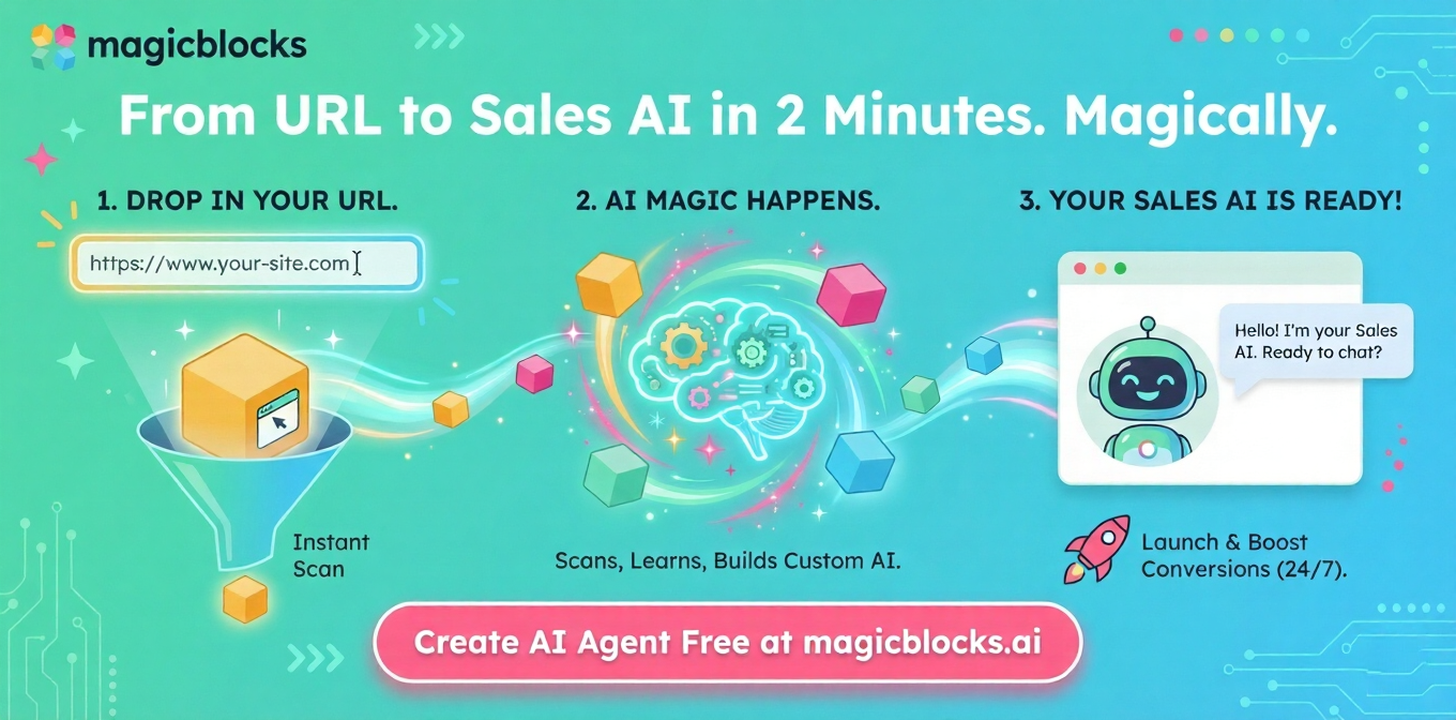
Try MagicBlocks free and watch how an AI agent with a real playbook transforms your conversion rates. No credit card required. No lengthy setup. Just plug in your website URL and see what an AI Sales Agent that actually sells can do for your business.
FAQs
Why does my AI Agent answer questions well but fail to convert leads into demos or sales?
Because answering questions isn’t the same as selling.
Your AI is doing exactly what it was trained to do—be helpful. But sales requires moving conversations forward, creating urgency, handling objections, and knowing when to push for commitment. Without a playbook defining what good looks like at each stage, your agent defaults to infinite helpfulness with zero momentum.
Here’s what’s happening: Prospects ask questions. Your agent answers them. Prospects ask more questions. Your agent keeps answering. The conversation stalls because there’s no strategic direction—no framework for qualifying intent, challenging assumptions, or closing.
At MagicBlocks, our agents are built on the HAPPA Framework (Hook → Align → Personalize → Pitch → Action). They don’t just respond—they guide prospects through a proven conversion path. That’s why our clients see 6x more qualified leads and 737% increases in applications. See how it works.
What is an AI sales playbook, and how is it different from training data or a knowledge base?
Great question. Let’s break it down:
Training data teaches the AI how to talk. It’s the foundation—language patterns, grammar, general knowledge.
A knowledge base gives the AI what to say. Product features, pricing, FAQs, support docs.
A sales playbook tells the AI what to do. It’s strategic guidance on how to move deals forward based on buyer signals, objection types, and conversation context.
Think of it this way: Your knowledge base is the menu. Your playbook is the sales strategy for getting someone to order.
A playbook includes:
- When to educate vs. when to challenge
- How to handle price objections without folding
- Which CTA to deploy based on buyer readiness
- How to create urgency without being pushy
- When to qualify out bad-fit prospects
MagicBlocks playbooks are built from thousands of real sales conversations that generated over $200M in leads. We’re not guessing—we’re operationalizing what actually works.
Do AI Agents need objection-handling scripts to actually close deals?
Not scripts. Frameworks.
Scripts are rigid. They break the moment a prospect says something unexpected. Frameworks are strategic—they give your AI the logic to handle objections dynamically while staying aligned with your sales strategy.
Here’s the reality: Every high-ticket deal hits objections. “That’s expensive.” “I need to think about it.” “How are you different from [competitor]?” If your AI doesn’t have structured responses for these, it either fumbles or gives generic answers that kill momentum.
At MagicBlocks, we’ve built objection-handling frameworks into every playbook:
- Price objections → Reframe value, anchor against cost of inaction
- Timing objections → Create urgency without pressure
- Competitor objections → Differentiate with proof, not claims
- Trust objections → Deploy social proof strategically
This is why our agents convert. They don’t avoid objections—they expect them and know exactly how to respond. Try it free and see the difference.
What happens when an AI Agent doesn’t have a defined sales playbook?
Five failure modes. Every single time.
- FAQ Mode Forever – Endless answering, zero closing. The agent becomes a support bot, not a sales system.
- Inconsistent Advice – Different answers to the same objection. One conversation says $99, the next says $149. Trust erodes fast.
- No Objection Spine – Price pushback kills the conversation because the agent has no framework for reframing value.
- Broken Hand-offs – No clear moment to book, capture, or escalate. Prospects slip through the cracks.
- Trust Decay – The agent sounds smart but feels hollow. Buyers sense they’re talking to something that’s improvising.
The result? You’re paying for traffic, generating conversations, but not converting revenue. Your agent becomes a liability instead of an asset.
MagicBlocks agents are built differently. They execute against proven sales frameworks from day one—so you’re not learning these lessons the expensive way. Start your free trial.
How do I make my AI Agent sell like a human instead of sounding generic?
Two things: personality and strategy.
Personality comes from your brand voice, tone, and communication style. Generic agents sound like every other chatbot because they’re using default model outputs with no customization.
Strategy comes from your sales playbook—the frameworks, objection responses, and conversion logic that guide conversations toward action.
Here’s what makes the difference:
Context-aware responses – Not canned scripts, but dynamic answers based on where the prospect is in the journey
Memory across channels – Your agent remembers who they talked to, what was discussed, and what matters to them
Natural language + sales psychology – Conversational tone combined with proven persuasion frameworks
Adaptive pacing – Knowing when to slow down and educate vs. when to push for commitment
MagicBlocks agents sound human because they operate like human sales reps—using the same frameworks, psychology, and strategic thinking your best closers use. The difference? They do it consistently, at scale, 24/7. See it in action.
Can an AI Agent follow a proven sales framework instead of improvising responses?
Absolutely. In fact, that’s the only way to scale AI selling.
Improvisation might work for generative AI demos, but it’s a disaster for revenue. You need consistency, repeatability, and strategic direction. That’s what frameworks provide.
At MagicBlocks, every agent operates on the HAPPA Framework:
Hook → Grab attention with relevance
Align → Understand their needs and pain points
Personalize → Tailor the pitch to their specific situation
Pitch → Present value in terms they care about
Action → Drive commitment (demo, trial, purchase)
This isn’t theoretical. It’s the same methodology that’s generated over $200M in leads across thousands of real sales conversations. We’ve encoded this into our playbooks so your agent doesn’t guess—it executes.
The result? Predictable, scalable revenue growth. Not “let’s see what happens” experimentation. Try MagicBlocks free and watch your conversion rates transform.
Which AI platforms let you control sales logic, tone, and next-best actions with a playbook?
Most don’t. That’s the problem.
Standard chatbot platforms give you rule-based flows or generic LLM responses. You can’t define strategic sales logic. You can’t customize objection handling. You can’t control when to educate vs. when to close.
What you need:
- Strategic playbook configuration (not just prompts)
- Dynamic decision-making based on buyer signals
- Memory that persists across channels and sessions
- Customizable tone, personality, and brand voice
- Objection-handling frameworks built in
- Clear conversion paths with CTAs calibrated to intent
What you get with MagicBlocks:
Full playbook control – Define your sales strategy, not just your knowledge base
HAPPA Framework – Proven methodology that drives conversations toward action
CDP-native memory – Relationship continuity across every channel
Autonomous agents – They don’t just respond—they qualify, handle objections, and close
Battle-tested – Built on $200M+ in generated leads and thousands of real conversations
Stop settling for chatbots that sound smart but don’t sell. Start your free trial and see what real AI selling looks like. No credit card required.
The Real Takeaway
AI Agents don’t fail because they’re dumb.
They fail because they’re undirected.
Intelligence without strategy is just noise. Your AI can sound smart, answer questions, and generate responses all day long. But if it doesn’t know how to sell, it’s just an expensive FAQ bot.
A playbook is how you turn AI from a talking interface into a selling system.
At MagicBlocks, we’ve built AI Sales Agents that convert because they execute against proven sales frameworks. They know when to educate, when to challenge, when to close. They handle objections with confidence. They create urgency without being pushy. They move deals forward, consistently, at scale, 24/7.
Your AI Agent deserves better than “wing it and see what happens.”
Give it a playbook. Give it a strategy. Give it the frameworks your best reps would use.
That’s how you build AI that doesn’t just chat—it sells.
Ready to stop leaving revenue on the table? Try MagicBlocks free and see what real AI selling looks like. Your competitors are already figuring this out. Don’t get left behind.
Want to see this in action?
See a demoRead the playbook. Now see it run.
Watch a 4-minute demo. No sales pitch. Then decide if you want to talk.