

Top Enterprise Conversion Rate Optimization (CRO) Tools Ranked by Revenue Impact
The enterprise CRO software market is projected to reach $5.0 billion by 2035 at an 11.6% CAGR, according to Future Market Insights. Large enterprises will command 61% of all CRO platform usage in 2025.
Discover top enterprise CRO tools ranked by revenue impact and learn how to optimize lead conversion beyond the session for measurable business growth.
On this page 9
- Executive Summary
- Best Conversion Rate Optimization Platforms for Enterprises in Recap
- 1. MagicBlocks, Enterprise Lead Conversion Engine
- 2. Adobe Target, Enterprise Personalization Engine
- 3. Optimizely, Mature Experimentation Framework
- 4. Dynamic Yield, Real-Time Personalization at Scale
- 5. VWO Enterprise, Accessible Experimentation with Managed Services
- Final Verdict
- FAQ
Executive Summary
The enterprise CRO software market is projected to reach $5.0 billion by 2035 at an 11.6% CAGR, according to Future Market Insights. Large enterprises will command 61% of all CRO platform usage in 2025.
Most of that spend is going toward session-level optimization, such as A/B tests, page personalization, heatmaps. The problem it’s leaving unsolved is revenue leakage after the session: lead decay, delayed follow-up, and lifecycle drop-off between form fill and closed deal.
This article ranks the top five enterprise CRO platforms by measurable revenue impact, with evaluations across six dimensions: incremental lift, RPV improvement, pipeline velocity, time-to-conversion, experimentation throughput, and lifecycle coverage.
Best Conversion Rate Optimization Platforms for Enterprises in Recap
| Category | Quick Answer |
| Best for lifecycle automation | MagicBlocks: AI agents that engage, qualify, follow up, and re-activate leads 24/7 with sub-5-second response |
| Best for Adobe ecosystem | Adobe Target: unmatched personalization depth for enterprises already in Adobe Experience Cloud |
| Best for experimentation depth | Optimizely: gold-standard A/B testing framework, used by 80%+ of Fortune 500 |
| Best for ecommerce personalization | Dynamic Yield: AdaptML recommendation engine and real-time session personalization for transaction-heavy funnels |
| Best for lean teams | VWO Enterprise: transparent pricing, Bayesian SmartStats engine, managed services support |
What Is an Enterprise CRO Platform?
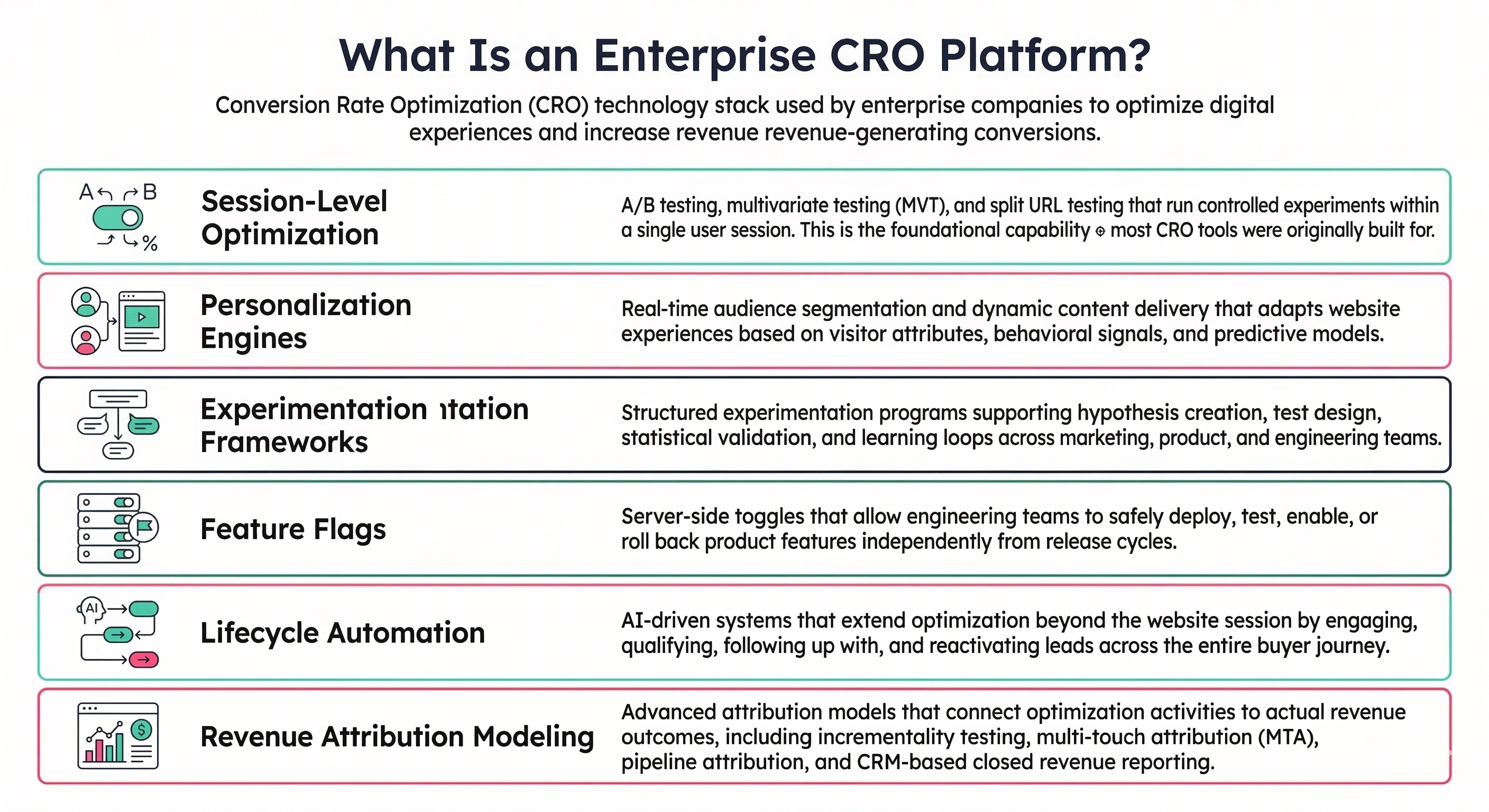
An enterprise CRO (Conversion Rate Optimization) platform is a technology system designed to increase the percentage of visitors, leads, or users who complete a desired revenue-generating action, and to measure the incremental revenue lift that results. Enterprise-grade platforms distinguish themselves from SMB tools by their statistical rigor, data governance capabilities, organizational scalability, and ability to instrument complex multi-channel digital environments.
According to industry research, over 70% of medium and large businesses now use at least one CRO platform.
The category spans six distinct capability layers, and most platforms specialize in one or two:
Session-Level Optimization: A/B testing, multivariate testing (MVT), and split URL testing that runs controlled experiments within a single user session. This is the foundational capability most enterprise CRO tools were built for.
Personalization Engines: Real-time audience segmentation and dynamic content delivery that adapts the digital experience to individual visitor attributes, behavioral signals, and predictive models.
Experimentation Frameworks: Structured programs for hypothesis generation, test design, statistical validation, and compounding learning, typically supported by feature flagging infrastructure for product and engineering teams.
Feature Flags: Server-side toggles that allow product and engineering teams to deploy, test, and roll back product features independently of release cycles.
Lifecycle Automation: AI-driven systems that extend conversion infrastructure beyond the session, engaging, qualifying, following up with, and re-activating leads across their full buying journey. This is the layer most traditional CRO platforms do not cover.
Revenue Attribution Modeling: Incrementality testing (holdout groups vs. exposed), multi-touch attribution (MTA), pipeline-based attribution, and closed-loop CRM reporting that ties optimization activity to closed-won revenue rather than just micro-conversion events. Critically, most CRO platforms stop attribution at the form fill, not the closed deal. This systematically underreports revenue impact and masks the lifecycle leakage happening after the session.
Why Conversion Rate Is No Longer the Right Metric
According to Future Market Insights, the average online conversion rate across digital industries sits around 3.6%. That means 96% of enterprise traffic is exiting without converting. At enterprise scale, with millions of sessions and high-ACV deals, that’s not a metric problem. That’s a revenue hemorrhage.
The metric that actually matters is Revenue Per Visitor (RPV): total revenue divided by total visitors. Unlike conversion rate, RPV accounts for deal value, funnel depth, and lifecycle timing. A 1% RPV lift in a high-ACV funnel outperforms a 5% conversion rate lift in a low-ACV transaction by orders of magnitude.
But RPV still doesn’t capture what happens after the session. The biggest revenue losses in enterprise funnels happen in the 48 hours between a lead arriving and a sales rep following up, a gap most CRO tools are architecturally incapable of closing.
Lead response time is the hidden CRO variable. The Kellogg/MIT Lead Response Management Study by Dr. James Oldroyd and InsideSales.com, covering 55 million sales activities across 5.7 million inbound leads, found that leads contacted within 5 minutes are 100x more likely to convert than those contacted 30 minutes later. Yet only 0.1% of inbound leads are engaged within that window.
The Harvard Business Review’s “The Short Life of Online Sales Leads” (Oldroyd, McElheran, Elkington, 2011), which analyzed 2.24 million sales leads across 2,241 US firms, found that companies contacting leads within one hour were nearly 7x more likely to qualify them than those that waited even 60 minutes longer, and 60x more likely than companies that waited 24 hours or more. The average enterprise response time in that study: 42 hours.
Ranking Methodology
Platforms were evaluated across six weighted dimensions:
- Incremental revenue lift: measured via holdout group testing (not pre/post comparison), where the revenue delta between exposed and control groups at statistical confidence represents true lift
- Revenue per visitor (RPV) improvement: the north-star metric, accounting for deal value and funnel depth
- Pipeline velocity acceleration: time reduction from lead arrival to qualified pipeline stage
- Time-to-conversion reduction: critical in sales-assisted funnels where lead response latency directly determines win rate
- Experimentation throughput: validated tests per month; higher velocity compounds lift faster
- Lifecycle coverage: the platform’s ability to drive revenue outcomes beyond the on-page session
Data sources include platform documentation; verified enterprise user reviews on G2, Capterra, and TrustRadius; third-party pricing intelligence; the InsideSales Lead Response Research study; Future Market Insights CRO market data; and MagicBlocks’ first-party case study data. Pricing figures are directional estimates based on publicly available third-party benchmarks; actual enterprise contracts vary.
1. MagicBlocks, Enterprise Lead Conversion Engine
What It Is
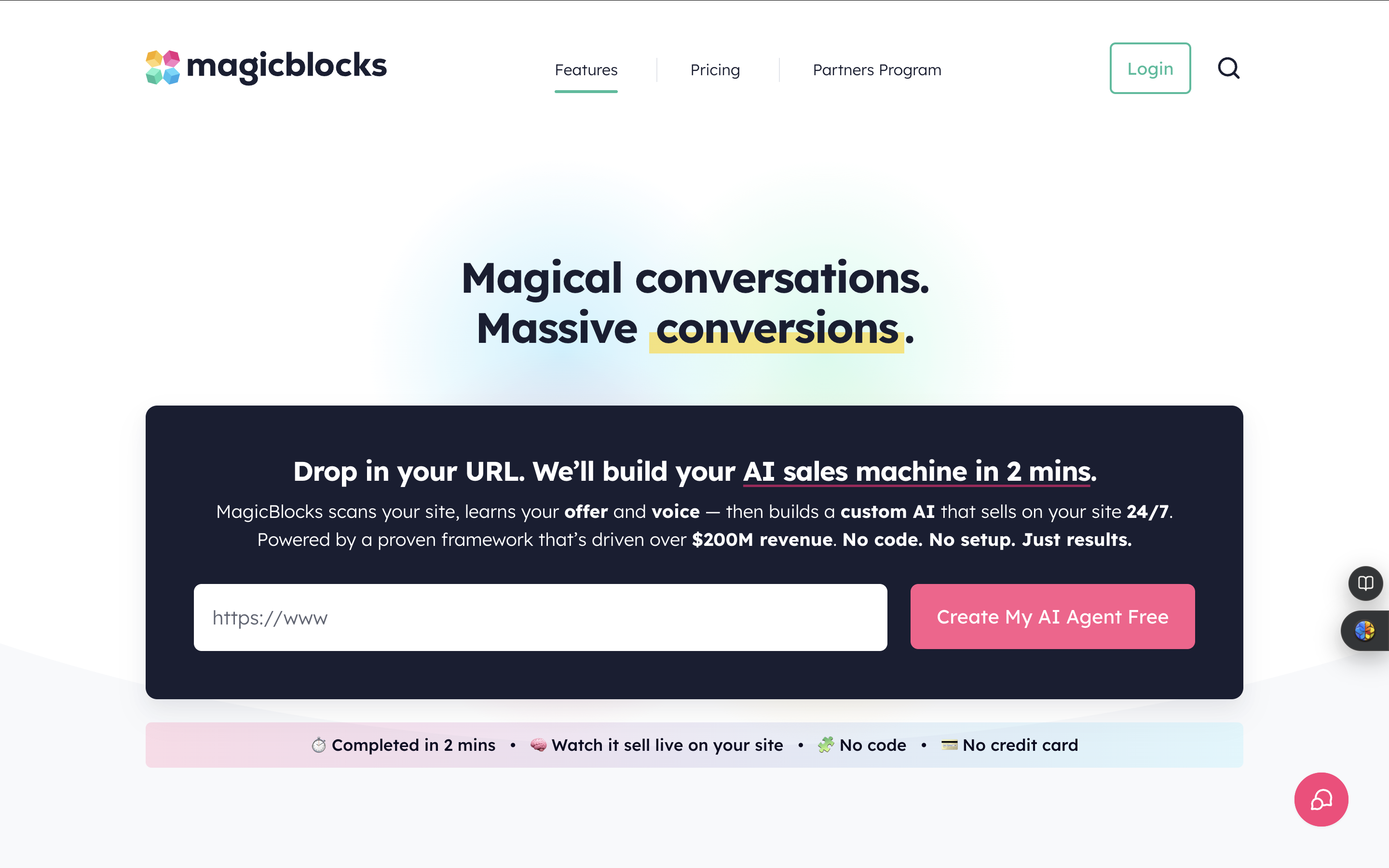
MagicBlocks is an AI sales agent platform purpose-built to eliminate lead decay across the entire lead lifecycle, not just optimize what happens during a page visit. Where every other platform on this list operates at the session level, MagicBlocks runs end-to-end: from the moment a lead arrives to the moment they close, or the moment they go dark and need re-activating.
The architecture is built on $200M+ in lead generation experience and embedded with proven sales psychology through the HAPPA framework (Hook, Align, Personalize, Pitch, Action). AI agents respond in under 5 seconds, 24/7, with full conversational context, qualifying leads automatically, following up persistently across chat, SMS, and email, and re-activating cold leads that other systems would leave untouched in the CRM.
Key Features
- Instant AI engagement: sub-5-second response at any hour, across chat, SMS, and email
- CDP-native persistent memory: retains context across sessions and channels so every conversation continues where it left off
- Automated lead qualification: HAPPA-driven conversation logic that qualifies leads without human intervention
- Omnichannel follow-up: persistent multi-channel outreach that doesn’t stop after one touchpoint
- Lead re-engagement: automated re-activation campaigns for dormant leads already in your CRM
- Native CRM integration: direct integrations with GoHighLevel and HubSpot
- Modular state-aware architecture: composable conversation blocks (qualification, compliance, journey) configurable per industry and funnel type
- Guardian compliance engine: built-in regulatory guardrails for mortgage, finance, and healthcare
- 97.5% success rate vs. monolithic prompt competitors: modular architecture maintains performance under complex conversation conditions
Pros and Cons
Pros
- Only platform in this ranking with full lead lifecycle coverage, from session through re-engagement
- Drives measurable pipeline velocity improvements, not just conversion rate uplift
- Operates autonomously with no ongoing experimentation team required
- Proven in high-ACV industries: fintech, mortgage, real estate, B2B SaaS
- Works on existing lead volume, converting spend you’ve already made into revenue
Cons
- Not a page-level testing tool and doesn’t replace A/B testing infrastructure for UI experimentation
- ROI is highest in sales-assisted funnels; lower-consideration high-volume ecommerce benefits less
- Works best with clean CRM integration and defined lead qualification criteria from day one
Quick-Scan Summary
| Best For | Not Ideal For | Pricing Range | Technical Requirement | Primary Revenue Lever |
| Enterprises, Sales-assisted B2B, high-ACV lead funnels, mortgage, fintech, real estate, HighLevel agencies | Low-ACV ecommerce, pure page-testing programs | Custom (free trial available) | Low to Medium (CRM admin + chat embed) | Lead lifecycle automation: turns paid-for leads into revenue at every stage |
Pricing
Custom pricing based on lead volume and plan tier. Free trial available to see actual conversion impact on your own traffic before committing.
Create AI Agent free at magicblocks.ai
Case Study: Beeline Mortgage (Fintech)
| Client | Beeline, a US-based fintech mortgage lending platform |
| Core Problem | 60% of leads arrived after business hours with no AI response. Manual qualification was draining sales capacity. Average follow-up response time exceeded 47 minutes |
| Solution Deployed | MagicBlocks AI agent (“Bob”): 24/7 conversational qualification, instant response, omnichannel follow-up |
| Measurement Method | Before/after comparison across lead volume, application completion rate, qualified lead count, and conversation-to-lead conversion rate |
| Completed Applications | Approximately 737% increase |
| Qualified Lead Growth | Approximately 484% growth in qualified leads entering sales funnel |
| Conversation-to-Lead Rate | Approximately 48.7% (up from approximately 25% with human follow-up) |
| Overall Engagement Uplift | Approximately 300% |
| Response Speed Improvement | Approximately 5x faster than human follow-up benchmarks |
| Revenue Significance | Each completed mortgage application represents a high-ACV deal opportunity; application volume is a direct leading indicator of revenue pipeline |
Use MagicBlocks to map revenue leakage across your entire lead lifecycle before running page-level tests. You’ll find more money in the gaps between touchpoints than in any button color test.
2. Adobe Target, Enterprise Personalization Engine
What It Is
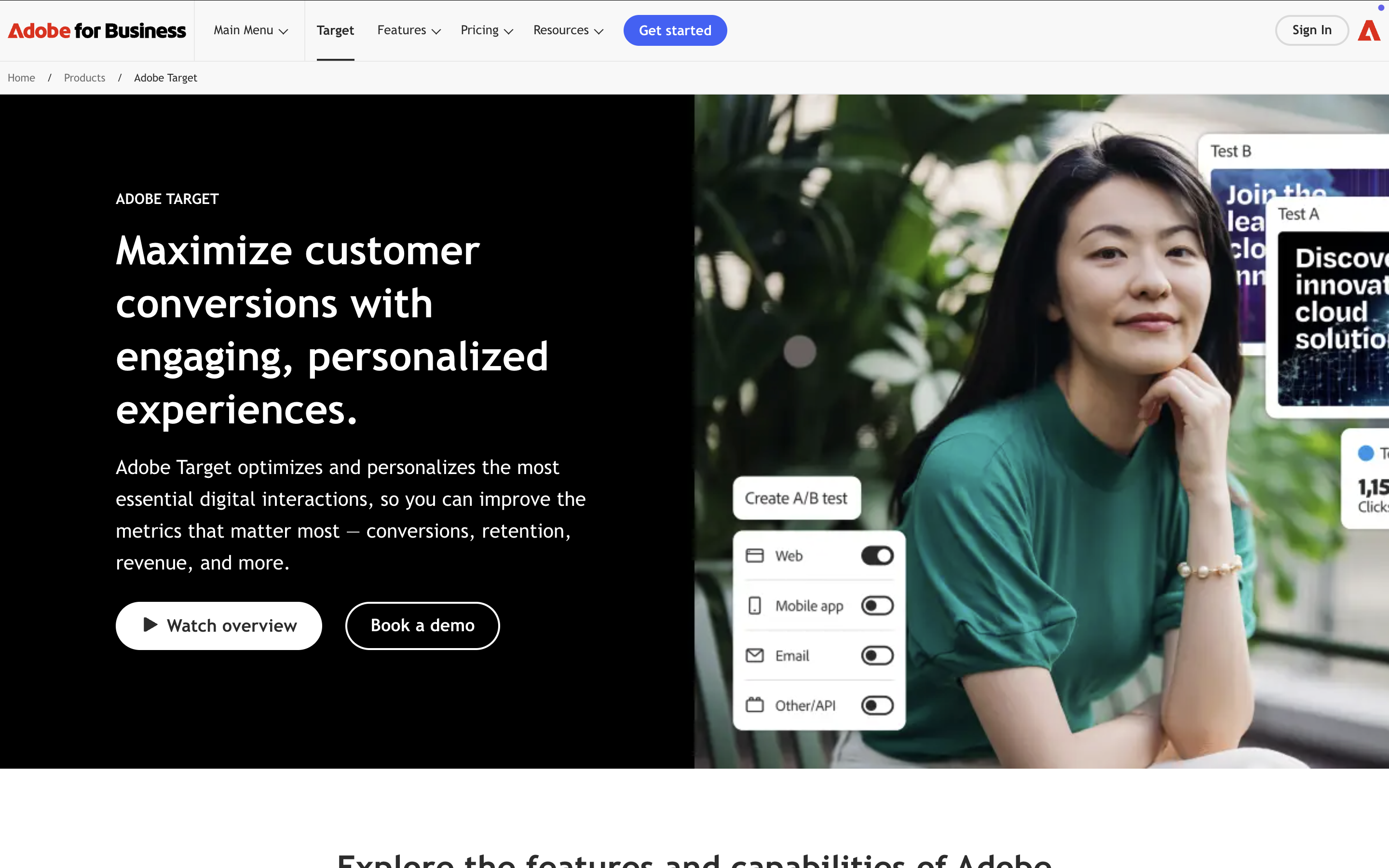
Adobe Target is Adobe’s enterprise-grade A/B testing and personalization platform, the workhorse for large organizations embedded in the Adobe Experience Cloud. With deep integration across Adobe Analytics, Real-Time CDP, Experience Manager, and Marketo, it’s purpose-built for enterprises where personalization must span every digital channel and every data system.
If your organization has already invested heavily in the Adobe stack, Target delivers personalization capability that’s genuinely difficult to replicate from outside that ecosystem. Adobe reports that 48% of marketers implementing website personalization achieved double-digit revenue lift.
Key Features
- A/B, multivariate, and split URL testing across web and mobile
- AI-powered Auto-Target: ML that automatically serves the best-performing experience per visitor in real time
- Automated Personalization (AP): algorithmically matches content and offers to individual visitor profiles
- Server-side and on-device decisioning: high-performance testing with no page flicker or latency impact
- Deep Adobe ecosystem integration: native sync with Adobe Analytics, Real-Time CDP, Experience Manager, and Journey Optimizer
- Recommendations engine: behavioral and attribute-based product and content recommendations
- Enterprise governance: role-based access controls, activity approval workflows, and audit logging
Pros and Cons
Pros
- Unmatched integration depth for enterprises already in the Adobe ecosystem
- AI Auto-Target produces measurable lift without manual test management overhead
- Server-side decisioning eliminates page flicker that degrades experiment validity
- Strong closed-loop analytics integration with Adobe Analytics for revenue attribution
- Enterprise governance and compliance tooling for complex organizational structures
Cons
- Among the most expensive platforms in this category, starting around $50K per year
- High implementation complexity; typically requires a qualified Adobe system integrator
- Value is bounded for organizations not deeply invested in the Adobe stack
- No lifecycle coverage: lead decay, post-conversion follow-up, and pipeline velocity are out of scope
- Enterprise procurement cycles are long, typically 3 to 6 months from evaluation to go-live
Quick-Scan Summary
| Best For | Not Ideal For | Pricing Range | Technical Requirement | Primary Revenue Lever |
| Large enterprises with Adobe stack, complex multi-channel personalization, content-heavy digital experience | Organizations not using Adobe Analytics or Experience Cloud; lean teams without dedicated CRO resources | Approximately $50K to $500K+/year (custom) | High (Adobe system integrator typically required) | Session-level personalization and AI-driven content optimization at enterprise scale |
Pricing
Custom enterprise pricing only. Reported starting price: approximately $50,000/year for standard plans, scaling to $500,000+/year for 100,000+ monthly active users. Implementation costs typically add $20,000 to $100,000+. Contact Adobe directly for a custom quote.
3. Optimizely, Mature Experimentation Framework
What It Is
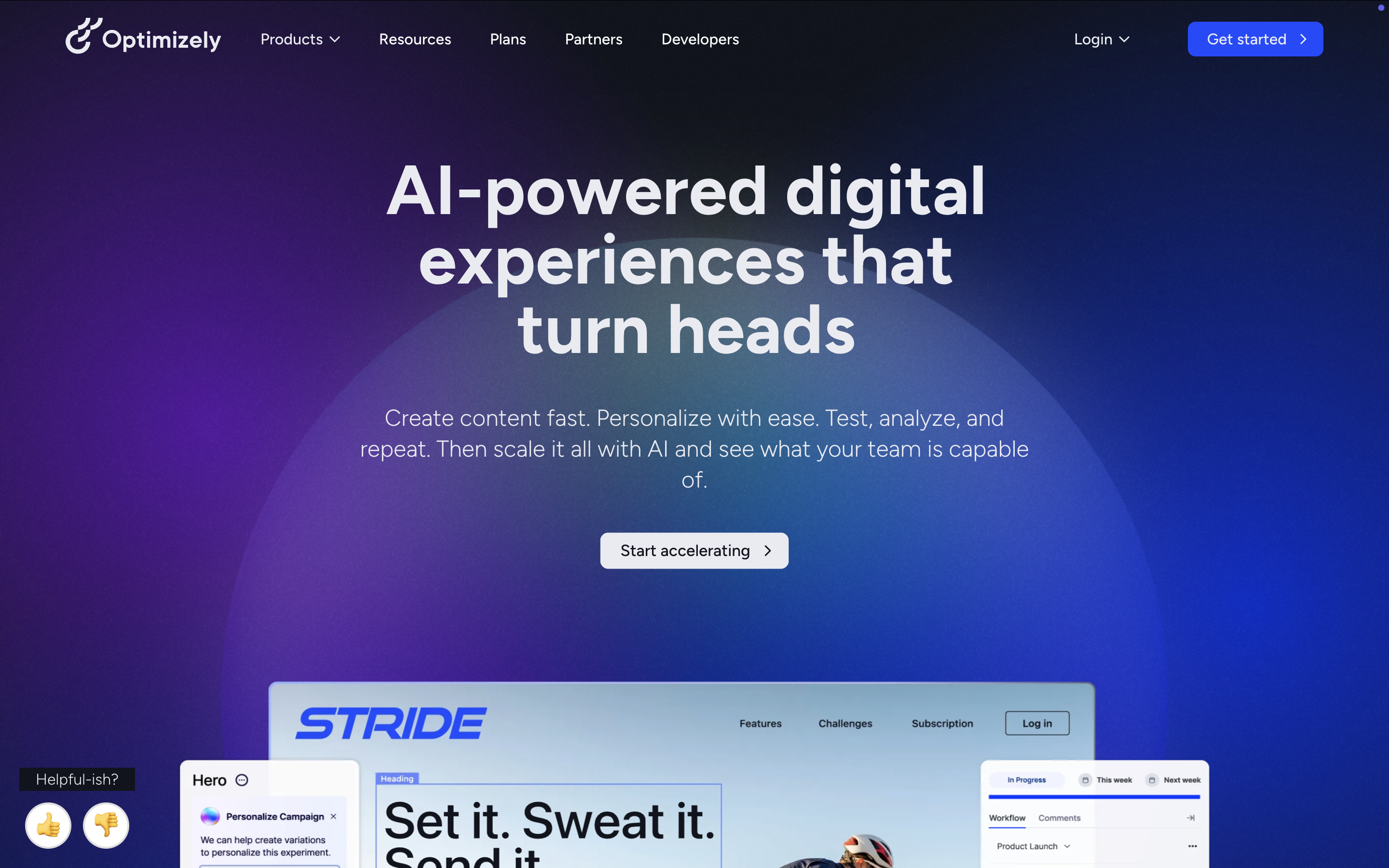
Optimizely is the gold standard for enterprise experimentation. Research cited across multiple CRO reports attributes approximately 25% of total CRO market share to Optimizely, with more than 80% of Fortune 500 companies running on their testing and personalization infrastructure.
What started as an A/B testing tool in 2010 has evolved into a full Digital Experience Platform spanning content orchestration, commerce, experimentation, and analytics, all powered by the Opal AI layer for hypothesis generation and insight analysis.
For product-led growth enterprises that treat experimentation as a core business discipline, where engineering, product, and marketing all have a stake in the testing program, Optimizely delivers the depth, statistical rigor, and workflow infrastructure to run experimentation at genuine scale.
Key Features
- Web and full-stack (server-side) experimentation: A/B, multivariate, and feature experiments across web, mobile, and back-end services
- Feature flags: safely test and roll out product features with statistical guardrails, independently of release cycles
- AI-driven personalization: Contextual Bandits and algorithmic content personalization that adapts to real-time behavioral signals
- Content orchestration: plan, create, and publish digital experiences within the same platform
- Warehouse-native analytics: direct data warehouse connection for revenue-attributed reporting beyond session metrics
- Optimizely Opal: AI agents for hypothesis generation, test design, and insight analysis
- Statistical engine: sequential testing, CUPED variance reduction, multi-armed bandit optimization
Pros and Cons
Pros
- Industry-leading experimentation framework with the statistical rigor enterprise teams require
- Feature flagging enables engineering teams to safely ship and test product capabilities without full releases
- Comprehensive DXP reduces vendor sprawl for teams that also need CMS alongside experimentation
- Opal AI meaningfully accelerates hypothesis generation and test velocity
- Trusted by Salesforce, Nike, Zoom, Calendly, and 80%+ of Fortune 500
Cons
- Among the most expensive CRO platforms: minimum $36,000+/year, scaling to $200,000+ for high-traffic enterprises.
- Requires significant technical resources; not a marketer-friendly self-serve platform
- Pricing scales with traffic volume, not experiments run, which penalizes teams early in their testing program
- Annual contracts only with no monthly payment flexibility
- No lifecycle coverage: post-conversion lead management is out of scope
Quick-Scan Summary
| Best For | Not Ideal For | Pricing Range | Technical Requirement | Primary Revenue Lever |
| PLG enterprises, engineering-led experimentation, companies running 20+ concurrent tests, Optimizely CMS users | Budget-constrained teams, organizations needing lifecycle automation, companies without developer resources | Approximately $36K to $200K+/year (custom, annual only) | High (front-end and back-end developer typically required) | Experimentation velocity: compounds learning across the digital experience to lift conversion rates over time |
Pricing
Custom pricing only with no public rates. Web Experimentation plans start around $36,000/year. A plan covering 10 million monthly impressions is estimated at $63,700 to $113,100/year. Complex enterprise DXP implementations can exceed $200,000/year. Annual contracts required.
4. Dynamic Yield, Real-Time Personalization at Scale
What It Is
Dynamic Yield (acquired by Mastercard in 2022 and positioned as the “Experience OS”) is a personalization and experience optimization platform built around one core idea: every customer is different, and your digital experience should reflect that in real time at every touchpoint.
Particularly powerful in ecommerce, retail, financial services, and quick-service restaurants, industries where real-time personalization of product recommendations and offers directly drives revenue per session.
Key Features
- AdaptML AI recommendations: algorithmically predicts and serves the most relevant products or content per individual user
- Real-time segmentation: builds and activates audience segments based on behavioral signals, purchase history, and contextual attributes
- A/B and multivariate testing: experimentation across web, mobile, email, and advertising
- Journey orchestration: triggers personalized experiences at critical moments across channels
- Element hyper-personalization: individual-level personalization beyond segment-level targeting
- Search personalization: re-ranks search results based on individual user preferences
- Email personalization: render-time content that adapts live at open
- Experience APIs: developer-friendly APIs for custom personalized experience builds
- Mastercard-grade enterprise compliance: GDPR, CCPA, SOC 2, enterprise security infrastructure
Pros and Cons
Pros
- AdaptML recommendation engine is best-in-class for high-SKU ecommerce environments
- Journey orchestration coordinates web, mobile, email, and advertising in a unified personalization layer
- Mastercard acquisition brings enterprise-grade security, compliance, and financial industry credibility
- No setup fee, which reduces initial deployment costs relative to other enterprise vendors
- Strong ROI documented in retail, restaurant, and financial services verticals
Cons
- Enterprise-tier pricing: mid-market teams frequently cite cost as prohibitive, per user reviews
- Built for transaction-oriented funnels with limited applicability to complex B2B sales-assisted funnels
- No native post-session lead lifecycle coverage: qualification, follow-up, and reactivation are out of scope
- Mastercard acquisition has introduced some product roadmap uncertainty
- Implementation requires technical resources and is not a quick-win self-serve deployment
Quick-Scan Summary
| Best For | Not Ideal For | Pricing Range | Technical Requirement | Primary Revenue Lever |
| Ecommerce enterprises, multi-location restaurants, financial services, travel, high-volume retail | B2B sales-assisted funnels, lead-generation businesses, lean teams without engineering support | Approximately $50K to $300K+/year (custom, no setup fee) | Medium to High (data layer and developer required) | AI-driven product recommendations and real-time session personalization that lifts revenue per transaction |
Pricing
Dynamic Yield uses custom, quote-based pricing with no public price list, but third‑party sources indicate it typically starts at around 35,000 USD per year and scales with your traffic, selected modules, and support level.
5. VWO Enterprise, Accessible Experimentation with Managed Services
What It Is
VWO (Visual Website Optimizer) has been in the experimentation business since 2009, earning a loyal enterprise following by doing something the bigger platforms often miss: making CRO genuinely accessible without requiring a PhD in statistics or a full engineering team. VWO Enterprise covers testing, behavioral analytics, personalization, and voice-of-customer tools in a connected platform, with pricing that’s more transparent than most competitors.
The standout differentiator is SmartStats 2.0, a Bayesian statistical engine introduced in 2023 that VWO reports reduces test duration by up to 50% compared to traditional frequentist approaches. For headcount-constrained teams, that’s a meaningful velocity gain. Add VWO’s managed services offering, and it’s one of the few enterprise CRO platforms where you can generate lift without building a large internal team.
Key Features
- Web, mobile, and server-side testing: A/B, split URL, and multivariate testing across all digital properties
- VWO Copilot: AI assistant for hypothesis generation, test prioritization, and insight analysis
- SmartStats 2.0: Bayesian statistical engine that reduces test duration by up to 50%
- Behavioral analytics: heatmaps, session recordings, funnel analysis, and form analytics
- Personalization: rule-based and AI-assisted content personalization
- Voice of Customer (VWO Pulse): in-page surveys and direct visitor feedback collection
- Feature experimentation: server-side feature flags for product and engineering teams
- Managed services: VWO’s team can run experiments on behalf of clients
Pros and Cons
Pros
- More transparent pricing than Adobe, Optimizely, or Dynamic Yield, with published starter rates available
- SmartStats 2.0 cuts test duration by up to 50%, compounding velocity gains for lean teams
- All-in-one platform covering testing, behavioral analytics, personalization, and VoC in one tool
- Managed services make experimentation accessible even without an internal CRO team
- Intuitive visual editor accessible to marketers without engineering support for basic tests
- 3,000+ enterprise customers across ecommerce, SaaS, and media
Cons
- MTU-based pricing scales steeply at enterprise traffic volumes, per independent pricing analysis
- Advanced features including personalization, heatmaps, and surveys are add-ons not included in base plans
- Less sophisticated statistical capabilities than Optimizely for complex multi-variable experiments
- No lifecycle coverage: post-session lead management is outside platform scope
- Feature depth can feel limiting for highly complex enterprise experimentation programs
Quick-Scan Summary
| Best For | Not Ideal For | Pricing Range | Technical Requirement | Primary Revenue Lever |
| Mid-enterprise and growth-stage teams, lean CRO programs, ecommerce wanting testing and analytics in one tool | Large enterprises needing sophisticated statistical models or lifecycle automation; very high-traffic properties where MTU pricing scales steeply | Approximately $199/mo starting (MTU-based), custom enterprise | Low to Medium (JS tag or API, visual editor available) | Experimentation velocity through accessible testing and Bayesian statistics that compounds learning faster |
Pricing
MTU (Monthly Tracked Users) pricing model. Starting at approximately $199/month for up to 10,000 MTU on testing plans. Enterprise volumes are custom-quoted. Personalization, heatmaps, and surveys are priced as add-ons. See current rates at vwo.com/pricing.
How to Choose an Enterprise CRO Platform
The right platform depends less on feature lists and more on your funnel architecture, ACV range, martech maturity, and sales cycle.
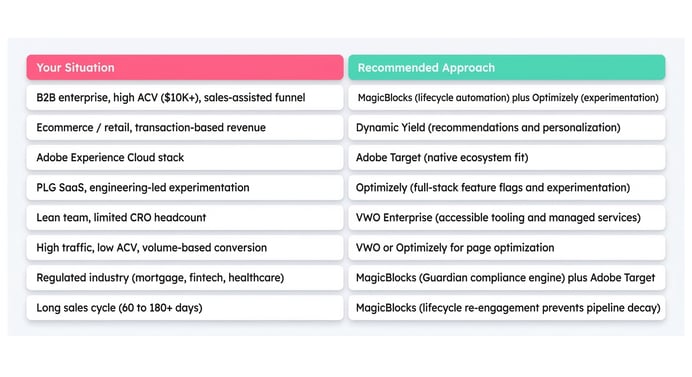
Traffic Volume: High-traffic properties (1M+ monthly sessions) benefit most from statistical rigor tools like Optimizely or VWO. Lower-traffic, high-ACV funnels benefit most from lifecycle acceleration, where MagicBlocks produces outsized ROI on smaller lead volumes. Research from Future Market Insights confirms that large enterprises now lead CRO platform adoption at 61% of global usage.
Martech Maturity: Enterprises with mature analytics stacks and dedicated experimentation teams can leverage Optimizely or Adobe Target’s full depth. Teams earlier in their CRO journey should prioritize automation-first platforms (MagicBlocks) or managed service options (VWO).
Data Governance Requirements: Financial services, healthcare, and mortgage enterprises require explicit compliance infrastructure. MagicBlocks’ Guardian engine, Adobe Target’s HIPAA-compatible BAA options, and Optimizely’s enterprise data governance are the relevant considerations in regulated sectors.
CRM Complexity: Enterprises running GoHighLevel or HubSpot get the deepest native integration through MagicBlocks. Adobe Target and Optimizely offer CRM connectivity through data layers and API ecosystems but lack the conversational-layer CRM feedback loop MagicBlocks closes.
Head-to-Head Comparisons
Adobe Target vs. Optimizely
Adobe Target wins for organizations deeply embedded in Adobe Experience Cloud: the analytics, CDP, and CMS integrations are native and deeply interoperable.
Optimizely wins for product-led growth enterprises that need full-stack feature flagging and server-side experimentation baked into engineering workflows, without the broader Adobe ecosystem dependency.
Pricing is comparable at enterprise tier; Optimizely is generally more accessible for teams without existing Adobe commitments, per independent pricing comparisons.
Dynamic Yield vs. Optimizely
Different use cases, different strengths. Dynamic Yield is a personalization-first platform with AI recommendation capability that shines in ecommerce: built to increase average order value and return visit revenue through real-time session personalization. Optimizely is an experimentation-first platform with personalization layered on top, built to validate hypotheses at scale. For transaction-heavy ecommerce, Dynamic Yield’s AdaptML recommendation engine is stronger. For complex product and website experimentation programs, Optimizely’s statistical framework is more rigorous.
Best CRO Tool for B2B Enterprise
| Criterion | Best Choice | Why |
| High ACV ($20K+), sales-assisted | MagicBlocks | Lifecycle automation eliminates the lead decay that kills high-ACV deals between touchpoints |
| PLG SaaS, product experimentation | Optimizely | Full-stack feature flags and Contextual Bandits for in-product personalization |
| Adobe ecosystem enterprise | Adobe Target | Native personalization depth and analytics integration for Adobe stack users |
| Full-funnel coverage | MagicBlocks plus Optimizely | Session-level experimentation combined with lifecycle automation covers the complete funnel |
Best CRO Tool for Ecommerce Enterprise
| Criterion | Best Choice | Why |
| High-SKU product recommendations | Dynamic Yield | AdaptML recommendation engine is best-in-class for ecommerce product personalization |
| Large-scale A/B testing program | Optimizely | Statistical rigor and experimentation velocity at Fortune 500 scale |
| Lean team, quick deployment | VWO Enterprise | Accessible visual editor, Bayesian SmartStats, and managed services option |
| Post-purchase lifecycle and win-back | MagicBlocks | Re-engagement automation for lapsed customers and abandoned checkout follow-up |
Best CRO Tool for High-ACV Funnels
When average deal value exceeds $10,000 to $20,000, the economics of lead lifecycle optimization dramatically outperform page-level A/B testing. A single percentage point improvement in lead-to-qualified conversion on a $50K ACV deal generates far more revenue than a 2% lift in on-page CTR.
Research from the InsideSales Lead Response Management study confirms that speed-to-lead is the single biggest lever in high-ACV funnels: the first company to engage wins the deal in 78% of cases. MagicBlocks is purpose-built for this profile, turning lead decay into captured pipeline through instant AI engagement, persistent follow-up, and lifecycle re-activation.
Final Verdict
Every platform in this ranking does its job. Adobe Target personalizes at session depth. Optimizely runs experiments at scale. Dynamic Yield surfaces AI-driven product recommendations in real time. VWO makes experimentation accessible for resource-constrained teams.
All of them optimize the session. None of them own what happens after.
That’s the gap MagicBlocks was built for. Lead decay, lifecycle leakage, delayed follow-up, untouched CRM records: these are the revenue losses that page-level CRO tools can’t see, let alone fix.
The enterprises winning at revenue conversion aren’t choosing between page optimization and lifecycle automation. They’re running both. And that’s when you start seeing numbers like Beeline’s 737% lift in completed applications, not from a better landing page, but from eliminating the leakage happening in the 48 hours after the page.
Start with the lifecycle. Then scale the experimentation.
FAQ
What is enterprise CRO?
Enterprise CRO (Conversion Rate Optimization) is the practice of using data, experimentation, and automation to systematically increase the percentage of visitors, leads, and users who complete revenue-generating actions and to measure the incremental revenue lift that results.
Enterprise-grade CRO extends beyond basic A/B testing to include personalization engines, feature experimentation, lifecycle automation, and revenue attribution modeling. According to Future Market Insights, the CRO software market is growing at 11.6% CAGR, reflecting how central optimization has become to enterprise revenue strategy.
What is RPV and why does it matter more than conversion rate?
RPV (Revenue Per Visitor) is total revenue divided by total visitors. Unlike conversion rate, RPV accounts for deal value: a 1% RPV lift in a $50K ACV funnel generates dramatically more revenue than a 5% conversion rate lift in a $50 transaction. For high-ACV enterprise funnels, RPV is the accurate north-star metric.
What is lead decay and how does it cost enterprises revenue?
Lead decay is the degradation in lead quality and conversion probability that occurs when follow-up is delayed. The Kellogg/MIT Lead Response Management Study via InsideSales.com found that leads contacted within 5 minutes are 100x more likely to convert than those contacted 30 minutes later, yet only 0.1% of inbound leads are engaged within that window. At enterprise scale, lead decay is one of the single largest sources of revenue leakage.
How do enterprises measure incremental revenue lift from CRO tools?
The most defensible method is holdout group testing: a randomly assigned control group receives no optimization while the exposed group receives the change. The revenue delta between the two groups, measured at statistical confidence, is your true incremental lift. Pre/post comparisons are less reliable and susceptible to seasonality and traffic quality shifts.
What is experimentation velocity and why does it predict revenue lift?
Experimentation velocity is the number of validated experiments a team runs per unit of time. Higher velocity means faster learning cycles and faster compounding of lift. Research across enterprise CRO programs consistently shows that experimentation cadence, not platform sophistication, is the strongest predictor of sustained revenue improvement.
Which CRO tools integrate best with CRM systems?
MagicBlocks offers native integrations with GoHighLevel and HubSpot. Adobe Target integrates with the Adobe ecosystem including Marketo and Adobe Analytics. Optimizely supports CRM connections through its data layer and API integrations. Salesforce compatibility varies by platform and typically requires custom configuration.
What ROI should enterprises expect from CRO investment?
ROI varies significantly by funnel type and deal value. For sales-assisted funnels with ACV above $10,000, even a 1 to 2% improvement in lifecycle conversion velocity can produce 10 to 25x returns on CRO tooling investment. The Beeline case study (approximately 737% increase in completed mortgage applications) illustrates what’s possible when the full lead lifecycle is optimized, not just the session.
What is lead leakage in enterprise funnels?
Lead leakage is the revenue lost when qualified leads exit the funnel prematurely due to slow response times, inconsistent follow-up, poor qualification routing, or absence of re-engagement programs. Enterprise funnels with complex, multi-touchpoint sales cycles are especially vulnerable. Harvard Business Review research found that 23% of companies never respond to web-generated leads at all, and the average enterprise response time is 42 hours.
Adobe Target vs Optimizely: which is better for enterprise?
Adobe Target is better if you’re already embedded in Adobe Experience Cloud and need deep personalization across a multi-tool Adobe stack. Optimizely is better if you need engineering-grade experimentation, feature flagging, and PLG infrastructure that operates independently of any specific vendor ecosystem. For pure budget-to-lift ROI without legacy ecosystem lock-in, independent analysis suggests Optimizely typically offers more accessible entry points.
Enterprise CRO shouldn’t stop at the page.
Map where your leads are dying. Then let MagicBlocks convert them.
Create Your AI Sales Agent Free at MagicBlocks, upgrade your plan and increase your conversion rate.
Want to see this in action?
See a demoRead the playbook. Now see it run.
Watch a 4-minute demo. No sales pitch. Then decide if you want to talk.