

How to Use AI to Turn Enterprise Websites Into Sales Machines
Your enterprise sales team runs like a machine. Your website probably doesn't. Here's how AI closes that gap, and turns your site into an active, revenue-generating part of your go-to-market system.
Transform your enterprise website into a dynamic sales engine using AI for personalized messaging, real-time qualification, and seamless sales integration. Discover how to close the gap and drive revenue.
On this page17
- TL;DR
- Key Takeaways in A Minute
- Try MagicBlocks AI Sales Agent
- What Is an AI-Powered Enterprise Website?
- Your Sales Team Is Systematic. Your Website Is a Brochure.
- Static Websites vs AI-Powered Revenue Websites
- Why Enterprise Websites Generate Traffic, Not Revenue
- What an Enterprise Sales Machine Actually Looks Like
- The 4 Layers of an AI Revenue Website
- How AI Turns Your Website Into a Revenue Engine
- Step-by-Step: Building an AI-Powered Enterprise Sales Website
- How MagicBlocks Turns Traffic Into Revenue
- The Metrics That Prove Your Website Is Driving Revenue
- Common Mistakes When Using AI on Enterprise Websites
- Advanced: Multi-Threading, Expansion, and Account Orchestration
- AI Enterprise Website Implementation Checklist
- FAQ: AI for Enterprise Website Revenue
TL;DR
Your enterprise sales team runs like a machine. Your website probably doesn’t. Here’s how AI closes that gap, and turns your site into an active, revenue-generating part of your go-to-market system.
- Align your website to your actual sales process, not vanity traffic metrics
- Use AI to personalize messaging dynamically by ICP, vertical, and buying stage
- Automate qualification, routing, and content orchestration for multi-stakeholder deals
- Integrate website intelligence directly into your RevOps and sales workflows
- Treat the website as a pre-sales environment, not just a content library
Key Takeaways in A Minute
- Enterprise websites fail at revenue because they treat all visitors identically, no ICP logic, no buying stage awareness, no role-based content.
- AI revenue websites adapt messaging, qualification, and content delivery based on who is visiting and where they are in their buying journey.
- The 4-layer AI website architecture (Recognition, Personalization, Qualification, Sales Activation) mirrors how enterprise sales teams already operate.
- Conversational AI qualifies prospects automatically, replacing slow form-to-follow-up cycles with real-time deal progression.
- CRM integration turns website traffic into pipeline data, account-level signals that change how reps approach every conversation.
- MagicBlocks closes the gap between strategy and execution: drop in your URL, engage every visitor, qualify automatically, route to sales, and reactivate cold leads.
Try MagicBlocks AI Sales Agent
What Is an AI-Powered Enterprise Website?
An AI-powered enterprise website uses personalization, intent detection, and automated qualification to convert website traffic into sales pipeline, integrating with CRM, RevOps workflows, and sales teams to guide buyers through the enterprise purchasing process.
Legacy enterprise websites function as digital brochures: they house content, support brand credibility, and generate organic traffic. An AI-powered revenue website does something fundamentally different. It recognizes who a visitor is, adapts messaging to their role and buying stage, qualifies them in real time, and routes high-fit leads directly into your sales motion.
Platforms like MagicBlocks are built specifically for this layer: the gap between a lead arriving on your website and a qualified conversation starting with your sales team.
Your Sales Team Is Systematic. Your Website Is a Brochure.
Here’s something that should bother you more than it probably does.
Your SDRs follow a precise sequence. Your Account Es run structured discovery. Your RevOps team tracks every handoff with surgical accuracy. The whole machine is built for repeatability: ICP prioritization, multi-threaded outreach, ROI modeling, security reviews, expansion motions. It’s a system.
Now go look at your website.
Same hero headline for every visitor. Same case studies regardless of vertical. No awareness of where someone is in their buying journey. No logic to differentiate the CFO from the practitioner, or the day-one researcher from the vendor-shortlisting buyer. Just content. Sitting there.
The sales org runs like a machine. The website runs like a brochure.
This mismatch is one of the most expensive problems in enterprise go-to-market. McKinsey’s research on AI-powered marketing and sales finds that research finds that a fifth of current sales-team functions could be automated through AI, and 90% of commercial leaders expect to deploy gen AI solutions regularly within two years. Yet most enterprise websites still operate as passive content libraries with no sales intelligence built in.
The data makes the case clearly. Gartner projects that 80% of B2B sales interactions will occur in digital channels by 2025, making the website the primary sales environment for enterprise buyers. And McKinsey’s B2B growth study finds that data-driven commercial teams blending personalized customer experiences with gen AI are 1.7 times more likely to increase market share than those that do not. The companies winning enterprise pipeline aren’t outspending their competitors on ads. They’re outperforming them on what happens after a visitor arrives.
The opportunity is real and the gap is wide. McKinsey’s research on B2B sales technology adoption finds that only 20% of B2B respondents have a proven track record of consistently implementing technologies that fuel outsize growth, leaving a wide-open playing field for companies that move decisively on AI. Yet most enterprise websites still generate traffic rather than pipeline, because they’re built for content, not for selling.
Discover more on why enterprise conversion rates plateau and what’s driving the gap between traffic and pipeline.
Static Websites vs AI-Powered Revenue Websites
The gap between a traditional enterprise website and an AI revenue website is systemic, not cosmetic.
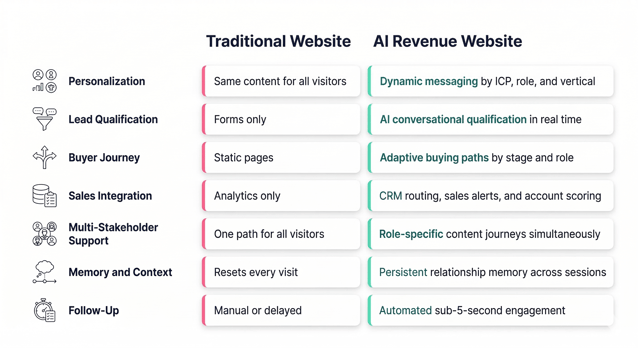
Why Enterprise Websites Generate Traffic, Not Revenue
Most enterprise websites are optimized for the wrong outcomes: SEO rankings, brand credibility, and content volume. Those things matter. But they don’t qualify leads, advance deals, or route buyers to the right sales motion. According to McKinsey’s B2B growth research, B2B winners generate more growth from existing demand by converting higher percentages of their traffic, not simply generating more of it.
The 4 Ways Your Website Leaks Revenue
- No ICP segmentation. Every visitor sees the same page, regardless of industry, company size, or buying role. A logistics VP and a fintech founder get identical messaging.
- Static buying stage. Your website doesn’t know if someone’s in research mode or about to request a demo. The content they see doesn’t adapt.
- No multi-stakeholder orchestration. Enterprise deals involve 6 to 10 decision-makers. Your website serves one path. Everyone else figures it out, or leaves.
- No deal-stage awareness. Visitors return to your site multiple times before engaging sales. Your website has no memory. Every visit starts from zero.
And here’s the brutal truth about enterprise buyers: they’ve already done significant homework before they ever talk to your team. They’ve mapped competitive options, run internal alignment conversations, and evaluated security posture, all from content they found on the open web. See more on top enterprise conversion rate optimization strategies to understand how leading teams are closing this gap.
What an Enterprise Sales Machine Actually Looks Like
To turn your website into part of the revenue system, you first need to understand what that system actually is. McKinsey’s research on B2B sales technology shows that B2B sales leaders who systematically apply technology across their pipeline see 3x more pipeline efficiency than those who rely on human effort alone.
The 5 Layers of an Enterprise Sales Machine
- SDR/BDR Qualification: Prioritization by ICP fit and buying intent before any AE time gets invested.
- AE Discovery and Solution Design: Deep diagnosis of the specific business problem, customized to the account’s context.
- SE Validation: Technical confirmation that your solution integrates, scales, and meets security requirements.
- Multi-Stakeholder Engagement: Simultaneous touchpoints across the buying committee: economic buyer, champion, technical evaluator, end users.
- CSM Expansion Motion: Structured paths from initial deal to expanded usage and upsell opportunity.
Now ask yourself: how much of that is happening on your website? If the answer is ‘almost none,’ that’s the gap AI is designed to close.
The 4 Layers of an AI Revenue Website
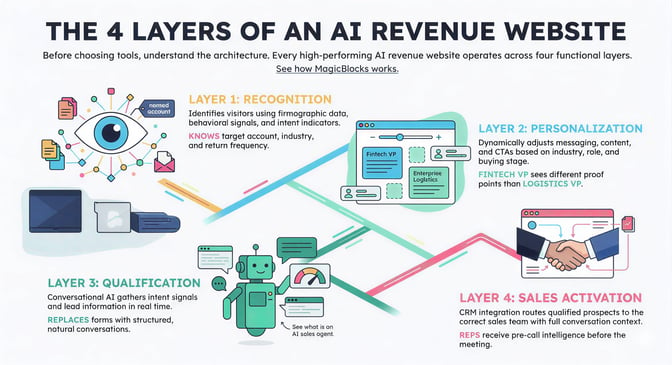
Before choosing tools or platforms, understand the architecture. Every high-performing AI revenue website operates across four functional layers. For a deeper breakdown, see how MagicBlocks works.
Layer 1: Recognition
Identifies visitors using firmographic data, behavioral signals, and intent indicators. Knows whether a visitor is from a named target account, what industry they’re in, and how many times they’ve returned.
Layer 2: Personalization
Dynamically adjusts messaging, content, and CTAs based on industry, role, and buying stage. A Series C fintech VP sees different proof points than a VP at an enterprise logistics firm.
Layer 3: Qualification
Conversational AI gathers intent signals and lead information in real time. Replaces forms with structured, natural conversations that advance qualification without friction. Related reading: what is an AI sales agent.
Layer 4: Sales Activation
CRM integration routes qualified prospects to the correct sales team with full conversation context. No lag. No lost handoffs. Reps receive pre-call intelligence before the meeting ever starts.
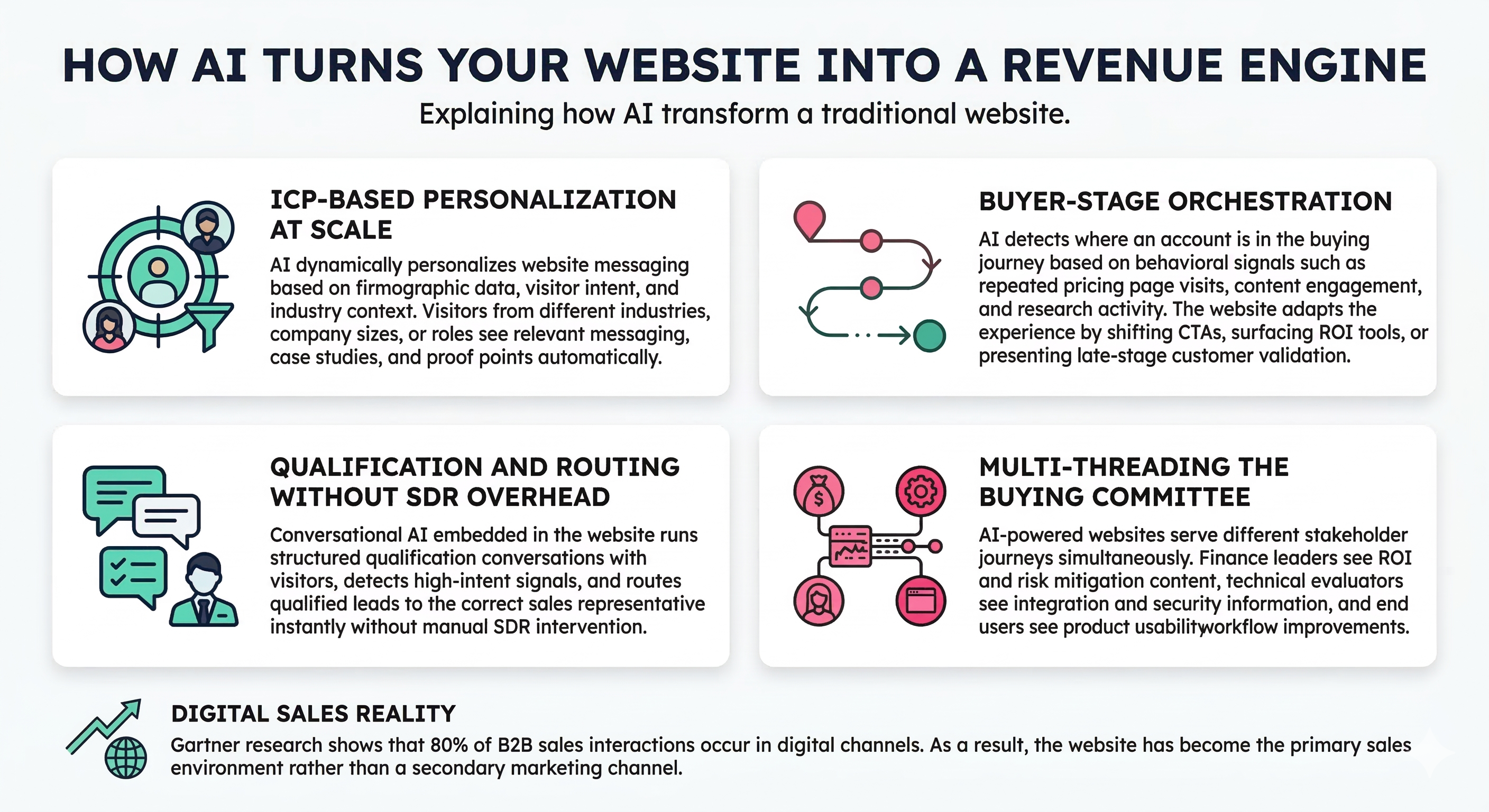
How AI Turns Your Website Into a Revenue Engine
McKinsey’s State of AI finds that 88% of organizations are now regularly using AI in at least one business function, and 64% report that AI is enabling their innovation. Marketing and sales remain among the top functions driving AI adoption.
Separately, Gartner’s Future of Sales research confirms that 80% of B2B sales interactions between suppliers and buyers will occur in digital channels by 2025, making your website the primary sales environment, not a secondary one.
ICP-Based Personalization at Scale
When a visitor from a Series C fintech lands on your site, they shouldn’t see the same headline as a VP at a regional logistics chain. AI can dynamically serve industry-specific messaging, role-relevant proof points, and vertical case studies, automatically, based on intent signals and firmographic data. Explore the 25 best AI sales tools in 2026 to understand the personalization landscape.
Buyer-Stage Orchestration
An account that’s visited your pricing page three times in the last week is not behaving the same as someone who just discovered you through a blog post.
AI-driven websites recognize the difference and shift the experience accordingly, swapping informational CTAs for direct demo paths, triggering in-context ROI tools, or surfacing customer stories relevant to late-stage evaluation.
Qualification and Routing Without SDR Overhead
Conversational AI embedded in the website runs structured qualification conversations, detects high-intent signals, and routes the right accounts to the right people in your sales org, automatically. Instead of ‘fill out a form and someone will get back to you in 48 hours,’ the buying journey progresses in real time. See the best AI sales agents powering this layer today.
Multi-Threading the Buying Committee
Different stakeholders care about completely different things. The CFO wants ROI math and risk mitigation. The technical evaluator wants integration specs and security documentation.
The end user wants to know if it’ll actually make their day easier. AI-powered websites serve distinct content journeys for each of those roles, simultaneously.
McKinsey’s B2B Pulse research shows that 19% of B2B sales forces are already implementing gen AI with measurable success, and an additional 23% are actively experimenting. The teams that combine data-driven personalization with AI are pulling ahead. See how AI-powered sales workflow platforms for B2B are building this capability.
Step-by-Step: Building an AI-Powered Enterprise Sales Website
Step 1: Map ICP Segments to Revenue Potential
Not all traffic is equal. Start by defining your highest-value ICP segments, the company types, verticals, and buyer roles with the most ACV potential and the strongest product-market fit. These become the first personalization layers your site needs to serve.
Step 2: Align Messaging to Each Segment
For each ICP segment, define the pain hierarchy (what keeps them up at night), the value proof (what outcomes you reliably deliver), and the industry-specific evidence (case studies, benchmarks, peer references). Generic messaging is a conversion killer at the enterprise level. Specificity builds buying confidence.
Step 3: Implement the AI Personalization Layer
This is where the technology comes in. Behavioral triggers, intent signals, CRM enrichment, and account-level recognition all feed into dynamic content delivery. The visitor from a named target account gets a materially different experience from an anonymous first-time visitor. For a full breakdown of what’s available, see the best AI tools for sales teams.
Step 4: Embed Sales Enablement Assets Directly
ROI calculators. Security documentation centers. Mutual action plan previews. Executive one-pagers. These aren’t nice-to-haves, they’re the resources enterprise buyers are actively hunting for during their evaluation. AI surfaces them at the right moment in the buying journey.
Step 5: Connect Website Intelligence to Your Sales Workflow
Website activity without sales integration is just analytics. The real value comes when account-level engagement signals flow into your CRM, trigger sales plays, and give your AEs pre-call intelligence that changes how they approach conversations. The future of the sales role is built on this kind of intelligence layer.
How MagicBlocks Turns Traffic Into Revenue
Every step above describes what needs to happen. MagicBlocks is the engine that makes it happen automatically.
Most businesses hit a wall between the strategy and the execution. They know they need ICP-aligned personalization, real-time qualification, and multi-stakeholder orchestration.
Then they run into the reality of building it: engineers, timelines, integrations, prompts that break in production. Months of work for a system that still doesn’t close deals. MagicBlocks collapses that gap.
Here’s how the platform works end-to-end on your website. For a full technical walkthrough, see how MagicBlocks works.
Step 1: Drop in Your URL. MagicBlocks Reads Your Site.
The platform ingests your existing content, your positioning, and your product knowledge. No massive setup project. It learns your offer the same way a new sales rep would, except it does it in minutes and never forgets.
Step 2: The AI Agent Engages Every Visitor in Real Time.
The moment a prospect lands on your site, MagicBlocks is live. Context-aware hooks fire based on the page they’re on, where they came from, and what they’re looking at. The HAPPA Framework kicks in automatically: Hook, Align, Personalize, Pitch, Action. Every conversation is built to advance the deal, not just answer a question.
Step 3: The Platform Qualifies and Scores Every Lead Automatically.
MagicBlocks doesn’t wait for a form submission to decide if a lead is worth your team’s time. The AI runs structured qualification logic mid-conversation, detecting intent signals and mapping them against your ICP criteria. High-fit visitors get fast-tracked. Everyone else gets nurtured. Your reps only see leads that are actually ready.
Step 4: Qualified Leads Get Routed and Booked Without Human Intervention.
When a prospect qualifies, MagicBlocks books them directly into your calendar, or routes them to your CRM (GoHighLevel, HubSpot, or via Zapier) with full conversation context attached. No handoff lag. No leads sitting in a queue. Average response time: under five seconds.
Step 5: The Memory Engine Maintains Relationship Continuity Across Every Channel.
Generic chatbots forget everything the moment a session ends. MagicBlocks remembers. The CDP-native memory engine tracks every interaction across chat, SMS, and email, so when a prospect returns to your site three days later, the conversation picks up where it left off. Context preserved. Relationship intact.
Step 6: Dead Leads Get Reactivated. Nothing Leaks.
Most businesses have a graveyard of leads that went cold, disengaged, or got lost. MagicBlocks reaches back into that database and re-engages aged contacts with personalized, context-aware sequences.
The leads you already paid for, converting months after you wrote them off. That’s the full revenue loop: new traffic in at the top, nothing leaking out the bottom. See how this compares to other tools for closing deals faster.
Built on $200M+ in lead generation across dozens of verticals and grounded in behavioral science, MagicBlocks isn’t guesswork. It’s proven conversion patterns are encoded into AI agents that run 24/7. Get started at MagicBlocks.ai.
The Metrics That Prove Your Website Is Driving Revenue
If your website reporting still centers on page views and bounce rate, you’re measuring the wrong things. McKinsey’s revenue growth research from Gartner confirms that revenue leaders who connect digital engagement data to pipeline outcomes see measurably shorter sales cycles and higher win rates than those who treat web analytics as a separate discipline. Revenue-driven websites optimize for deal progression, not traffic volume.
Leading Indicators
- Account-level engagement depth: which named accounts are showing multi-stakeholder activity?
- Stakeholder penetration rate: how many buying committee members from a single account have engaged?
- Qualified demo ratio: what percentage of website-originated demo requests meet your ICP criteria?
Pipeline Metrics
- MQL to SQL lift: are website-originated leads converting to sales-qualified at a higher rate?
- Deal velocity: are accounts that engaged deeply with the website closing faster?
- Win rate improvement: does strong pre-sales website engagement correlate with higher win rates?
Revenue Metrics
- ACV growth: are website-influenced deals trending toward higher contract values?
- Expansion revenue: is the website supporting CSM expansion motions post-close?
- Shortened sales cycles: is AI-powered pre-qualification reducing the time from first touch to contract?
Common Mistakes When Using AI on Enterprise Websites
- Over-personalization without ICP clarity. If you don’t know who your highest-value segments are, personalization just creates noise. Start with the ICP work before you build the AI layer.
- Deploying a generic chatbot. A chatbot that says ‘Hi, how can I help?’ is not an enterprise sales asset. The conversation logic needs to be rooted in real qualification methodology.
- Ignoring security and compliance content. Enterprise buyers will hit a wall if your site doesn’t address security posture proactively. AI should surface this content early.
- No RevOps integration. If your website intelligence isn’t flowing into your CRM and triggering sales plays, you’ve built a disconnected system.
- AI-generated content without positioning alignment. AI that doesn’t reflect your actual positioning and USPs just produces more content. The methodology matters as much as the technology.
Advanced: Multi-Threading, Expansion, and Account Orchestration
Designing Website Journeys for Buying Committees
Enterprise deals don’t have a single decision-maker. Your website needs to serve a CFO path (ROI math, risk framing), a technical validator path (integration documentation, security), an end-user path (workflow impact, ease of adoption), and an executive sponsor path (strategic narrative, expansion roadmap).
These are adaptive journeys within the same site, triggered by role identification and behavioral signals. See the future of AI sales roles to understand how this changes hiring and team structure.
AI-Driven Expansion Motions
Winning the initial deal is only part of the enterprise revenue story. Usage-based cross-sell signals, industry-specific upsell pathways, and customer-only content hubs extend the website’s role into the post-sales journey.
When MagicBlocks handles post-sale engagement, surfacing expansion content, identifying reactivation opportunities, maintaining relationship continuity, the website becomes an active CSM support system.
Enterprise ABM Website Strategy
For your highest-value target accounts, the website experience can get hyper-specific. Named account personalization, executive briefing content, and AI-generated custom microsites reflect the specific challenges and priorities of a target company.
This is the ceiling of AI-powered enterprise web strategy, and it’s increasingly accessible without massive engineering overhead.
AI Enterprise Website Implementation Checklist
Use this checklist to audit your current state and prioritize your build sequence.
- Define ICP segments by vertical, company size, and buyer role
- Map buying committee members and their distinct content needs
- Create industry-specific messaging for each ICP segment
- Deploy AI conversational qualification on high-traffic pages
- Integrate website engagement data with your CRM
- Track account-level engagement signals across visits
- Build role-specific content journeys for each buying committee member
- Embed sales enablement assets (ROI calculators, security docs) inline
- Connect website intelligence to sales plays and rep notifications
- Set up lead reactivation sequences for aged database contacts
FAQ: AI for Enterprise Website Revenue
How does AI improve conversion rates on enterprise B2B websites?
AI improves enterprise website conversions by replacing static, one-size-fits-all experiences with dynamic personalization that reflects ICP, buying stage, and multi-stakeholder context. Specifically: ICP-based personalization shows the right message to the right buyer role; buying stage detection shifts CTAs from informational to transactional at the right moment; conversational AI qualifies leads in real time instead of waiting for form submissions; CRM integration routes qualified prospects immediately; and role-specific content journeys serve every member of the buying committee simultaneously. McKinsey reports that a fifth of current sales-team functions could be automated through AI, and that 90% of commercial leaders expect to deploy gen AI solutions regularly within two years.
What is an enterprise sales machine?
An enterprise sales machine is a cross-functional pipeline system with defined ICP prioritization, multi-threaded stakeholder engagement, structured handoffs between SDR, AE, SE, and CSM roles, and clear expansion motions. The goal is a repeatable, scalable revenue system. An AI-powered website is the pre-sales layer of that machine. Learn more in our guide on what is an AI sales agent.
What AI tools are best for B2B enterprise website personalization?
Purpose-built platforms that combine qualification logic with dynamic content delivery and CRM integration outperform generic chatbots for enterprise use cases. Key categories include website personalization platforms (Optimizely, Dynamic Yield, Mutiny), conversational sales platforms (Drift, Intercom, Qualified), and AI sales agents with persistent memory like MagicBlocks. See the full breakdown in best AI sales tools for closing deals faster.
How do you align a website with enterprise sales processes?
Start with ICP clarity, then map your highest-value buyer segments to specific messaging layers. Implement AI personalization that shifts content based on behavioral signals and buying stage. Connect website intelligence to your CRM so sales always knows what accounts have been doing on the site. Embed sales enablement assets inline so enterprise buyers find what they need without navigating to a resource library.
How can websites support multi-stakeholder buying committees?
By building role-specific content journeys within the same site. The CFO path serves ROI math and risk framing. The technical validator path surfaces integration documentation and security certifications. The end-user path focuses on workflow impact and adoption ease. AI recognition and behavioral signals determine which path activates for each visitor.
What metrics prove a website is driving revenue?
Leading indicators include account-level engagement depth, stakeholder penetration rate (how many buying committee members from a single account have engaged), and qualified demo ratio. Pipeline metrics include MQL-to-SQL conversion lift, deal velocity, and win rate on website-influenced deals. Revenue metrics include ACV growth, expansion revenue, and shortened sales cycles.
How does RevOps connect to website optimization?
Website activity without RevOps integration is just analytics. When account-level engagement signals flow into your CRM, trigger sales plays, and generate pre-call intelligence packets for your AEs, the website becomes a revenue system. The bridge between website intelligence and RevOps is what separates traffic-generating websites from pipeline-generating ones.
How can AI support expansion revenue?
Post-sale, AI can surface usage-based cross-sell signals, serve industry-specific upsell content to existing customers, and maintain relationship continuity through persistent memory across channels. Customer-only content hubs and AI-driven re-engagement sequences turn the website into a CSM support tool, not just a pre-sales asset.
Create Your AI Sales Agent Now
MagicBlocks deploys a fully autonomous AI Sales Agent on your website in minutes. It engages every visitor, qualifies high-intent leads in real time, books meetings automatically, and routes the right accounts to your sales team, 24/7.Built on $200M+ in lead generation across dozens of verticals. Proven methodology. Not guesswork.
Want to see this in action?
See a demoRead the playbook. Now see it run.
Watch a 4-minute demo. No sales pitch. Then decide if you want to talk.