

What Is AI Lead Conversion? How AI Turns Leads Into Customers
Most companies convert somewhere between 2% and 5% of their leads. The other 95% just... disappear.
Discover how AI lead conversion transforms your sales process by automating lead identification, qualification, nurturing, and conversion, ensuring no lead slips through the cracks.
On this page17
- TL;DR
- What Is AI Lead Conversion?
- Why AI Lead Conversion Matters: The Numbers Are Brutal
- Why Leads Don’t Convert: The Four Leaks
- Speed to Lead: Why Response Time Kills Conversion
- Lead Qualification: Converting the Right Leads
- Follow-Up: The Conversion Killer Nobody Fixes
- Lead Reactivation: Converting Leads You’ve Already Written Off
- How AI Lead Conversion Works: Step by Step
- AI Lead Conversion by Vertical
- AI Lead Conversion vs. Traditional Methods
- Lead Conversion Rate: Benchmarks and Proof
- Lead Conversion vs. Lead Generation: A Critical Distinction
- How AI Sales Agents Fix Lead Conversion
- Future of AI Lead Conversion
- Frequently Asked Questions
- Create Your AI Sales Agent and Stop Leaking Leads
TL;DR
Most companies convert somewhere between 2% and 5% of their leads. The other 95% just… disappear. AI lead conversion fixes this by using machine learning, predictive analytics, and generative AI to identify, qualify, nurture, and convert prospects automatically.
It scores leads in real time, fires follow-ups without human involvement, and routes your hottest prospects to your sales team before they go cold. The result isn’t incremental improvement. It’s a fundamentally different conversion system.
What You’ll Learn
- What AI lead conversion actually means (and what it doesn’t)
- Why leads don’t convert and where the revenue leaks
- How speed to lead determines whether you win or lose
- What qualification looks like when AI does it properly
- Why follow-up is the conversion killer nobody fixes
- How lead reactivation recovers revenue you’ve already written off
- Benchmarks, proof points, and what good actually looks like
- How AI Sales Agents fix the full conversion problem
What Is AI Lead Conversion?
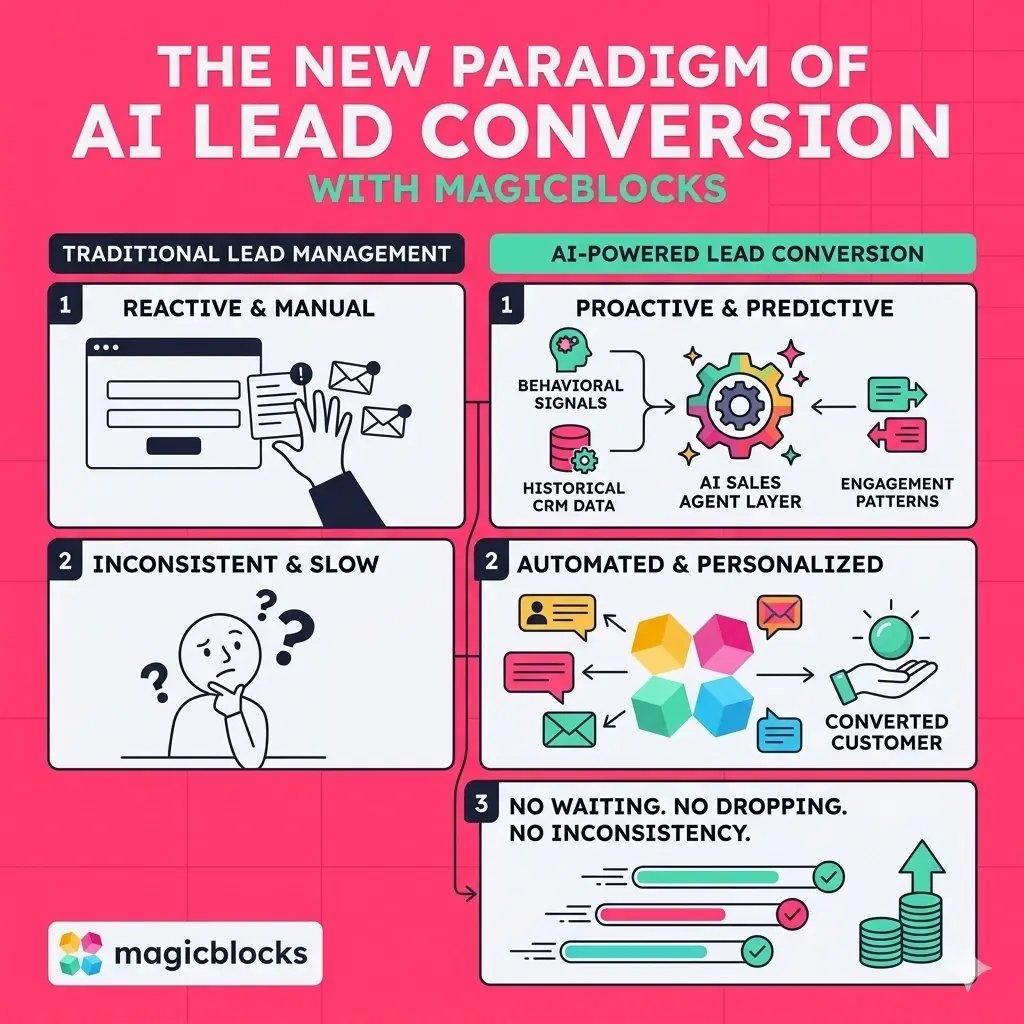
AI lead conversion is the process of using artificial intelligence technologies including machine learning, predictive analytics, and generative AI to automatically identify, qualify, nurture, and convert leads into paying customers.
Here’s what makes it genuinely different from what most businesses are doing today: traditional lead management is reactive and manual. Someone fills out a form, a notification fires, a rep (hopefully) follows up at some point. Maybe today. Maybe tomorrow. Maybe never.
AI lead conversion flips that entirely. These systems analyze behavioral signals, historical CRM data, and engagement patterns to predict which prospects are most likely to convert, then automatically deliver personalized interactions that move them through the funnel. No waiting. No dropping. No inconsistency.
For a deeper look at the agent layer that powers this, see what an AI Sales Agent actually is and how MagicBlocks works as a lead conversion engine.
Why AI Lead Conversion Matters: The Numbers Are Brutal
Let’s get honest about the scale of the problem.
According to McKinsey’s research on unlocking the power of data in sales, companies consistently underperform on lead conversion because of structural gaps in how they respond, qualify, and follow up. The problem isn’t lead generation. Companies are generating more leads than ever. The problem is conversion: what happens after the lead comes in.
Industry averages paint a pretty grim picture:
- 80% of sales require 5 or more follow-up contacts
- 44% of sales reps give up after a single follow-up
- 50% of leads are never followed up with at all
- 70% of CRM leads were never properly worked
So you’ve got companies spending serious money on lead generation, then leaking the majority of that investment through four predictable gaps. McKinsey’s more recent work on AI agents for growth makes it clear that AI-powered agentic systems are now capable of closing precisely these gaps at scale.
Why Leads Don’t Convert: The Four Leaks
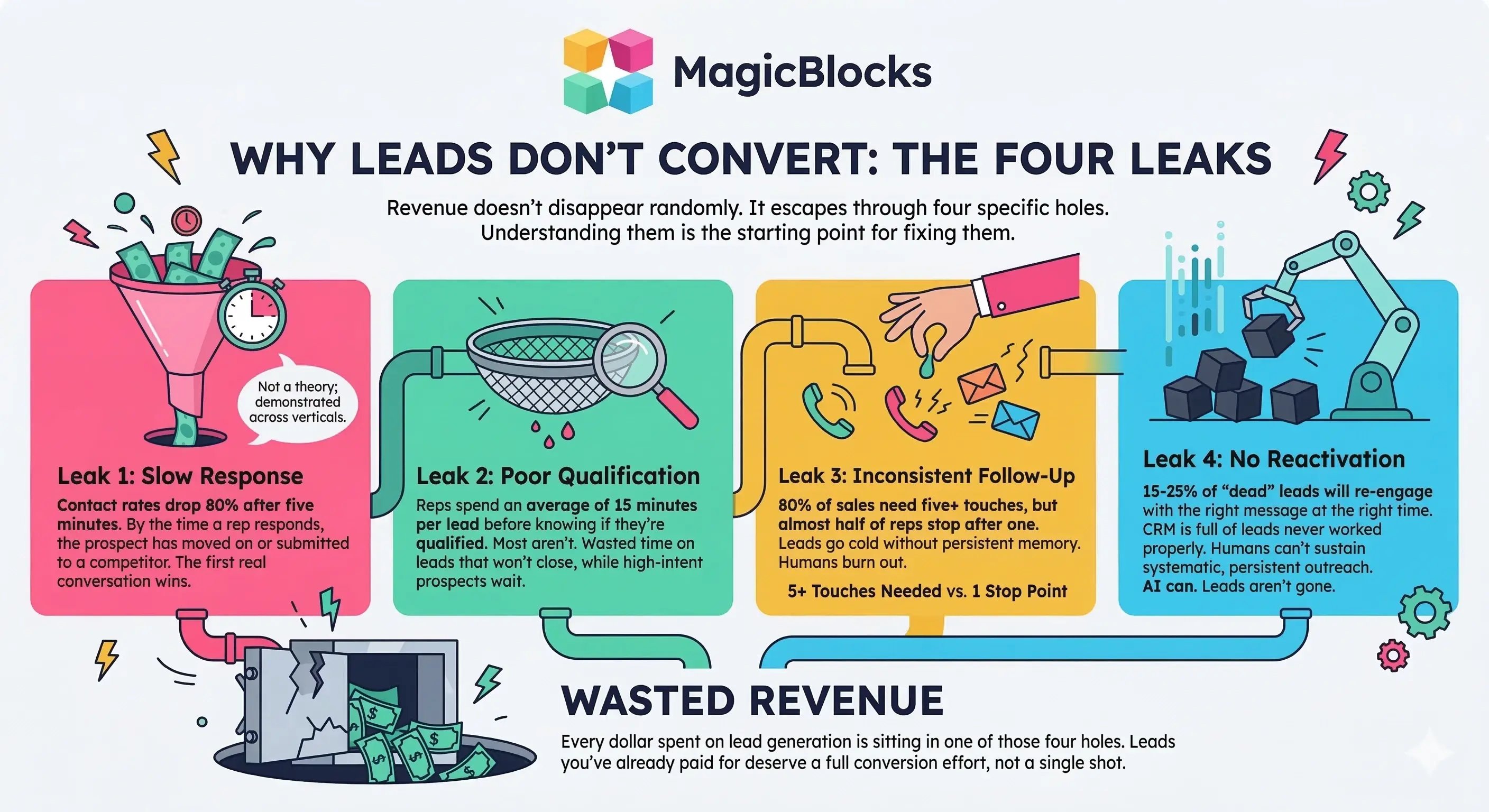
Revenue doesn’t disappear randomly. It escapes through four specific holes. Understanding them is the starting point for fixing them.
Leak 1: Slow Response. Contact rates drop 80% after five minutes. By the time a rep sees the notification, reads the lead record, and fires off a response, the prospect has either moved on or submitted to a competitor. The first real conversation wins. That’s not a theory; it’s consistently demonstrated across verticals.
Leak 2: Poor Qualification. Reps spend an average of 15 minutes per lead before knowing whether they’re even qualified. Most aren’t. That’s an enormous amount of time and attention wasted on leads that were never going to close, while genuinely high-intent prospects wait.
Leak 3: Inconsistent Follow-Up. Humans burn out, move on, forget. Leads that don’t respond on the first attempt often just get dropped. The math doesn’t work: 80% of sales need five or more touches, but almost half of reps stop after one. This is why leads go cold without persistent memory.
Leak 4: No Reactivation. Your CRM is full of leads that were never worked properly. Industry data suggests 15–25% of “dead” leads will re-engage with the right message at the right time. Almost no one capitalizes on this because it requires systematic, persistent outreach across weeks or months. Humans can’t sustain that. AI can. Leads that go dark aren’t gone.
Every dollar you’ve spent on lead generation is sitting in one of those four holes. And leads you’ve already paid to acquire deserve a full conversion effort, not a single shot.
Speed to Lead: Why Response Time Kills Conversion
This deserves its own section because it’s the most immediate and measurable conversion lever most businesses have.
The research on speed to lead is unambiguous. Contact rates fall off a cliff after five minutes. At 30 minutes, you’re essentially cold-calling someone who came to you warm. At the end of the day, that lead is statistically gone.
The problem is structural. Human response depends on availability, attention, and workflow. A lead comes in at 2pm on a Tuesday, maybe someone gets to it quickly. It comes in at 11pm on a Friday or during a team meeting or while your best rep is on another call, and it just sits there.
An AI Sales Agent responding to every lead in under five seconds doesn’t have any of those constraints. It fires a real, context-aware conversation the moment the lead arrives, regardless of volume, time zone, or what your team is doing. MagicBlocks runs this via edge compute across 3,000+ global servers, keeping response time under five seconds every single time.
McKinsey’s analysis of five ways B2B sales leaders can win with AI identifies speed of response as one of the highest-leverage AI applications in sales, precisely because the window is so narrow and the upside is so large.
For context on how this fits within the broader landscape, AI-powered response at scale is now a competitive baseline in high-volume lead environments.
Lead Qualification: Converting the Right Leads
Speed gets you into the conversation. Qualification determines whether that conversation is worth having.
Traditional qualification is slow, inconsistent, and human-dependent. Different reps ask different questions, weight answers differently, and make judgment calls that don’t always hold up. You end up with a pipeline full of noise and a sales team that’s genuinely uncertain about which leads deserve their time.
AI-powered automated lead qualification changes this structurally. The AI runs every lead through the same qualification logic, consistently, at scale, without fatigue. It collects the key facts, evaluates intent, assesses fit, and segments leads before a human ever gets involved.
What actually matters here is what makes qualification feel human. Nobody wants to feel interrogated by a bot. The best AI qualification conversations feel like talking to a knowledgeable rep who cares about getting the right outcome. That requires conversational intelligence layered on top of the structural logic.
There’s also a reliability dimension. Keeping qualification accurate and compliant matters enormously in regulated verticals like mortgage, insurance, and financial services. The Guardian Engine in MagicBlocks handles this: every message is reviewed before it sends to ensure it stays within compliance guardrails.
McKinsey’s work on generative AI driving profitable B2B growth specifically calls out qualification automation as one of the highest-ROI applications of AI in sales processes.
Follow-Up: The Conversion Killer Nobody Fixes
Here’s the uncomfortable truth: most businesses know their follow-up is broken. They just don’t know how to fix it systemically.
The math is straightforward. 80% of sales require 5 or more touches. The average rep gives up after one. That gap is where the majority of your conversion potential lives.
SMS is the highest-response follow-up channel by a significant margin. SMS follow-up that actually gets replies works because it meets people where they actually are. The compliance side is important to get right: how to drive 3-6x more replies from SMS follow-up walks through the mechanics of A2P approval and what makes SMS campaigns actually convert.
But follow-up without structure is just noise. Why follow-up without a playbook fails gets at the core issue: unstructured follow-up, even at high volume, doesn’t move leads forward. You need a defined sequence, clear next-step logic, and a system that knows when to escalate versus when to keep nurturing.
This is where MagicBlocks’ HAPPA framework (Hook, Align, Personalise, Pitch, Action) earns its value. Every follow-up isn’t just a reminder. It’s a purposeful step in a proven sales methodology, grounded in $200M+ in lead generation across dozens of verticals and behavioral science.
Lead Reactivation: Converting Leads You’ve Already Written Off
Your dead database probably isn’t as dead as you think.
Between 15 and 25% of leads that never converted will re-engage if you reach them with the right message at the right time. The challenge is that identifying which ones and reaching them with something relevant, at scale, across weeks or months, is something no human team can sustain.
AI can. Reactivating aged leads via SMS is one of the most underutilized revenue recovery plays available. It requires no new ad spend, no new leads. You’re working on a base that’s already in your CRM.
The key is timing and relevance. A reactivation message sent six months after someone went cold needs to acknowledge the gap, offer something new or relevant, and create a reason to re-engage. Generically blasting your old database doesn’t work. Personalized, behavioral-triggered reactivation does.
Leads that ghosted you aren’t lost. They’re an opportunity that requires a different approach.
How AI Lead Conversion Works: Step by Step
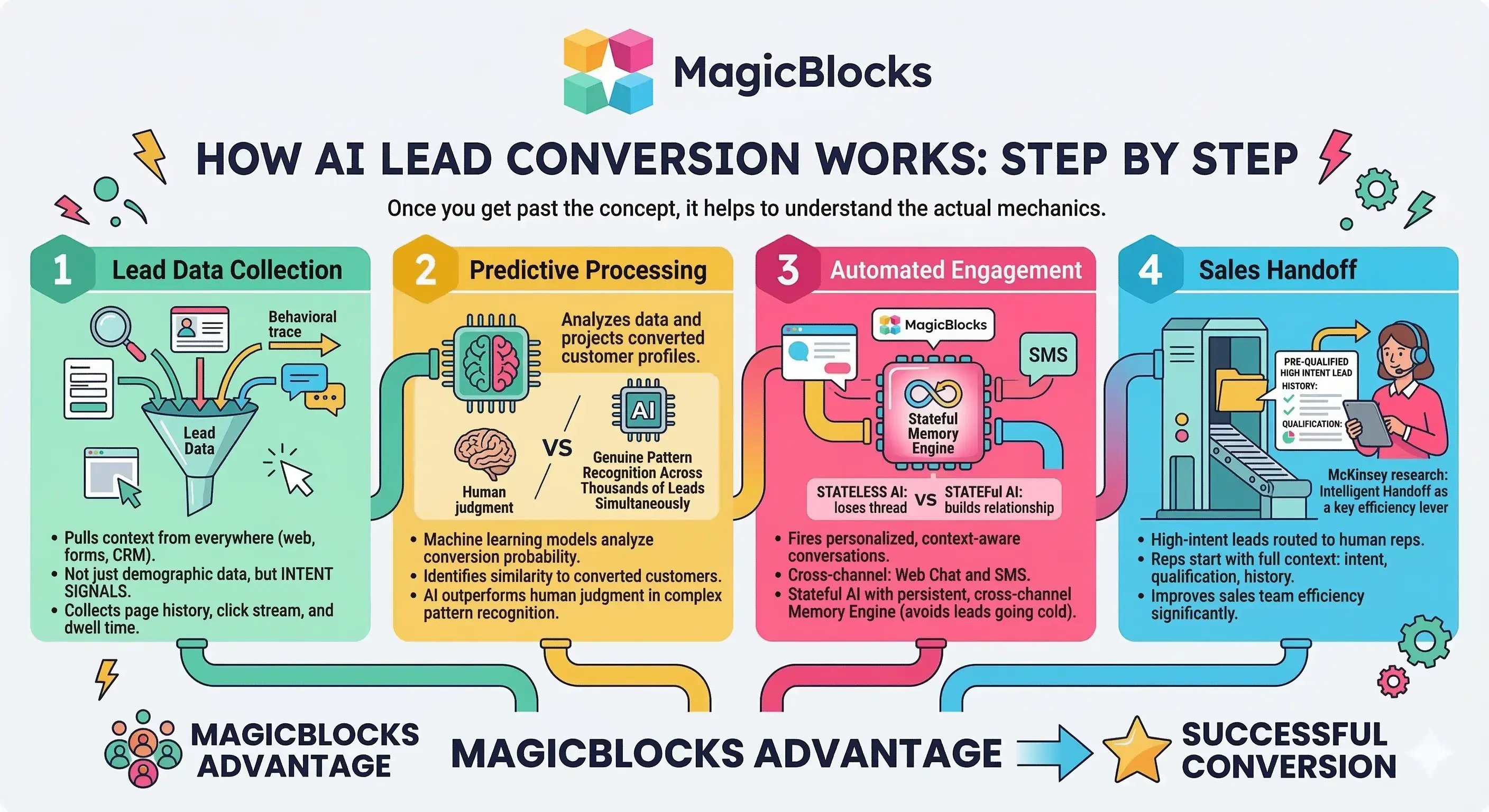
Once you get past the concept, it helps to understand the actual mechanics.
Step 1: Lead Data Collection. The AI pulls context from wherever the lead came from: website interactions, form submissions, CRM history, behavioral signals, prior engagement. This isn’t just demographic data. It’s intent signals: what page they were on, how long they stayed, what they clicked before they submitted.
Step 2: Predictive Processing. Machine learning models analyze conversion probability, intent signals, engagement patterns, and similarity to prior converted customers. This is where AI genuinely outperforms human judgment: it sees patterns across thousands of leads simultaneously.
Step 3: Automated Engagement. The AI fires a personalized, context-aware conversation. For MagicBlocks, this happens across web chat and SMS, with the Memory Engine maintaining a persistent, cross-channel view of each lead’s history. This is why leads go cold without persistent memory: stateless AI loses the thread. Stateful AI builds the relationship.
Step 4: Sales Handoff. High-intent leads get routed to human reps with context already built in. The rep doesn’t start cold. They know the lead’s intent, qualification status, and conversation history. McKinsey’s research on AI-powered marketing and sales reaching new heights with generative AI points to intelligent handoff as one of the key levers for improving sales team efficiency.
AI Lead Conversion by Vertical
Conversion stakes are highest in industries where leads are expensive and the deal value is significant. Here’s where AI lead conversion has the most measurable impact.
Mortgage and Finance. Improving mortgage lead conversion rates is the highest-proof use case. The Beeline case study is the anchor. Bob, the AI agent built by MagicBlocks co-founder Sean Clark, achieved a 737% increase in completed applications, 484% growth in qualified leads, and a 48.72% conversation-to-lead conversion rate. CEO Nick Liuzza published those results in a NASDAQ shareholder letter. That’s the benchmark. Find more on AI agent for mortgage lead conversion and building a custom AI agent for a specific vertical.
Real Estate. Qualifying home buyer leads with AI reduces the time between lead submission and qualified handoff dramatically. Buyers move fast. Response windows are short.
Insurance, Auto, Home Services. High lead volume, significant acquisition costs, and complex qualification needs all make AI lead conversion the obvious lever.
AI Lead Conversion vs. Traditional Methods
Let’s make the comparison concrete.
| Dimension | Traditional Lead Management | AI Lead Conversion |
| Response time | 8-12+ minutes average | Under 5 seconds |
| Follow-up consistency | Depends on rep | 100% consistent |
| Lead scoring | Rule-based, static | ML-based, adaptive |
| Qualification | Manual, variable | Automated, structured |
| Reactivation | Rarely happens | Systematic, always on |
| Scale | Headcount-constrained | Infinite |
Rule-based lead scoring uses static criteria and requires manual updates when the market shifts. AI lead scoring trains on historical conversions, incorporates behavioral data, and updates as it learns. The accuracy gap is significant.
The conversational piece is equally important. Forms create friction. They’re one-directional and impersonal. AI conversations collect richer data because the exchange feels natural. Leads share more in a conversation than they do in a form.
Lead Conversion Rate: Benchmarks and Proof
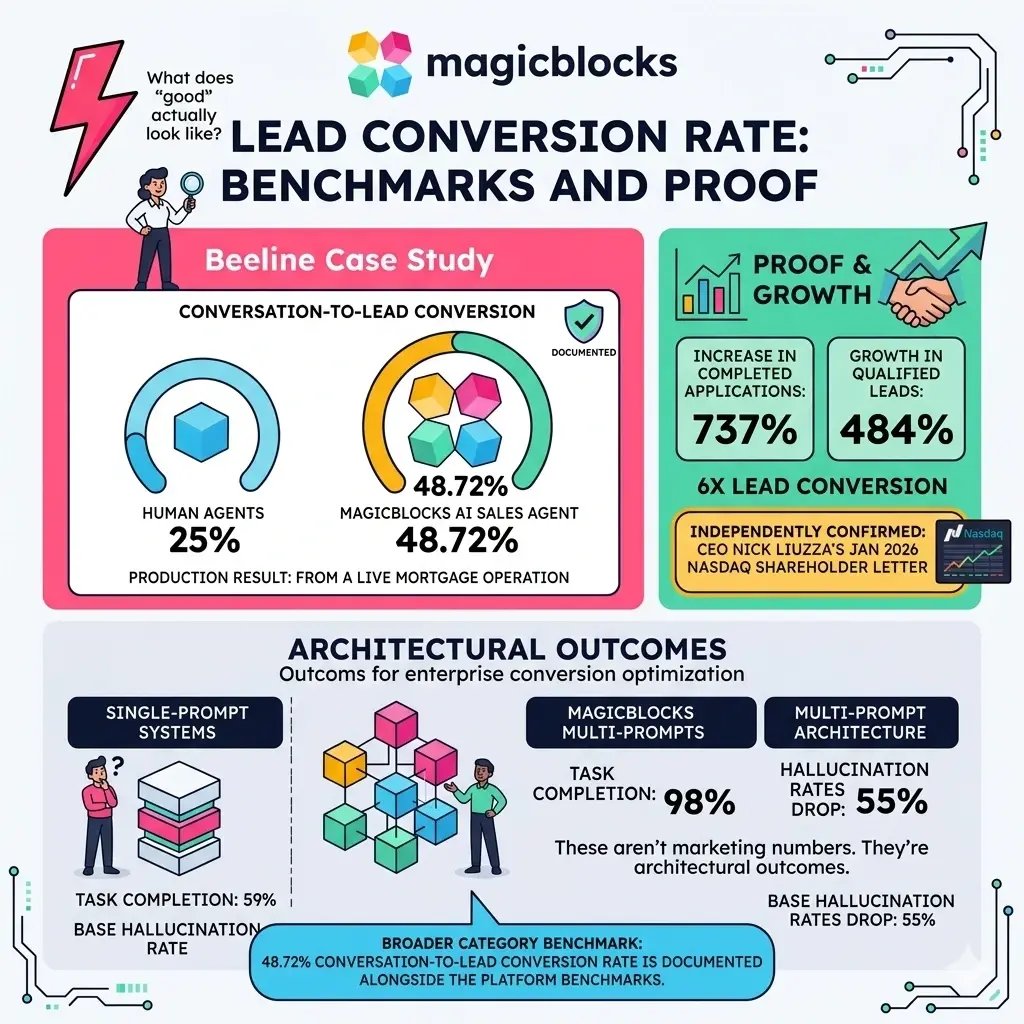
What does “good” actually look like?
The Beeline case study sets the benchmark: a 48.72% conversation-to-lead conversion rate for the AI Sales Agent, compared to 25% with human agents. That’s not a projection. That’s a production result from a live mortgage operation, documented in the MagicBlocks Beeline case study.
The same deployment drove a 737% increase in completed applications and 484% growth in qualified leads, with the 6x lead conversion figure independently confirmed in CEO Nick Liuzza’s January 2026 shareholder letter to NASDAQ investors.
For enterprise conversion rate optimization, the baseline comparison matters: MagicBlocks’ multi-prompt architecture achieves 98% task completion versus 59% for single-prompt systems. Hallucination rates drop 55%. These aren’t marketing numbers. They’re architectural outcomes.
For a broader look at what the category delivers, 48.72% conversation-to-lead conversion rate is documented alongside the platform benchmarks.
Lead Conversion vs. Lead Generation: A Critical Distinction
This matters a lot and gets confused constantly.
Lead generation tools vs. conversion tools solve different problems. Lead generation is about getting people into the funnel: ads, content, SEO, outbound. Lead conversion is about what happens after they arrive.
MagicBlocks lives entirely in the conversion category. It doesn’t generate leads. It takes the leads you’re already generating and turns them into revenue. Once you have leads, conversion is the job.
Most businesses underinvest in conversion and overinvest in generation. If your conversion rate is 3% and you double your ad spend, you still have a 3% conversion rate. If you fix the conversion problem first, every lead source immediately becomes more profitable.
How AI Sales Agents Fix Lead Conversion
This is where it comes together.
An AI Sales Agent isn’t a chatbot. It’s not a form with a chat widget stuck on top. It’s a purpose-built system designed to do four jobs: engage every new lead instantly, prequalify before handoff, follow up persistently without dropping anyone, and re-engage cold leads sitting in the database.
MagicBlocks runs this through the HAPPA framework: Hook, Align, Personalise, Pitch, Action. Each conversation isn’t a generic exchange. It’s a structured sales interaction, tuned to the specific vertical, lead source, and lead history. The Dynamic Journey Engine computes what to do next based on relationship state, lead behavior, and outcome history. No flowcharts. No manual configuration every time something changes.
How to deploy an AI Sales Agent for lead conversion walks through the setup. The end state is booking qualified leads directly into your calendar without human intervention in the early stages. And the team structure that runs it is what the sales role of the future actually looks like.
Future of AI Lead Conversion
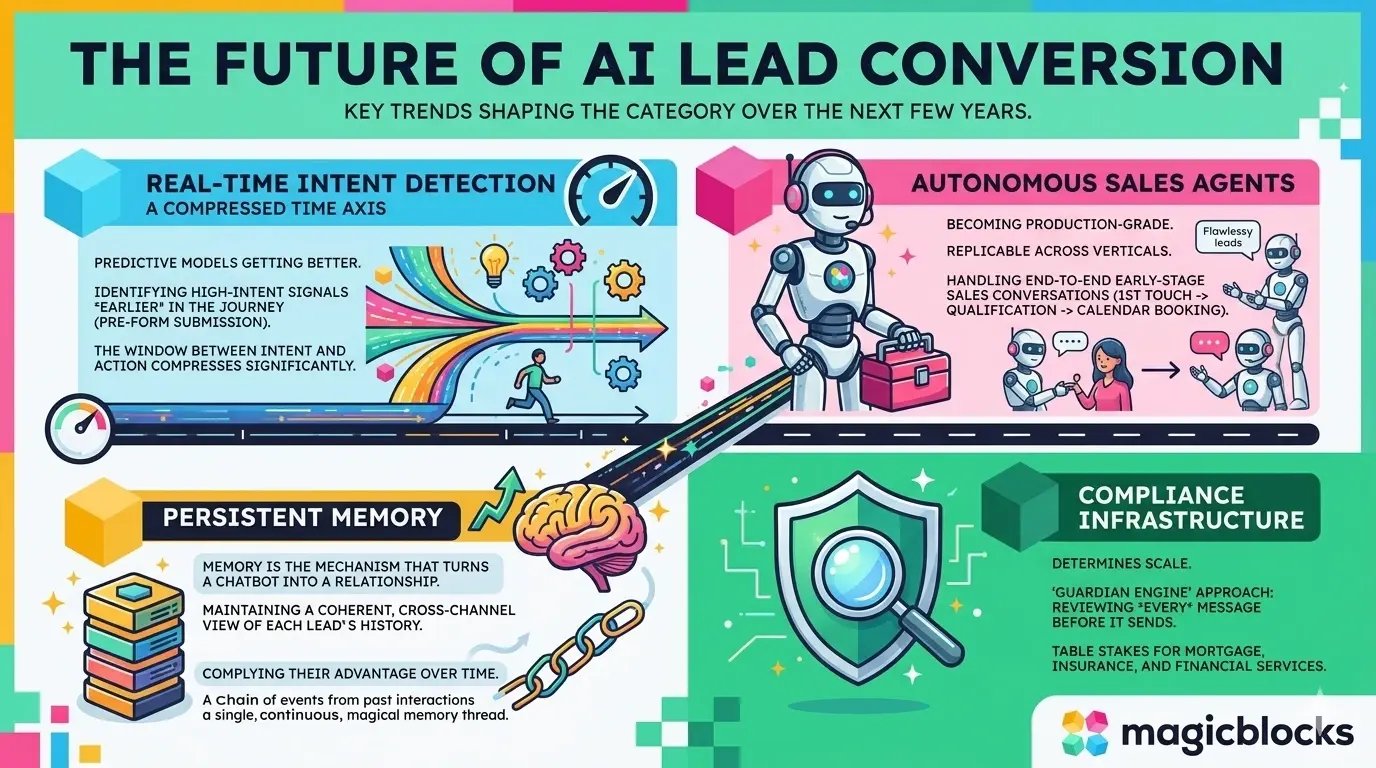
A few things are happening right now that will define the category over the next few years.
Real-time intent detection is improving fast. Predictive models are getting better at identifying high-intent signals earlier in the journey, before a form submission even happens. The window between intent and action will compress significantly.
Autonomous sales agents are becoming production-grade. The Beeline result was an early proof point. What Bob demonstrated in mortgage is now replicable across verticals. AI agents handling end-to-end early-stage sales conversations, from first touch through qualification and calendar booking, is already happening.
Persistent memory is becoming the differentiator. Most AI tools are stateless: every conversation starts fresh. The systems that maintain a coherent, cross-channel view of each lead’s history will compound their advantage over time. Memory is the mechanism that turns a chatbot into a relationship.
Compliance infrastructure will determine who can operate at scale. In regulated industries, it’s not enough to convert. You have to convert within the guardrails. The Guardian Engine approach, reviewing every message before it sends, is table stakes for mortgage, insurance, and financial services.
Frequently Asked Questions
What is AI lead conversion?
AI lead conversion is the use of artificial intelligence technologies to automatically qualify, nurture, and convert leads into customers. It combines machine learning, predictive analytics, and generative AI to respond faster, qualify more accurately, and follow up more persistently than any human team.
How does AI improve lead conversion rates?
AI eliminates the four structural leaks that kill conversion: slow response, poor qualification, inconsistent follow-up, and zero reactivation. It responds to every lead in under five seconds, qualifies automatically, follows up persistently across channels, and works aged leads that human teams ignore.
What is predictive lead scoring?
Predictive lead scoring uses machine learning models trained on historical CRM data to estimate the probability a lead will convert. It’s adaptive, incorporating behavioral signals and updating as it learns, rather than relying on static rules that require manual maintenance.
What are the best AI lead conversion tools?
The category includes platforms like MagicBlocks (purpose-built for lead conversion), HubSpot AI, Salesforce Einstein, and Drift. The meaningful distinction is between tools built for conversion versus tools that have added AI features to existing marketing automation. They solve different problems.
How can generative AI improve lead nurturing?
Generative AI enables personalized outreach at scale: tailored email sequences, context-aware SMS follow-ups, and lead magnets adapted to each prospect’s behavior. It removes the tradeoff between personalization and volume.
Can AI replace sales reps?
AI complements sales teams by handling early-stage qualification and follow-up, so reps focus on high-intent, pre-qualified conversations. Complex deals, enterprise negotiations, and relationship-intensive sales still require human judgment. The right frame is augmentation, not replacement.
How do you measure ROI of AI lead conversion?
The key metrics are lead-to-customer conversion rate, customer acquisition cost, sales cycle length, revenue per lead, and marketing ROI. The Beeline case study benchmarks: 48.72% conversation-to-lead rate, 737% increase in completed applications, 6x higher lead conversion versus human-led chat.
What are the GDPR requirements for AI lead capture?
Companies must obtain explicit consent, store data securely, and ensure transparency in automated decision-making. In the US, mortgage and financial services specifically require TCPA compliance. MagicBlocks’ Guardian Engine is built to handle TCPA, GLBA, SOC 2, ISO 27001, and GDPR requirements.
Why do some AI systems reduce lead quality?
Poor training data, overly aggressive automation, generic qualification logic, and lack of compliance oversight all degrade lead quality. The architectural approach matters: a single monolithic prompt behaves very differently from a structured, multi-stage system with built-in qualification logic.
How will generative AI change lead conversion over the next three years?
Expect real-time intent detection before form submission, fully autonomous early-stage sales conversations across regulated verticals, and persistent memory systems that build genuine relationship context across months of engagement. The gap between AI-first and human-first conversion operations will become very difficult to close.
Create Your AI Sales Agent and Stop Leaking Leads
You’re already generating leads. The question is how many of them are actually converting.
The four leaks are fixable. Slow response, broken qualification, dropped follow-up, and ignored databases aren’t revenue problems. They’re system problems. And systems are solvable.
MagicBlocks is your lead conversion engine. Create your AI Sales Agent at magicblocks.ai and put it to work engaging every inbound lead in under five seconds, qualifying automatically using the HAPPA framework, following up across every channel without dropping anyone, and reactivating the aged leads already sitting in your database.
The Beeline result is your benchmark: 737% more completed applications, a 48.72% conversation-to-lead conversion rate, $30M in monthly origination built in six months. Bob wasn’t a pilot. It was a production system running at scale.
Yours can too.
Create your AI Sales Agent at MagicBlocks and turn your lead conversion engine on.
Want to see this in action?
See a demoRead the playbook. Now see it run.
Watch a 4-minute demo. No sales pitch. Then decide if you want to talk.